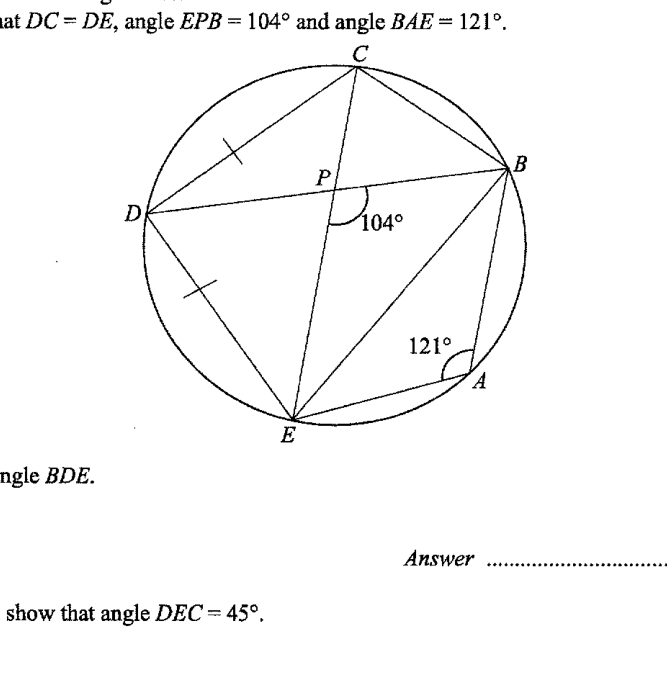
In the diagram, not drawn to scale, A, B, C, D and E are points on the circle.
CPE and BPD are straight lines.
It is given that DC = DE, angle EPB = 104° and angle BAE = 121°.
- ((a))
Find angle BDE.
Answer ... °
- ((b))
Hence show that angle DEC = 45°.
- ((c))
Prove that CE is the diameter of the circle.
Answer ...
...
- ((d))
Hence find angle CDB.
Answer ... °
- ((e))
Find angle BEP.
Answer ... °
- ((f))
Explain why P cannot be the centre of the circle.
Answer ...
...
- ((g))
It is further given that EP = 9 cm.
Find the length of DP.
Answer ... cm
It won't just hand you the answer — it asks where you're stuck.How the checker works
Worked solution
9((a))
1. Use the angle property of a cyclic quadrilateral involving points $A$, $B$, $D$ and $E$.
Since , , and lie on the circle, is a cyclic quadrilateral.
Opposite angles in a cyclic quadrilateral are supplementary, so
9((b))
1. Use straight-line angles at $P$ to find the angle inside triangle $DPE$.
Since is a straight line,
2. Apply the angle sum of triangle $DPE$ and use collinearity to identify $\angle DEC$.
From part (a), . Since are collinear, .
In ,
Since are collinear, .
9((c))
1. Find the angle at $D$ in triangle $DCE$.
From part (b),
Since , triangle is isosceles, so
Hence
2. Use the circle theorem to prove that $CE$ is a diameter.
Since and are points on the circle, the chord subtends a right angle at the circumference.
Therefore, by the converse of the angle in a semicircle theorem, is the diameter of the circle.
Since has and subtends a right angle at the circumference, is the diameter of the circle.
9((d))
1. Use the diameter result to find the right angle at the circumference, then subtract $\angle BDE$.
Since is a diameter, .
From part (a), .
Hence
9((e))
1. Find the angle at $E$ in triangle $BCE$ using the diameter result and angles in the same segment.
Since is a diameter, .
From part (d), .
Angles in the same segment give
would be incorrect because they do not subtend the same chord. Instead, in ,
(angles in the same segment, subtending chord ).
Thus
2. Use collinearity of $C,P,E$ to identify the required angle.
Since are collinear, lies along .
Therefore
9((f))
1. Find the actual value of $\angle BED$ using earlier results and collinearity.
Since , and are collinear,
.
From part (e), .
Hence
2. Explain the contradiction if $P$ were the centre.
If were the centre, then would pass through the centre because , and are collinear. Therefore would be a diameter.
An angle in a semicircle is , so would have to be .
But , which is a contradiction. Therefore cannot be the centre of the circle.
If were the centre, then would be a diameter, so . But . This is impossible, so cannot be the centre of the circle.
9((g))
1. Identify the angles in triangle $DPE$ needed for the sine rule.
From earlier parts, and .
Since are collinear and are collinear,
2. Apply the sine rule in triangle $DPE$ to find $DP$.
In ,
Given ,
AI analysis — may contain mistakes.
Worked this one out on paper? Snap your steps and Gigle's AI math checker will circle the step where it went wrong.
More questions on this topic
- 1A circle with centre O has a tangent XY at D. ∠ODC = 70°, ∠BCD = 120° and ∠ODA = 15°. Find ∠CDY. Find ∠DAB. Find ∠OBA. T…
- 2In the diagram, BA and BC are tangents to the circle with centre O. BO meets the circle at D, OA = 10 cm and BC = 28 cm.…
- 3The diagram shows a circle PQRST, with centre O. PV and RV are tangents to the circle and U is the intersection of PS an…
- 4A, B and C are points on the circle with centre O. Q and R are points on the circle with centre P. CSR and BSQ are tange…
- 5下列关于圆的叙述正确的有( ) ①圆内接四边形的对角互补; ②相等的圆周角所对的弧相等; ③正多边形内切圆的半径与正多边形的半径相等; ④圆内接平行四边形是矩形. A. 1个 B. 2个 C. 3个 D. 4个