Fig. 1 A tablet is dissolving in water and is modelled as a cylinder, as shown in Fig. 1. At t seconds after being dropped into the water, the radius of the tablet is mm, and its thickness is mm. The circular cross-sectional area of the tablet is decreasing at a constant rate of 0.5 mm^2 per second. When , find the exact value of
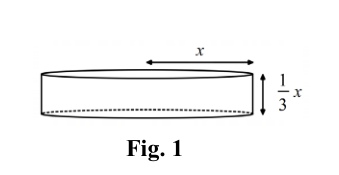
- (a)
- (b)
the rate of change of the volume of the tablet.
It won't just hand you the answer — it asks where you're stuck.How the checker works
Worked solution
1(a)
1. Express the cross-sectional area in terms of $x$ and differentiate with respect to $x$.
Let be the circular cross-sectional area.
2. Apply the chain rule using the given rate of change to find $\frac{dx}{dt}$.
Using the chain rule for connected rates of change:
Since the area is decreasing at , .
Substituting :
1(b)
1. Express the volume of the tablet in terms of $x$ and differentiate it with respect to $x$.
The volume of a cylinder is .
Given and :
2. Use the chain rule to evaluate the rate of change of the volume when $x = 5$.
By the chain rule:
From part (a), when , . Substituting into :
AI analysis — may contain mistakes.
Worked this one out on paper? Snap your steps and Gigle's AI math checker will circle the step where it went wrong.
More questions on this topic
- 1A drilling company plans to install a straight pipeline through a mountain. Points are defined relative…
- 2NJC JC1 Promo 9758/2019/Q6 A vessel is formed by removing a smaller cone of radius 5 m from a bigger cone whose semi-ver…
- 3[The surface area and volume of a sphere are given by and respectively.] An aquarist wh…
- 4Fig. 1 shows a piece of card, , in the form of a rhombus of sides cm. The card is made up of 2 identical equil…
- 5The diagram shows a V-shaped tank with dimensions , and . The tank…