The diagram shows a solid trapezoidal prism with four rectangular faces. AB = 10cm, BC = 12cm, DC = 6cm and CT = 16cm.
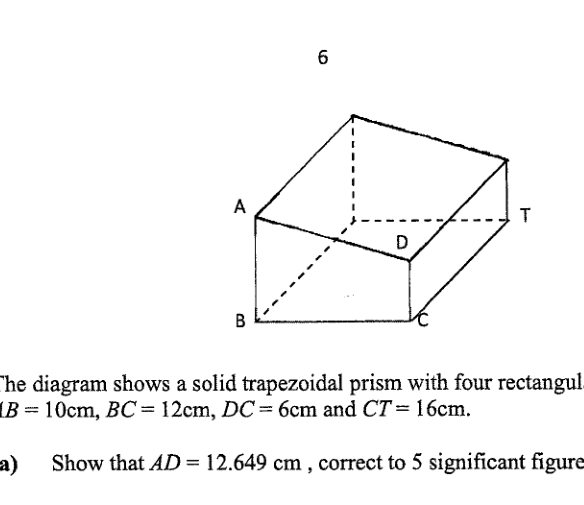
- (a)
Show that AD = 12.649 cm , correct to 5 significant figures.
- (b)
Calculate the surface area of the prism.
Ans: ___ cm^2
- (c)
Calculate the volume of the prism.
Ans: ___ cm^3
It won't just hand you the answer — it asks where you're stuck.How the checker works
Worked solution
3(a)
1. Find the horizontal difference between the two parallel sides of the trapezium.
Since and ,
This forms one side of a right-angled triangle with height .
2. Apply Pythagoras' theorem to find the slanted side $AD$.
Hence, , correct to 5 significant figures.
3(b)
1. Find the area of the two trapezoidal end faces.
Area of one trapezoidal end
Area of two trapezoidal ends
2. Find the total area of the four rectangular faces using the perimeter of the trapezium.
Using from part (a),
Area of four rectangular faces
3. Add all exposed face areas to obtain the surface area of the prism.
3(c)
1. Find the area of the trapezoidal cross-section.
The parallel sides of the trapezium are and , and the perpendicular height is .
2. Multiply the cross-sectional area by the prism length to find the volume.
The length of the prism is .
AI analysis — may contain mistakes.
Worked this one out on paper? Snap your steps and Gigle's AI math checker will circle the step where it went wrong.
More questions on this topic
- 1In the diagram, there are two right-angled triangles ΔABD and ΔCEB such that AD = 12 cm, BD = 15 cm and BE = 20 cm. Find…
- 2In triangle ABC, , and . Express as a fraction in its…
- 3In the diagram, POR is a quadrant of a circle with radius 6 cm. OR and PQ are parallel. QR is an arc of a circle with ce…
- 4Triangle ABC is a right-angled triangle. Given that two of its lengths are 11 cm and 5 cm, find two possible lengths for…
- 5The diagram below shows a gift souvenir formed by joining the plane face of a solid hemisphere of radius 3 cm and a soli…