Jesse leans a 6 metre rod in the position as shown below. At time seconds, the two ends and are and metres from respectively.
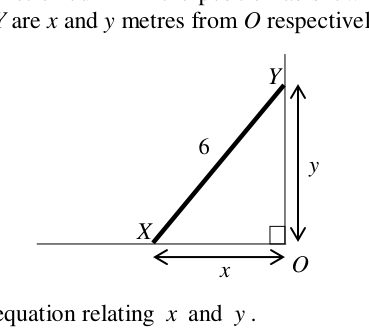
- (i)
State an equation relating and .
- (ii)
As the rod slips, Jesse proposes that decreases at a rate proportional to .
Based on Jesse's proposal, show that
where is a constant. - (iii)
Initially, is 4 metres from . Take .
Find an expression for in terms of and find the time taken for to be 3 metres from from the instance Jesse lets go of the rod, giving your answer to 1 decimal place.
- (iv)
Sketch the graph of against . Hence, comment on whether Jesse's proposed model is appropriate. Justify your answer.
It won't just hand you the answer — it asks where you're stuck.How the checker works
Worked solution
8(i)
1. Apply Pythagoras' theorem to the right-angled triangle formed by the wall, the ground, and the rod.
In the right-angled triangle , the lengths of the two legs are and , and the hypotenuse is the length of the rod, m.
By Pythagoras' Theorem:
8(ii)
1. Translate the given proportional rate of decrease into a mathematical equation.
Since decreases at a rate proportional to , the rate of change of is negative and given by:
where is a constant of proportionality.
2. Differentiate the relationship between $x$ and $y$ with respect to time $t$.
From part (i), we have the relationship .
Differentiating implicitly with respect to :
3. Substitute $\frac{\mathrm{d}y}{\mathrm{d}t}$ and $y^2$ to obtain the target expression for $\frac{\mathrm{d}x}{\mathrm{d}t}$.
Substitute into the connected rates equation:
Since , we substitute this in to eliminate :
8(iii)
1. Substitute $k=2$ and separate the variables of the differential equation.
2. Integrate both sides to find the general solution.
3. Apply the initial condition to find the constant of integration.
When , :
So,
4. Rearrange to make $x$ the subject of the formula.
Since is a distance (),
5. Use the equation from part (i) to find the value of $x^2$ when $y = 3$, and solve for $t$.
From part (i), .
When , .
Substitute into the earlier equation:
x = \sqrt{36 - 20e^{-4t}}, \quad t = 0.2
8(iv)
1. Derive the explicit equation for $x$ in terms of $t$ (solving the required result from part iii).
Given from parts (ii) and (iii):
Given when :
Since as it represents a physical distance,
2. Identify the key features and sketch the graph of $x$ against $t$.
Using :
- Initial point: At , .
- Asymptote: As , , so . Hence, is a horizontal asymptote.
- Gradient: Since for , the graph is strictly increasing.
Sketching details:
- Draw the -axis (horizontal) and -axis (vertical).
- Mark the initial point .
- Draw a dashed horizontal line at .
- Sketch a smooth concave-down curve starting from that increases and asymptotically approaches the line .
3. Comment on the appropriateness of the model with justification based on the graph.
From the graph, approaches asymptotically as .
This implies that, under Jesse's model, the rod only fully reaches the ground (, which corresponds to ) after an infinite amount of time.
In reality, a slipping rod would completely fall to the ground in a finite amount of time.
Therefore, Jesse's proposed model is not appropriate.
Graph sketch: A concave-down curve starting at and approaching a horizontal asymptote at .
Comment: The model is not appropriate.
Justification: According to the graph, approaches asymptotically as . This implies it would take an infinite amount of time for the rod to fall completely to the ground (), whereas in reality, it would hit the ground in finite time.
AI analysis — may contain mistakes.
Worked this one out on paper? Snap your steps and Gigle's AI math checker will circle the step where it went wrong.
More questions on this topic
- 1A drilling company plans to install a straight pipeline through a mountain. Points are defined relative…
- 2NJC JC1 Promo 9758/2019/Q6 A vessel is formed by removing a smaller cone of radius 5 m from a bigger cone whose semi-ver…
- 3[The surface area and volume of a sphere are given by and respectively.] An aquarist wh…
- 4Fig. 1 shows a piece of card, , in the form of a rhombus of sides cm. The card is made up of 2 identical equil…
- 5The diagram shows a V-shaped tank with dimensions , and . The tank…