The diagram above shows a solid structure that is formed from two identical cones and a cylinder. The cylinder is attached to the bases of the two cones. The cone has radius , height and slant height . The cylinder has radius and height $y\ \mathrm{cm}.
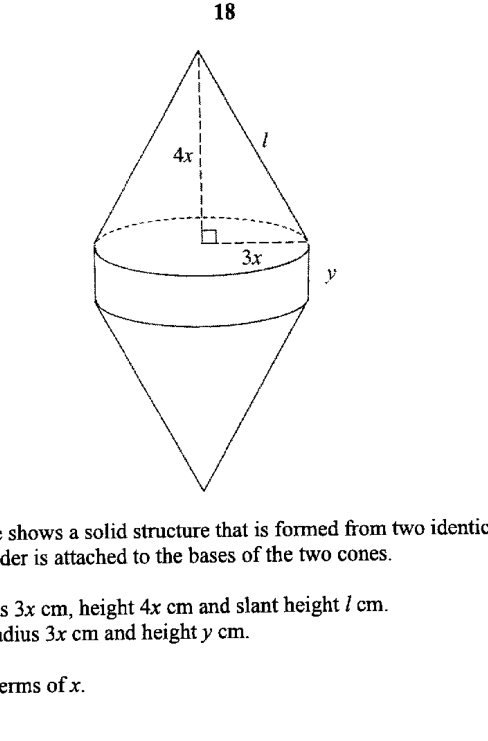
- (a)
Express in terms of .
Answer
- (b)
The volume of the cylinder is equal to the volume of one cone.
Show that .
Answer
- (c)
The total surface area of the solid structure is . Write an expression, in terms of , for the total surface area of the solid and show that it reduces to $38x^2 + x - 200 = 0.
Answer
- (d)
Solve the equation , giving your solutions correct to 2 decimal places.
Answer
It won't just hand you the answer — it asks where you're stuck.How the checker works
Worked solution
8(a)
1. Find the slant height using Pythagoras' theorem
The cone's radius, height and slant height form a right-angled triangle.
8(b)
1. Write the volume of the cylinder and the volume of one cone in terms of $x$ and $y$
Radius of both solids .
Volume of cylinder:
Volume of one cone:
2. Equate the two volumes and solve for $y$
Given that the volume of the cylinder is equal to the volume of one cone,
Divide both sides by :
8(c)
1. Find the curved surface area of the two cones
From earlier, and the radius is .
Curved surface area of one cone:
For two identical cones:
2. Find the curved surface area of the cylinder and write the total surface area
From earlier, and the radius is .
Curved surface area of cylinder:
Total surface area of the solid:
3. Equate the expression to the given total surface area and reduce to the required quadratic equation
Given that the total surface area is ,
Divide by :
Bring all terms to one side:
Total surface area .
Since the total surface area is also ,
8(d)
1. Identify the coefficients and substitute into the quadratic formula
For ,
Using
2. Simplify the discriminant and calculate the two roots
3. Round the solutions correct to 2 decimal places
Correct to 2 decimal places,
or
AI analysis — may contain mistakes.
Worked this one out on paper? Snap your steps and Gigle's AI math checker will circle the step where it went wrong.
More questions on this topic
- 1In the diagram, there are two right-angled triangles ΔABD and ΔCEB such that AD = 12 cm, BD = 15 cm and BE = 20 cm. Find…
- 2In triangle ABC, , and . Express as a fraction in its…
- 3In the diagram, POR is a quadrant of a circle with radius 6 cm. OR and PQ are parallel. QR is an arc of a circle with ce…
- 4Triangle ABC is a right-angled triangle. Given that two of its lengths are 11 cm and 5 cm, find two possible lengths for…
- 5The diagram below shows a gift souvenir formed by joining the plane face of a solid hemisphere of radius 3 cm and a soli…