The figure shows a triangle ABC. E is the mid-point of AC. and . K lies on EB such that .
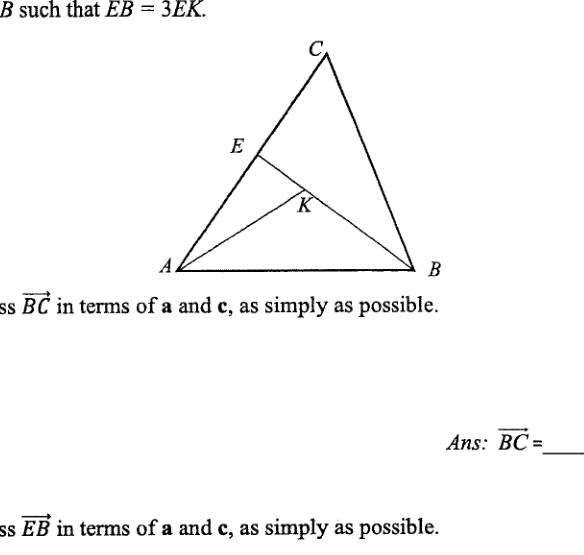
- (a)
Express in terms of and , as simply as possible.
Ans: ___
- (b)
Express in terms of and , as simply as possible.
Ans: = ___
- (c)
Given that , explain why A, K and P lies on a straight line.
Answer
- (d)
Find the value of (\dfrac{\text{area of }\triangle AEK}{\text{area of }\triangle AKB}).
Ans: ___
- (e)
Find the value of (\dfrac{\text{area of }\triangle AEK}{\text{area of }\triangle ABC}).
Ans: ___
It won't just hand you the answer — it asks where you're stuck.How the checker works
Worked solution
4(a)
1. Express $\overrightarrow{BC}$ using the path $B \to A \to C$.
Since , we have .
Also, .
Hence,
4(b)
1. Find the vector from $E$ to $A$ using the midpoint information.
Since is the midpoint of ,
.
Hence
.
2. Express $\overrightarrow{EB}$ by adding vectors along $E \to A \to B$.
4(c)
1. Find $\overrightarrow{AE}$ and $\overrightarrow{EK}$ using the midpoint and ratio information.
Since is the midpoint of ,
From part (b), .
Since ,
2. Express $\overrightarrow{AK}$ in terms of $a$ and $c$.
Using the path ,
Thus
3. Compare $\overrightarrow{KP}$ with $\overrightarrow{AK}$ and conclude collinearity.
Given
Since ,
Therefore is a scalar multiple of , so the two vectors are parallel. Since both involve the point , , and lie on a straight line.
Since and , and are parallel. As both pass through , , and lie on a straight line.
4(d)
1. Relate the areas using the common base $AK$ and the given division of $EB$.
Since ,
Triangles and have the same base , and , , are collinear, so their areas are in the ratio of their corresponding heights:
4(e)
1. Compare the area of $\triangle AEB$ with the area of $\triangle ABC$, then use the subdivision of $\triangle AEB$ by $AK$.
Since is the midpoint of , .
and have bases and on the same straight line, and the same height from .
So
From part (d),
so if , then .
Thus
so
Therefore
AI analysis — may contain mistakes.
Worked this one out on paper? Snap your steps and Gigle's AI math checker will circle the step where it went wrong.