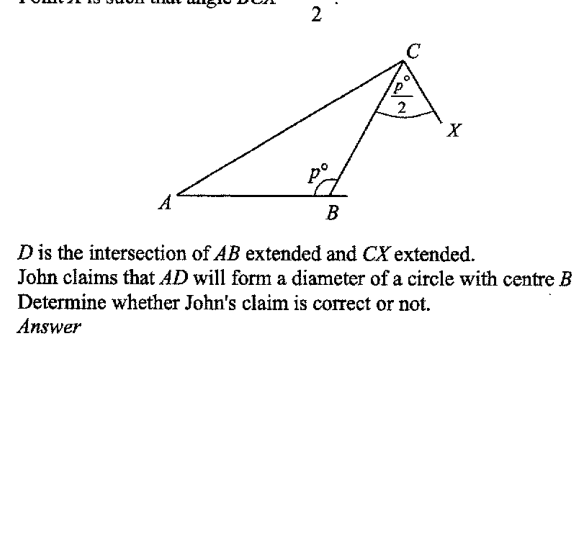
The diagram shows an isosceles triangle ABC where angle ABC = p° and BA = BC. Point X is such that angle BCX = p°/2. D is the intersection of AB extended and CX extended. John claims that AD will form a diameter of a circle with centre B. Determine whether John's claim is correct or not.
It won't just hand you the answer — it asks where you're stuck.How the checker works
Worked solution
4
1. Find the base angle at $C$ in isosceles triangle $ABC$.
Since , triangle is isosceles with base .
2. Show that triangle $BCD$ is isosceles and conclude whether $B$ is the midpoint of $AD$.
Since lies on extended, is a straight extension of .
Also, since lies on extended and , the angle at in triangle is
Hence
So , and therefore .
But , so . Thus is the midpoint of .
Therefore will form a diameter of a circle with centre .
John's claim is correct, since , so is the centre/midpoint of . Hence is a diameter of a circle with centre .
AI analysis — may contain mistakes.
Worked this one out on paper? Snap your steps and Gigle's AI math checker will circle the step where it went wrong.
More questions on this topic
- 1In triangle ABC, , and . Express as a fraction in its…
- 2A cuboid has a volume of 250 cm^3, correct to the nearest cubic centimetre. The height of the cuboid is 8.4 cm, correct…
- 3The diagram shows the positions of a harbour, H, a lighthouse, L, and two buoys P and Q. HPQ is a straight line. The bea…
- 4,则的余角是 A. B. C. D.
- 5The figure is made up of a regular pentagon ABCDE and a regular hexagon CDFGHI. Find angle BCI. Answer ... ° Determine w…