The diagram above shows a cuboid with horizontal base where and . , , and are vertical with height . The point is taken as the origin and vectors , and are unit vectors in the directions , and respectively. The point on and the point on are such that and . Point is the midpoint of .
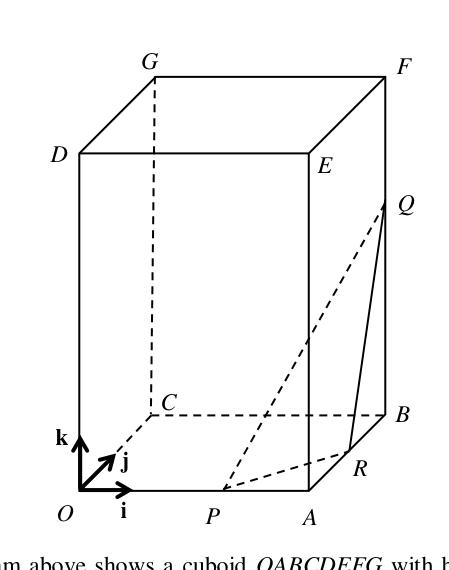
- (i)
Show that the equation of the plane is .
- (ii)
Find the distance from the point to the plane .
- (iii)
Find the acute angle between the plane and the plane .
- (iv)
Find the position vector of the point of intersection of the line and the plane . Hence write down the distance from to the plane .
- (v)
Find a vector equation of the plane, in the form , when the plane is reflected about the plane .
It won't just hand you the answer — it asks where you're stuck.How the checker works
Worked solution
9(i)
1. Find the position vectors of points $P$, $Q$, and $R$.
From the given dimensions and ratios, we determine the coordinates of the vertices:
, , .
Since , is along :
Since , is along :
Since is the midpoint of :
2. Find two directional vectors on the plane $PQR$.
3. Find a normal vector to the plane by calculating the cross product of the two vectors.
To simplify, we can divide by 4 to get a simpler normal vector: .
4. Form the cartesian equation of the plane.
The equation of a plane is , where is a point on the plane.
Using point :
Writing , we obtain:
(Shown)
3x - 3y + z = 12
9(ii)
1. Identify the coordinates or position vector of point $C$.
Since is a rectangle with , . Because is a unit vector in the direction of , the position vector of is .
2. Apply the perpendicular distance formula from a point to a plane.
The equation of the plane is , which gives a normal vector .
The perpendicular distance from to the plane is given by :
(or ) cm
9(iii)
1. Identify the normal vectors of the planes $PQR$ and $OABC$.
From part (i), the equation of plane is , so its normal vector is .
The plane is the -plane, so its normal vector is .
2. Calculate the acute angle between the two planes.
Let be the acute angle between the planes.
9(iv)
1. Find the position vectors of $P$ and $Q$.
Given and , we have .
Point lies on , which is vertical with height . Given , .
The position of is .
2. Form the vector equation of the line $PQ$.
The direction vector of is:
The equation of line is:
3. Find the intersection point $M$ with the plane $OCGD$.
The plane contains the -axis (through ) and -axis (through ). Its equation is .
Substituting the -component of the line into the plane equation:
Substituting into the line equation:
Thus, the position vector of is .
4. Deduce the distance from $M$ to the plane $OABC$.
The plane is the -plane, which has equation .
The distance from to the -plane is simply the magnitude of its -coordinate:
has position vector , distance is cm
9(v)
1. Determine the coordinates of points $P$, $Q$, and $R$ and find their reflections about the plane $OABC$.
The plane is the -plane (where ).
From the given geometry, the coordinates of the points in the original plane are:
Reflecting these points about the -plane negates their -coordinates. The reflected points , , and are:
2. Calculate two direction vectors for the reflected plane.
We use the vectors and as our direction vectors:
3. Write the vector equation of the reflected plane.
Using as the position vector and the simplified direction vectors:
(Note: Other valid point/direction vector combinations are acceptable.)
AI analysis — may contain mistakes.
Worked this one out on paper? Snap your steps and Gigle's AI math checker will circle the step where it went wrong.
More questions on this topic
- 1The lines and have equations …
- 2A drilling company plans to install a straight pipeline through a mountain. Points are defined relative…
- 3A plane has equation . A line passes through the points and with position vectors …
- 4The planes and have vector equations …
- 5A home interior designer is looking to design a pull-down wardrobe lift. To test his concept, the designer built a small…