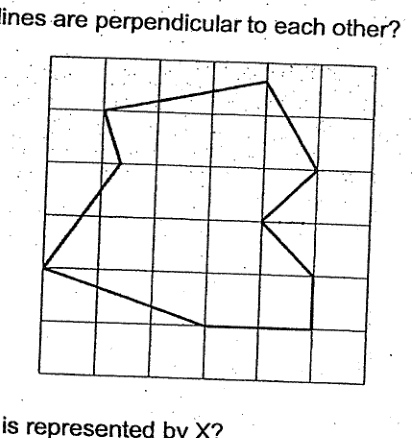
In the given figure, how many pairs of lines are perpendicular to each other?
Work through it with AI →

It won't just hand you the answer — it asks where you're stuck.How the checker works

Worked solution

4

1. Identify the vectors for each line segment of the polygon

Let the vertices be A(1,2)A(1, 2), B(2,4)B(2, 4), C(2.5,4.5)C(2.5, 4.5), D(2,5)D(2, 5), E(5,5.5)E(5, 5.5), F(6,4)F(6, 4), G(5,3)G(5, 3), H(6,2)H(6, 2), I(6,1)I(6, 1), J(4,1)J(4, 1).
The vectors for the segments are:
AB=(12)AB = \begin{pmatrix} 1 \\ 2 \end{pmatrix}
BC=(0.50.5)BC = \begin{pmatrix} 0.5 \\ 0.5 \end{pmatrix}
CD=(−0.50.5)CD = \begin{pmatrix} -0.5 \\ 0.5 \end{pmatrix}
DE=(30.5)DE = \begin{pmatrix} 3 \\ 0.5 \end{pmatrix}
EF=(1−1.5)EF = \begin{pmatrix} 1 \\ -1.5 \end{pmatrix}
FG=(−1−1)FG = \begin{pmatrix} -1 \\ -1 \end{pmatrix}
GH=(1−1)GH = \begin{pmatrix} 1 \\ -1 \end{pmatrix}
HI=(0−1)HI = \begin{pmatrix} 0 \\ -1 \end{pmatrix}
IJ=(−20)IJ = \begin{pmatrix} -2 \\ 0 \end{pmatrix}
JA=(−31)JA = \begin{pmatrix} -3 \\ 1 \end{pmatrix}

2. Check adjacent segments for perpendicularity using dot product or slope

Two segments are perpendicular if their dot product is zero (or slopes are negative reciprocals).

  1. BC⋅CD=(0.5)(−0.5)+(0.5)(0.5)=−0.25+0.25=0BC \cdot CD = (0.5)(-0.5) + (0.5)(0.5) = -0.25 + 0.25 = 0. So BC⊥CDBC \perp CD.
  2. FG⋅GH=(−1)(1)+(−1)(−1)=−1+1=0FG \cdot GH = (-1)(1) + (-1)(-1) = -1 + 1 = 0. So FG⊥GHFG \perp GH.
  3. HI⋅IJ=(0)(−2)+(−1)(0)=0HI \cdot IJ = (0)(-2) + (-1)(0) = 0. So HI⊥IJHI \perp IJ.
    Checking other adjacent pairs:
    AB⋅BC=1(0.5)+2(0.5)=1.5≠0AB \cdot BC = 1(0.5) + 2(0.5) = 1.5 \neq 0
    CD⋅DE=−1.5+0.25≠0CD \cdot DE = -1.5 + 0.25 \neq 0
    DE⋅EF=3−0.75≠0DE \cdot EF = 3 - 0.75 \neq 0
    EF⋅FG=−1+1.5≠0EF \cdot FG = -1 + 1.5 \neq 0
    GH⋅HI=0+1≠0GH \cdot HI = 0 + 1 \neq 0
    IJ⋅JA=6+0≠0IJ \cdot JA = 6 + 0 \neq 0
    JA⋅AB=−3+2≠0JA \cdot AB = -3 + 2 \neq 0
    There are 3 pairs of perpendicular adjacent lines.
Answer

3 (option 3)

AI analysis — may contain mistakes.

Worked this one out on paper? Snap your steps and Gigle's AI math checker will circle the step where it went wrong.

More questions on this topic

  1. 1In the figure, WXYZ is a trapezium and AXYB is a rhombus. XBC and XAZ are straight lines. WX // ZY, BC = BY, ∠XAB=82∘\angle XAB = 82^\circ…
  2. 2In the figure below, ABCD is a trapezium. AF and EC are straight lines. Peishan wrote four statements to describe the fi…
  3. 3In the figure below, ABGF and BCDG are rhombuses. ∠ABF=31∘\angle ABF = 31^\circ, ∠CBG=40∘\angle CBG = 40^\circ and EF is parallel to…
  4. 4In the figure, PQ = PS and SRP is a straight line. Find ∠RQS\angle\text{RQS}. Ans: ___ ∘^\circ
  5. 53.76°= 度 分 秒.