The equations of two planes p1p_1 and p2p_2 are 2x+sy+z=−3,x−2y+3z=1,\begin{aligned} 2x + sy + z &= -3, \\ x - 2y + 3z &= 1, \end{aligned} respectively, where ss is a negative real constant.

  1. (a)

    Find a vector parallel to both p1p_1 and p2p_2, giving your answer in terms of ss.

  2. (b)

    It is given that p1p_1 and p2p_2 intersect in a line ll, and ll meets the xzxz-plane at a point AA. Find the coordinates of AA.

  3. (c)

    The shortest distance between the origin OO and p1p_1 is 36\frac{3}{\sqrt{6}}. Find the value of ss.

  4. (d)

    It is now given that s=−2s = -2, with the normal vectors to p1p_1 and p2p_2 denoted as
    n1=(2−21)andn2=(1−23)\mathbf{n}_1 = \begin{pmatrix} 2 \\ -2 \\ 1 \end{pmatrix} \quad \text{and} \quad \mathbf{n}_2 = \begin{pmatrix} 1 \\ -2 \\ 3 \end{pmatrix}
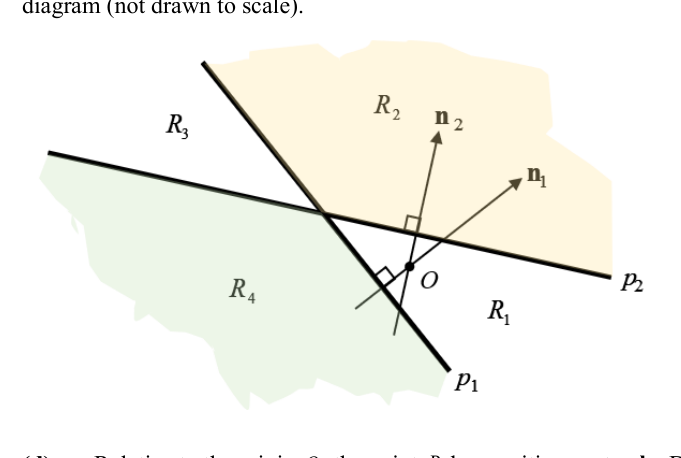
    respectively. It is given that p1p_1 and p2p_2 divide the real space into four regions R1R_1, R2R_2, R3R_3 and R4R_4 as shown in the following two-dimensional diagram (not drawn to scale).

    Relative to the origin OO, the point BB has position vector k\mathbf{k}. Determine whether BB lies in R1R_1, R2R_2, R3R_3 or R4R_4, justifying your answer.

Work through it with AI →

It won't just hand you the answer — it asks where you're stuck.How the checker works

Worked solution

5(a)

1. Identify the normal vectors of the two planes.

From the Cartesian equations of the planes, the normal vectors to p1p_1 and p2p_2 are respectively:
n1=(2s1)andn2=(1−23)\mathbf{n}_1 = \begin{pmatrix} 2 \\ s \\ 1 \end{pmatrix} \quad \text{and} \quad \mathbf{n}_2 = \begin{pmatrix} 1 \\ -2 \\ 3 \end{pmatrix}

2. Calculate the cross product of the normal vectors.

A vector parallel to both planes must be perpendicular to both normal vectors. We can find this by taking their cross product:
n1×n2=(2s1)×(1−23)\mathbf{n}_1 \times \mathbf{n}_2 = \begin{pmatrix} 2 \\ s \\ 1 \end{pmatrix} \times \begin{pmatrix} 1 \\ -2 \\ 3 \end{pmatrix}
=((s)(3)−(1)(−2)(1)(1)−(2)(3)(2)(−2)−(s)(1))= \begin{pmatrix} (s)(3) - (1)(-2) \\ (1)(1) - (2)(3) \\ (2)(-2) - (s)(1) \end{pmatrix}
=(3s+21−6−4−s)=(3s+2−5−s−4)= \begin{pmatrix} 3s + 2 \\ 1 - 6 \\ -4 - s \end{pmatrix} = \begin{pmatrix} 3s + 2 \\ -5 \\ -s - 4 \end{pmatrix}

Answer

(3s+2−5−s−4)\begin{pmatrix} 3s + 2 \\ -5 \\ -s - 4 \end{pmatrix}

5(b)

1. State the condition for a point to lie on the $xz$-plane.

For a point to lie on the xzxz-plane, its yy-coordinate must be zero. Therefore, we set y=0y = 0.

2. Substitute $y = 0$ into the equations of $p_1$ and $p_2$ to form a system of linear equations.

Substitute y=0y = 0 into the equation for p1p_1:
2x+s(0)+z=−3  ⟹  2x+z=−3— (1)2x + s(0) + z = -3 \implies 2x + z = -3 \quad \text{--- (1)}

Substitute y=0y = 0 into the equation for p2p_2:
x−2(0)+3z=1  ⟹  x+3z=1— (2)x - 2(0) + 3z = 1 \implies x + 3z = 1 \quad \text{--- (2)}

3. Solve the simultaneous equations for $x$ and $z$.

From (2), we can express xx in terms of zz:
x=1−3zx = 1 - 3z

Substitute this into (1):
2(1−3z)+z=−32(1 - 3z) + z = -3
2−6z+z=−32 - 6z + z = -3
−5z=−5  ⟹  z=1-5z = -5 \implies z = 1

Substitute z=1z = 1 back into the expression for xx:
x=1−3(1)=−2x = 1 - 3(1) = -2

4. State the final coordinates of point $A$.

Since x=−2x = -2, y=0y = 0, and z=1z = 1, the coordinates of AA are (−2,0,1)(-2, 0, 1).

Answer

(−2,0,1)(-2, 0, 1)

5(c)

1. Express the distance from the origin to $p_1$ in terms of $s$.

The equation of p1p_1 is 2x+sy+z=−32x + sy + z = -3.
This can be written as r⋅(2s1)=−3\mathbf{r} \cdot \begin{pmatrix} 2 \\ s \\ 1 \end{pmatrix} = -3.
The shortest distance from the origin to p1p_1 is:
∣−3∣22+s2+12=3s2+5\frac{|-3|}{\sqrt{2^2 + s^2 + 1^2}} = \frac{3}{\sqrt{s^2 + 5}}

2. Equate the expression to the given distance and solve for $s$.

3s2+5=36\frac{3}{\sqrt{s^2 + 5}} = \frac{3}{\sqrt{6}}
Equating the denominators:
s2+5=6\sqrt{s^2 + 5} = \sqrt{6}
s2+5=6s^2 + 5 = 6
s2=1s^2 = 1
s=±1s = \pm 1
Since it is given in the question that ss is a negative real constant, we reject s=1s = 1.
s=−1s = -1

Answer

s=−1s = -1

5(d)

1. Evaluate the position of $B$ relative to plane $p_1$.

The position vector of BB is rB=k=(001)\mathbf{r}_B = \mathbf{k} = \begin{pmatrix} 0 \\ 0 \\ 1 \end{pmatrix}.
For plane p1p_1 (2x−2y+z=−32x - 2y + z = -3), its vector equation is r⋅n1=−3\mathbf{r} \cdot \mathbf{n}_1 = -3.
rB⋅n1=(001)⋅(2−21)=1\mathbf{r}_B \cdot \mathbf{n}_1 = \begin{pmatrix} 0 \\ 0 \\ 1 \end{pmatrix} \cdot \begin{pmatrix} 2 \\ -2 \\ 1 \end{pmatrix} = 1
Since 1>−31 > -3, point BB lies on the side of p1p_1 that the normal vector n1\mathbf{n}_1 points towards (the direction of increasing dot product). From the diagram, n1\mathbf{n}_1 points into R1R_1 and R2R_2, so BB must lie in either R1R_1 or R2R_2.

2. Evaluate the position of $B$ relative to plane $p_2$.

For plane p2p_2 (x−2y+3z=1x - 2y + 3z = 1), its vector equation is r⋅n2=1\mathbf{r} \cdot \mathbf{n}_2 = 1.
rB⋅n2=(001)⋅(1−23)=3\mathbf{r}_B \cdot \mathbf{n}_2 = \begin{pmatrix} 0 \\ 0 \\ 1 \end{pmatrix} \cdot \begin{pmatrix} 1 \\ -2 \\ 3 \end{pmatrix} = 3
Since 3>13 > 1, point BB lies on the side of p2p_2 that the normal vector n2\mathbf{n}_2 points towards. From the diagram, n2\mathbf{n}_2 points into R2R_2 and R3R_3, so BB must lie in either R2R_2 or R3R_3.

3. Deduce the final region by finding the intersection of both conditions.

To satisfy both conditions, BB must lie in the intersection of the two sets of regions.
(R1∪R2)∩(R2∪R3)=R2(R_1 \cup R_2) \cap (R_2 \cup R_3) = R_2
Therefore, point BB lies in R2R_2.

Answer

Region R2R_2

AI analysis — may contain mistakes.

Worked this one out on paper? Snap your steps and Gigle's AI math checker will circle the step where it went wrong.

More questions on this topic

  1. 1The lines l1l_1 and l2l_2 have equations r=(4110)+λ(1−1−6),λ∈R\mathbf{r} = \begin{pmatrix} 4 \\ 1 \\ 10 \end{pmatrix} + \lambda \begin{pmatrix} 1 \\ -1 \\ -6 \end{pmatrix}, \lambda \in \mathbb{R}…
  2. 2A drilling company plans to install a straight pipeline ABAB through a mountain. Points (x,y,z)(x, y, z) are defined relative…
  3. 3A plane Π1\Pi_1 has equation x+y+z=3x + y + z = 3. A line passes through the points PP and QQ with position vectors i+j+2k\mathbf{i} + \mathbf{j} + 2\mathbf{k}…
  4. 4The planes Π1\Pi_1 and Π2\Pi_2 have vector equations r=λ1(i+j−k)+μ1(2i−j+k)andr=λ2(i+2j+k)+μ2(3i+j−k)\mathbf{r} = \lambda_1(\mathbf{i} + \mathbf{j} - \mathbf{k}) + \mu_1(2\mathbf{i} - \mathbf{j} + \mathbf{k}) \quad \text{and} \quad \mathbf{r} = \lambda_2(\mathbf{i} + 2\mathbf{j} + \mathbf{k}) + \mu_2(3\mathbf{i} + \mathbf{j} - \mathbf{k})…
  5. 5A home interior designer is looking to design a pull-down wardrobe lift. To test his concept, the designer built a small…