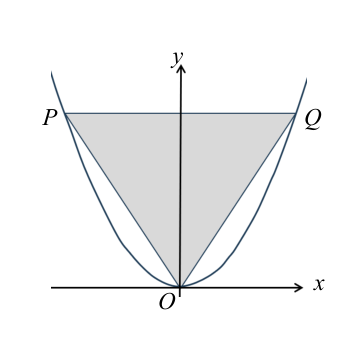
The diagram shows part of the curve . The points P and Q lie on the curve, and have the same y-coordinates. The points P and Q move along the curve such that their y-coordinates are changing at a rate of 3 units per second.
- (a)
Show that the area of the triangle OPQ, A cm2, is given by .
- (b)
Find, at the point where , the rate of change of .
- (c)
Find, at the point where , the rate of change of .
It won't just hand you the answer — it asks where you're stuck.How the checker works
Worked solution
9(a)
1. Determine the length of the base PQ and the perpendicular height of the triangle
Since P and Q lie on the curve and are symmetric about the y-axis, their coordinates are and .
Length of base .
The perpendicular height of the triangle from the origin to the line is the y-coordinate, which is .
2. Calculate the area of the triangle OPQ
Shown
9(b)
1. Express the length $PQ$ in terms of $x$.
Since is at and is at with , the length .
2. Find the relationship between $\frac{dx}{dt}$ and $\frac{dy}{dt}$.
Given , differentiating with respect to gives:
3. Calculate $\frac{dx}{dt}$ when $x = 4$.
We are given .
When :
4. Calculate the rate of change of $PQ$.
Let .
units/s
9(c)
1. Find the rate of change of $x$ at $x = 4$.
Given , we have .
At , .
Using the chain rule :
2. Find the derivative of the area $A$ with respect to $x$.
Given , we have .
At , .
3. Calculate the rate of change of $A$ using the chain rule.
AI analysis — may contain mistakes.
Worked this one out on paper? Snap your steps and Gigle's AI math checker will circle the step where it went wrong.
More questions on this topic
- 1The normal to the curve at point crosses the -axis at point …
- 2The point lies on the curve for . The normal to the curve at is par…
- 3The figure shows part of the curve . and are two points on the curve. Given that …
- 4The diagram shows part of the curve which crosses the -axis at and the -axis at …
- 5The triangle ABC is such that its area is , the length of AB is …