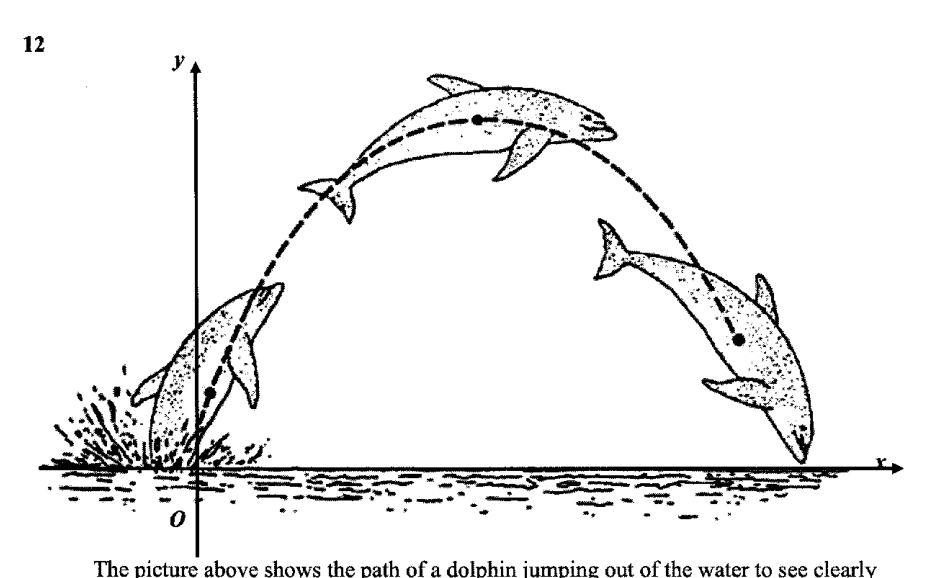
The picture above shows the path of a dolphin jumping out of the water to see clearly and to watch the surface of the oceans. The path is modelled by a quadratic function, as shown in the diagram. The dimensions of the path is given in the table below.
How high can the dolphin jump out of the water? 450 cm How far can the dolphin jump out of the water? 600 cm
| How high can the dolphin jump out of the water? | 450 cm |
| How far can the dolphin jump out of the water? | 600 cm |
- (i)
Find the coordinates of the highest point in the path.
- (ii)
Find the equation, in the form , of the path of the dolphin, where , and are real numbers.
It won't just hand you the answer — it asks where you're stuck.How the checker works
Worked solution
12(i)
1. Identify the maximum height (y-coordinate)
The maximum height is given as .
So, .
2. Identify the x-coordinate of the highest point using symmetry
The total horizontal distance is .
Since the parabola starts at and ends at , by symmetry, the highest point occurs at the midpoint of the x-intercepts.
12(ii)
1. Set up the quadratic equation using the $x$-intercepts
The dolphin starts at the origin and re-enters the water at . Thus, the -intercepts are and .
The equation can be written in the factored form:
2. Substitute the coordinates of the highest point to find $a$
From part (i), the highest point is . Substitute and into the equation:
3. Expand the equation to the required form $y = ax^2 + bx + c$
(Here , , )
AI analysis — may contain mistakes.
Worked this one out on paper? Snap your steps and Gigle's AI math checker will circle the step where it went wrong.