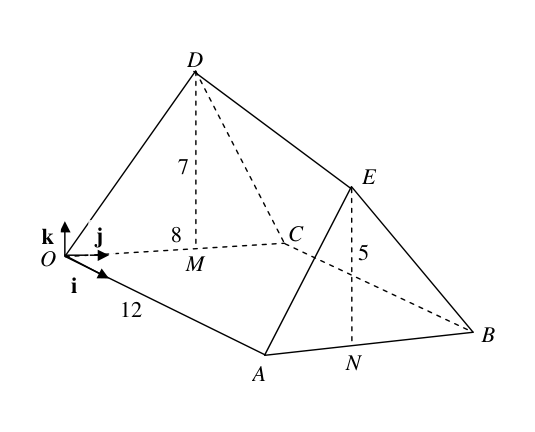
The diagram shows a solid with a horizontal rectangular base OABCOABC in which the lengths of OAOA and OCOC are 12 m12\text{ m} and 8 m8\text{ m} respectively. MM and NN are the mid-points of OCOC and ABAB respectively, and DD and EE are 7 m7\text{ m} and 5 m5\text{ m} vertically above MM and NN respectively. The point OO is taken as the origin for position vectors. Perpendicular vectors i\mathbf{i}, j\mathbf{j}, k\mathbf{k} are such that i\mathbf{i} and j\mathbf{j} are parallel to OAOA and OCOC respectively, and k\mathbf{k} is perpendicular to the plane OABCOABC.

  1. (i)

    Find a vector equation of the line DBDB. Hence find the foot of perpendicular from EE to the line DBDB.

  2. (ii)

    Find the acute angle between line DBDB and the plane OBEOBE.

  3. (iii)

    Find the length of projection of DEDE onto DBDB.

  4. (iv)

    State, giving a reason, whether lines DBDB and ACAC are coplanar.

Work through it with AI →

It won't just hand you the answer — it asks where you're stuck.How the checker works

Worked solution

5(i)

1. Determine the position vectors of the relevant points B, D, and E from the given geometric description.

Let the origin be O(0,0,0)O(0, 0, 0). With i\mathbf{i}, j\mathbf{j}, k\mathbf{k} parallel to OAOA, OCOC and perpendicular to the base respectively:
OA⃗=(1200)\vec{OA} = \begin{pmatrix} 12 \\ 0 \\ 0 \end{pmatrix}, OC⃗=(080)\vec{OC} = \begin{pmatrix} 0 \\ 8 \\ 0 \end{pmatrix}
Since OABCOABC is a rectangle, OB⃗=OA⃗+OC⃗=(1280)\vec{OB} = \vec{OA} + \vec{OC} = \begin{pmatrix} 12 \\ 8 \\ 0 \end{pmatrix}.
MM is the midpoint of OCOC, so OM⃗=(040)\vec{OM} = \begin{pmatrix} 0 \\ 4 \\ 0 \end{pmatrix}. DD is 7 m7\text{ m} vertically above MM, so OD⃗=(047)\vec{OD} = \begin{pmatrix} 0 \\ 4 \\ 7 \end{pmatrix}.
NN is the midpoint of ABAB, so ON⃗=(1240)\vec{ON} = \begin{pmatrix} 12 \\ 4 \\ 0 \end{pmatrix}. EE is 5 m5\text{ m} vertically above NN, so OE⃗=(1245)\vec{OE} = \begin{pmatrix} 12 \\ 4 \\ 5 \end{pmatrix}.

2. Find the vector equation of the line $DB$.

The direction vector of line DBDB is:
DB⃗=OB⃗−OD⃗=(1280)−(047)=(124−7)\vec{DB} = \vec{OB} - \vec{OD} = \begin{pmatrix} 12 \\ 8 \\ 0 \end{pmatrix} - \begin{pmatrix} 0 \\ 4 \\ 7 \end{pmatrix} = \begin{pmatrix} 12 \\ 4 \\ -7 \end{pmatrix}
Thus, a vector equation of the line DBDB is:
r=(047)+λ(124−7),λ∈R\mathbf{r} = \begin{pmatrix} 0 \\ 4 \\ 7 \end{pmatrix} + \lambda \begin{pmatrix} 12 \\ 4 \\ -7 \end{pmatrix}, \lambda \in \mathbb{R}

3. Express the position vector of the foot of the perpendicular, $F$, and the vector $\vec{EF}$ in terms of $\lambda$.

Let FF be the foot of the perpendicular from EE to DBDB. Then FF lies on the line DBDB, so its position vector is:
OF⃗=(12λ4+4λ7−7λ)\vec{OF} = \begin{pmatrix} 12\lambda \\ 4+4\lambda \\ 7-7\lambda \end{pmatrix} for some λ∈R\lambda \in \mathbb{R}.
The displacement vector from EE to FF is:
EF⃗=OF⃗−OE⃗=(12λ4+4λ7−7λ)−(1245)=(12λ−124λ2−7λ)\vec{EF} = \vec{OF} - \vec{OE} = \begin{pmatrix} 12\lambda \\ 4+4\lambda \\ 7-7\lambda \end{pmatrix} - \begin{pmatrix} 12 \\ 4 \\ 5 \end{pmatrix} = \begin{pmatrix} 12\lambda - 12 \\ 4\lambda \\ 2-7\lambda \end{pmatrix}

4. Use the dot product to solve for $\lambda$.

Since EF⃗\vec{EF} is perpendicular to line DBDB, the dot product of EF⃗\vec{EF} with the direction vector of DBDB is zero:
EF⃗⋅DB⃗=0\vec{EF} \cdot \vec{DB} = 0
(12λ−124λ2−7λ)⋅(124−7)=0\begin{pmatrix} 12\lambda - 12 \\ 4\lambda \\ 2-7\lambda \end{pmatrix} \cdot \begin{pmatrix} 12 \\ 4 \\ -7 \end{pmatrix} = 0
12(12λ−12)+4(4λ)−7(2−7λ)=012(12\lambda - 12) + 4(4\lambda) - 7(2-7\lambda) = 0
144λ−144+16λ−14+49λ=0144\lambda - 144 + 16\lambda - 14 + 49\lambda = 0
209λ−158=0  ⟹  λ=158209209\lambda - 158 = 0 \implies \lambda = \frac{158}{209}

5. Substitute $\lambda$ back to find the final position vector of the foot of the perpendicular.

Substitute λ=158209\lambda = \frac{158}{209} into OF⃗\vec{OF}:
OF⃗=(047)+158209(124−7)=(1896/2094+632/2097−1106/209)=1209(18961468357)\vec{OF} = \begin{pmatrix} 0 \\ 4 \\ 7 \end{pmatrix} + \frac{158}{209} \begin{pmatrix} 12 \\ 4 \\ -7 \end{pmatrix} = \begin{pmatrix} 1896/209 \\ 4 + 632/209 \\ 7 - 1106/209 \end{pmatrix} = \frac{1}{209} \begin{pmatrix} 1896 \\ 1468 \\ 357 \end{pmatrix}

Answer

Vector equation: r=(047)+λ(124−7),λ∈R\mathbf{r} = \begin{pmatrix} 0 \\ 4 \\ 7 \end{pmatrix} + \lambda \begin{pmatrix} 12 \\ 4 \\ -7 \end{pmatrix}, \lambda \in \mathbb{R}
Foot of perpendicular: 1209(18961468357)\frac{1}{209} \begin{pmatrix} 1896 \\ 1468 \\ 357 \end{pmatrix} or (1896209,1468209,357209)\left( \frac{1896}{209}, \frac{1468}{209}, \frac{357}{209} \right)

5(ii)

1. Find the coordinates of the relevant points and the direction vector of the line $DB$.

Let the origin be O(0,0,0)O(0, 0, 0).
Since OABCOABC is a rectangle with OA=12OA = 12 and OC=8OC = 8, the coordinates of BB are (12,8,0)(12, 8, 0).
MM is the mid-point of OCOC, so MM is (0,4,0)(0, 4, 0). DD is 7 m7\text{ m} vertically above MM, giving D(0,4,7)D(0, 4, 7).
The direction vector of line DBDB is:
DB⃗=OB⃗−OD⃗=(1280)−(047)=(124−7)\vec{DB} = \vec{OB} - \vec{OD} = \begin{pmatrix} 12 \\ 8 \\ 0 \end{pmatrix} - \begin{pmatrix} 0 \\ 4 \\ 7 \end{pmatrix} = \begin{pmatrix} 12 \\ 4 \\ -7 \end{pmatrix}

2. Determine a normal vector to the plane $OBE$.

NN is the mid-point of ABAB, so NN is (12,4,0)(12, 4, 0). EE is 5 m5\text{ m} vertically above NN, giving E(12,4,5)E(12, 4, 5).
The plane OBEOBE contains the vectors OB⃗=(1280)\vec{OB} = \begin{pmatrix} 12 \\ 8 \\ 0 \end{pmatrix} and OE⃗=(1245)\vec{OE} = \begin{pmatrix} 12 \\ 4 \\ 5 \end{pmatrix}.
A normal vector n\mathbf{n} to the plane OBEOBE is given by their cross product:
n=OB⃗×OE⃗=(1280)×(1245)=(8(5)−0(4)0(12)−12(5)12(4)−8(12))=(40−60−48)\mathbf{n} = \vec{OB} \times \vec{OE} = \begin{pmatrix} 12 \\ 8 \\ 0 \end{pmatrix} \times \begin{pmatrix} 12 \\ 4 \\ 5 \end{pmatrix} = \begin{pmatrix} 8(5) - 0(4) \\ 0(12) - 12(5) \\ 12(4) - 8(12) \end{pmatrix} = \begin{pmatrix} 40 \\ -60 \\ -48 \end{pmatrix}
We can take a simpler parallel vector by factoring out 44, giving n1=(10−15−12)\mathbf{n_1} = \begin{pmatrix} 10 \\ -15 \\ -12 \end{pmatrix}.

3. Calculate the acute angle between the line $DB$ and the plane $OBE$.

Let θ\theta be the acute angle between the line DBDB and the plane OBEOBE.
sin⁡θ=∣DB⃗⋅n1∣∣DB⃗∣∣n1∣\sin \theta = \frac{|\vec{DB} \cdot \mathbf{n_1}|}{|\vec{DB}||\mathbf{n_1}|}
sin⁡θ=∣(124−7)⋅(10−15−12)∣122+42+(−7)2102+(−15)2+(−12)2\sin \theta = \frac{\left| \begin{pmatrix} 12 \\ 4 \\ -7 \end{pmatrix} \cdot \begin{pmatrix} 10 \\ -15 \\ -12 \end{pmatrix} \right|}{\sqrt{12^2 + 4^2 + (-7)^2} \sqrt{10^2 + (-15)^2 + (-12)^2}}
sin⁡θ=∣120−60+84∣209469\sin \theta = \frac{|120 - 60 + 84|}{\sqrt{209} \sqrt{469}}
sin⁡θ=14498021\sin \theta = \frac{144}{\sqrt{98021}}
θ=sin⁡−1(14498021)≈27.38∘\theta = \sin^{-1}\left(\frac{144}{\sqrt{98021}}\right) \approx 27.38^\circ
The acute angle is 27.4∘27.4^\circ (to 1 d.p.).

Answer

27.4∘27.4^\circ

5(iii)

1. Identify the coordinates of $D$, $E$, and $B$ to find vectors $\vec{DE}$ and $\vec{DB}$.

From the given dimensions and taking OO as the origin:
D=(0,4,7)D = (0, 4, 7)
E=(12,4,5)E = (12, 4, 5)
B=(12,8,0)B = (12, 8, 0)

DE⃗=(1245)−(047)=(120−2)\vec{DE} = \begin{pmatrix} 12 \\ 4 \\ 5 \end{pmatrix} - \begin{pmatrix} 0 \\ 4 \\ 7 \end{pmatrix} = \begin{pmatrix} 12 \\ 0 \\ -2 \end{pmatrix}
DB⃗=(1280)−(047)=(124−7)\vec{DB} = \begin{pmatrix} 12 \\ 8 \\ 0 \end{pmatrix} - \begin{pmatrix} 0 \\ 4 \\ 7 \end{pmatrix} = \begin{pmatrix} 12 \\ 4 \\ -7 \end{pmatrix}

2. Calculate the dot product $\vec{DE} \cdot \vec{DB}$ and the magnitude $|\vec{DB}|$.

DE⃗⋅DB⃗=(120−2)⋅(124−7)\vec{DE} \cdot \vec{DB} = \begin{pmatrix} 12 \\ 0 \\ -2 \end{pmatrix} \cdot \begin{pmatrix} 12 \\ 4 \\ -7 \end{pmatrix}
=(12)(12)+(0)(4)+(−2)(−7)= (12)(12) + (0)(4) + (-2)(-7)
=144+0+14=158= 144 + 0 + 14 = 158

∣DB⃗∣=122+42+(−7)2=144+16+49=209|\vec{DB}| = \sqrt{12^2 + 4^2 + (-7)^2} = \sqrt{144 + 16 + 49} = \sqrt{209}

3. Use the scalar projection formula to find the length of projection.

Length of projection of DEDE onto DBDB is given by ∣DE⃗⋅DB⃗∣∣DB⃗∣\frac{|\vec{DE} \cdot \vec{DB}|}{|\vec{DB}|}.

Length =158209≈10.9 m= \frac{158}{\sqrt{209}} \approx 10.9\text{ m} (to 3 s.f.)

Answer

158209 m\frac{158}{\sqrt{209}}\text{ m} or 10.9 m10.9\text{ m}

5(iv)

1. State whether the lines are coplanar by analysing their intersection and parallel properties.

Line ACAC lies entirely on the base plane OABCOABC (z=0z=0).
Line DBDB connects point DD (which is above the plane) to point BB (which is on the plane), so it intersects the plane OABCOABC exactly at point BB.
Since BB is a vertex of the rectangle and does not lie on the diagonal ACAC, lines DBDB and ACAC do not intersect.
Furthermore, the lines are not parallel since ACAC is horizontal but DBDB has a vertical component.
Two lines that are neither parallel nor intersecting are skew lines. Therefore, lines DBDB and ACAC are not coplanar.

Answer

No, they are not coplanar. Line ACAC lies on the horizontal plane OABCOABC, and line DBDB intersects this plane only at point BB. Since BB does not lie on ACAC, the lines do not intersect. They are also clearly not parallel, meaning they must be skew lines.

AI analysis — may contain mistakes.

Worked this one out on paper? Snap your steps and Gigle's AI math checker will circle the step where it went wrong.

More questions on this topic

  1. 1The lines l1l_1 and l2l_2 have equations r=(4110)+λ(1−1−6),λ∈R\mathbf{r} = \begin{pmatrix} 4 \\ 1 \\ 10 \end{pmatrix} + \lambda \begin{pmatrix} 1 \\ -1 \\ -6 \end{pmatrix}, \lambda \in \mathbb{R}…
  2. 2A drilling company plans to install a straight pipeline ABAB through a mountain. Points (x,y,z)(x, y, z) are defined relative…
  3. 3With reference to the origin OO, the points AA, PP and QQ have position vectors a\mathbf{a}, p\mathbf{p} and q\mathbf{q}…
  4. 4The planes Π1\Pi_1 and Π2\Pi_2 have vector equations r=λ1(i+j−k)+μ1(2i−j+k)andr=λ2(i+2j+k)+μ2(3i+j−k)\mathbf{r} = \lambda_1(\mathbf{i} + \mathbf{j} - \mathbf{k}) + \mu_1(2\mathbf{i} - \mathbf{j} + \mathbf{k}) \quad \text{and} \quad \mathbf{r} = \lambda_2(\mathbf{i} + 2\mathbf{j} + \mathbf{k}) + \mu_2(3\mathbf{i} + \mathbf{j} - \mathbf{k})…
  5. 5A home interior designer is looking to design a pull-down wardrobe lift. To test his concept, the designer built a small…