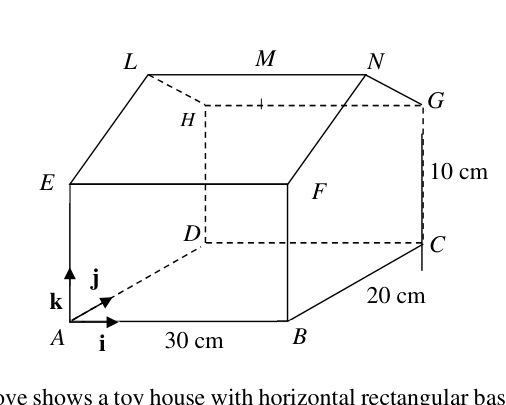
The diagram above shows a toy house with horizontal rectangular base ABCDABCD where AB=30 cmAB = 30\text{ cm} and BC=20 cmBC = 20\text{ cm}. There are two vertical rectangular walls, ABFEABFE and DCGHDCGH, where AE=BF=CG=DH=10 cmAE = BF = CG = DH = 10\text{ cm}. There are two vertical walls, AELHDAELHD and BFNGCBFNGC, where LE=LH=NF=NGLE = LH = NF = NG and LL and NN are 15 cm15\text{ cm} from the base respectively. The point AA is taken as the origin and vectors i\mathbf{i}, j\mathbf{j}, k\mathbf{k} each of length 1 cm1\text{ cm}, are taken along ABAB, ADAD and AEAE respectively.

  1. (i)

    There is a slanted rectangular false ceiling PQGHPQGH where PP and QQ are lying on AEAE and BFBF respectively with PE=QF=1 cmPE = QF = 1\text{ cm}. Show that a vector normal to the plane PQGHPQGH is given by j−20k\mathbf{j} - 20\mathbf{k}. Hence find the cartesian equation of plane PQGHPQGH.

  2. (ii)

    Find, in surd form, the cosine of the acute angle between ABCDABCD and PQGHPQGH.

  3. (iii)

    A wire fastened at MM, the midpoint of LNLN, is connected to the point VV on the false ceiling. Find the coordinates of VV for the length of the wire used to be minimum.

Work through it with AI →

It won't just hand you the answer — it asks where you're stuck.How the checker works

Worked solution

10(i)

1. Determine the coordinates and position vectors of points $P$, $H$, and $Q$.

From the given dimensions and origin A(0,0,0)A(0,0,0):

  • EE is (0,0,10)(0, 0, 10). Since PP lies on the line segment AEAE and PE=1PE = 1, PP is (0,0,9)(0, 0, 9).
  • HH is vertically above D(0,20,0)D(0, 20, 0) by 1010, so HH is (0,20,10)(0, 20, 10).
  • QQ lies on BFBF with QF=1QF = 1, and FF is (30,0,10)(30, 0, 10), so QQ is (30,0,9)(30, 0, 9).

Position vectors:
OP⃗=(009)\vec{OP} = \begin{pmatrix} 0 \\ 0 \\ 9 \end{pmatrix}, OH⃗=(02010)\vec{OH} = \begin{pmatrix} 0 \\ 20 \\ 10 \end{pmatrix}, OQ⃗=(3009)\vec{OQ} = \begin{pmatrix} 30 \\ 0 \\ 9 \end{pmatrix}

2. Find two non-parallel direction vectors parallel to the plane $PQGH$.

PQ⃗=OQ⃗−OP⃗=(3009)−(009)=(3000)=30i\vec{PQ} = \vec{OQ} - \vec{OP} = \begin{pmatrix} 30 \\ 0 \\ 9 \end{pmatrix} - \begin{pmatrix} 0 \\ 0 \\ 9 \end{pmatrix} = \begin{pmatrix} 30 \\ 0 \\ 0 \end{pmatrix} = 30\mathbf{i}

PH⃗=OH⃗−OP⃗=(02010)−(009)=(0201)=20j+k\vec{PH} = \vec{OH} - \vec{OP} = \begin{pmatrix} 0 \\ 20 \\ 10 \end{pmatrix} - \begin{pmatrix} 0 \\ 0 \\ 9 \end{pmatrix} = \begin{pmatrix} 0 \\ 20 \\ 1 \end{pmatrix} = 20\mathbf{j} + \mathbf{k}

3. Use the cross product of the direction vectors to show the given normal vector.

Let a normal vector be N\mathbf{N}.
N=PH⃗×PQ⃗=(0201)×(3000)=(0(0)−1(0)1(30)−0(0)0(0)−20(30))=(030−600)=30(01−20)\mathbf{N} = \vec{PH} \times \vec{PQ} = \begin{pmatrix} 0 \\ 20 \\ 1 \end{pmatrix} \times \begin{pmatrix} 30 \\ 0 \\ 0 \end{pmatrix} = \begin{pmatrix} 0(0) - 1(0) \\ 1(30) - 0(0) \\ 0(0) - 20(30) \end{pmatrix} = \begin{pmatrix} 0 \\ 30 \\ -600 \end{pmatrix} = 30 \begin{pmatrix} 0 \\ 1 \\ -20 \end{pmatrix}
Since any scalar multiple is also a valid normal, dividing by 30 gives n=(01−20)=j−20k\mathbf{n} = \begin{pmatrix} 0 \\ 1 \\ -20 \end{pmatrix} = \mathbf{j} - 20\mathbf{k} (shown).

4. Use the derived normal vector and a point on the plane to find the Cartesian equation.

Using r⋅n=a⋅n\mathbf{r} \cdot \mathbf{n} = \mathbf{a} \cdot \mathbf{n} with the position vector of point P(0,0,9)P(0, 0, 9):
(xyz)⋅(01−20)=(009)⋅(01−20)\begin{pmatrix} x \\ y \\ z \end{pmatrix} \cdot \begin{pmatrix} 0 \\ 1 \\ -20 \end{pmatrix} = \begin{pmatrix} 0 \\ 0 \\ 9 \end{pmatrix} \cdot \begin{pmatrix} 0 \\ 1 \\ -20 \end{pmatrix}
0(x)+1(y)−20(z)=0(0)+0(1)+9(−20)0(x) + 1(y) - 20(z) = 0(0) + 0(1) + 9(-20)
y−20z=−180y - 20z = -180

Answer

Vector normal shown to be j−20k\mathbf{j} - 20\mathbf{k}, equation of plane is y−20z=−180y - 20z = -180.

10(ii)

1. Identify the normal vector to the base $ABCD$.

The plane ABCDABCD is horizontal and lies on the plane defined by i\mathbf{i} and j\mathbf{j}.
Therefore, its normal vector is the vertical unit vector, n2=k\mathbf{n}_2 = \mathbf{k}.
From part (i), the normal vector to the plane PQGHPQGH is n1=j−20k\mathbf{n}_1 = \mathbf{j} - 20\mathbf{k}.

2. Evaluate the scalar product and magnitudes of the normal vectors.

Scalar product:
n1⋅n2=(j−20k)⋅k=−20\mathbf{n}_1 \cdot \mathbf{n}_2 = (\mathbf{j} - 20\mathbf{k}) \cdot \mathbf{k} = -20

Magnitudes:
∣n1∣=02+12+(−20)2=401|\mathbf{n}_1| = \sqrt{0^2 + 1^2 + (-20)^2} = \sqrt{401}
∣n2∣=02+02+12=1|\mathbf{n}_2| = \sqrt{0^2 + 0^2 + 1^2} = 1

3. Calculate the cosine of the acute angle between the two planes.

Let θ\theta be the acute angle between the planes. The angle is determined by the absolute value of the scalar product of their normals:
cos⁡θ=∣n1⋅n2∣∣n1∣∣n2∣\cos \theta = \frac{|\mathbf{n}_1 \cdot \mathbf{n}_2|}{|\mathbf{n}_1||\mathbf{n}_2|}
cos⁡θ=∣−20∣401×1=20401\cos \theta = \frac{|-20|}{\sqrt{401} \times 1} = \frac{20}{\sqrt{401}}

Answer

20401\frac{20}{\sqrt{401}}

10(iii)

1. Determine the coordinates of $M$, the midpoint of $LN$.

From the given dimensions, the apices LL and NN are at a height of 15 cm15\text{ cm} from the base, so their zz-coordinates are 1515.
Since the pentagonal walls are symmetrical and LE=LHLE = LH, LL lies vertically above the midpoint of ADAD. AA is at y=0y=0 and DD is at y=20y=20, so the yy-coordinate of LL is 1010.
Thus, L(0,10,15)L(0, 10, 15).
Similarly, NN lies above BCBC (where x=30x=30), giving N(30,10,15)N(30, 10, 15).
As MM is the midpoint of LNLN:
OM→=12((01015)+(301015))=(151015)\overrightarrow{OM} = \frac{1}{2} \left( \begin{pmatrix} 0 \\ 10 \\ 15 \end{pmatrix} + \begin{pmatrix} 30 \\ 10 \\ 15 \end{pmatrix} \right) = \begin{pmatrix} 15 \\ 10 \\ 15 \end{pmatrix}.
So, M(15,10,15)M(15, 10, 15).

2. Formulate the equation of the line $MV$.

For the length of the wire to be minimum, the line MVMV must be perpendicular to the false ceiling plane PQGHPQGH.
Therefore, the direction vector of the line MVMV is parallel to the normal of the plane, which is given in part (i) as n=j−20k=(01−20)\mathbf{n} = \mathbf{j} - 20\mathbf{k} = \begin{pmatrix} 0 \\ 1 \\ -20 \end{pmatrix}.
The vector equation of line MVMV is:
r=(151015)+λ(01−20)\mathbf{r} = \begin{pmatrix} 15 \\ 10 \\ 15 \end{pmatrix} + \lambda \begin{pmatrix} 0 \\ 1 \\ -20 \end{pmatrix}, where λ∈R\lambda \in \mathbb{R}.

3. Find the point of intersection $V$ between the line $MV$ and the plane $PQGH$.

From part (i), the cartesian equation of the plane PQGHPQGH (using normal j−20k\mathbf{j}-20\mathbf{k} and point P(0,0,9)P(0,0,9)) is:
y−20z=−180y - 20z = -180

Substitute the parametric equations of the line MVMV (x=15x = 15, y=10+λy = 10 + \lambda, z=15−20λz = 15 - 20\lambda) into the plane equation:
(10+λ)−20(15−20λ)=−180(10 + \lambda) - 20(15 - 20\lambda) = -180
10+λ−300+400λ=−18010 + \lambda - 300 + 400\lambda = -180
401λ−290=−180401\lambda - 290 = -180
401λ=110  ⟹  λ=110401401\lambda = 110 \implies \lambda = \frac{110}{401}

Substitute λ\lambda back into the coordinates:
x=15x = 15
y=10+110401=4010+110401=4120401y = 10 + \frac{110}{401} = \frac{4010 + 110}{401} = \frac{4120}{401}
z=15−20(110401)=6015−2200401=3815401z = 15 - 20\left(\frac{110}{401}\right) = \frac{6015 - 2200}{401} = \frac{3815}{401}

The coordinates of VV are (15,4120401,3815401)\left(15, \frac{4120}{401}, \frac{3815}{401}\right).

Answer

(15,4120401,3815401)\left(15, \frac{4120}{401}, \frac{3815}{401}\right)

AI analysis — may contain mistakes.

Worked this one out on paper? Snap your steps and Gigle's AI math checker will circle the step where it went wrong.

More questions on this topic

  1. 1The lines l1l_1 and l2l_2 have equations r=(4110)+λ(1−1−6),λ∈R\mathbf{r} = \begin{pmatrix} 4 \\ 1 \\ 10 \end{pmatrix} + \lambda \begin{pmatrix} 1 \\ -1 \\ -6 \end{pmatrix}, \lambda \in \mathbb{R}…
  2. 2A drilling company plans to install a straight pipeline ABAB through a mountain. Points (x,y,z)(x, y, z) are defined relative…
  3. 3A plane Π1\Pi_1 has equation x+y+z=3x + y + z = 3. A line passes through the points PP and QQ with position vectors i+j+2k\mathbf{i} + \mathbf{j} + 2\mathbf{k}…
  4. 4The planes Π1\Pi_1 and Π2\Pi_2 have vector equations r=λ1(i+j−k)+μ1(2i−j+k)andr=λ2(i+2j+k)+μ2(3i+j−k)\mathbf{r} = \lambda_1(\mathbf{i} + \mathbf{j} - \mathbf{k}) + \mu_1(2\mathbf{i} - \mathbf{j} + \mathbf{k}) \quad \text{and} \quad \mathbf{r} = \lambda_2(\mathbf{i} + 2\mathbf{j} + \mathbf{k}) + \mu_2(3\mathbf{i} + \mathbf{j} - \mathbf{k})…
  5. 5A home interior designer is looking to design a pull-down wardrobe lift. To test his concept, the designer built a small…