The graph below shows the mass of a cup when empty and when different combinations of objects A, B and C are placed in the cup.
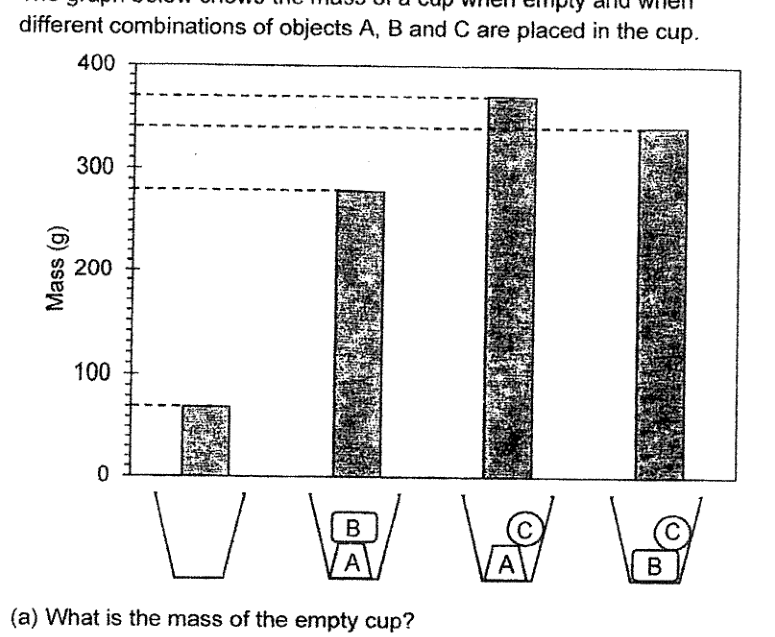
- (a)
What is the mass of the empty cup?
Ans: (a) ___
- (b)
What is the mass of object A?
Ans: (b) ___
- (c)
What is the average mass of objects A, B and C?
Ans: (c) ___
It won't just hand you the answer — it asks where you're stuck.How the checker works
Worked solution
9(a)
1. Read the mass of the empty cup directly from the first bar on the graph
From the graph, the height of the first bar (empty cup) is .
9(b)
1. Find the combined mass of each pair of objects by subtracting the mass of the empty cup.
Mass of A + B = g
Mass of A + C = g
Mass of B + C = g
2. Find the total mass of A, B, and C, and then find the mass of A.
Sum of the three pairs: g
Total mass of A + B + C = g
Mass of A = Total mass - (Mass of B + C) = g
g
9(c)
1. Find the mass of each pair of objects by subtracting the mass of the empty cup.
Mass of A + B =
Mass of A + C =
Mass of B + C =
2. Sum the masses of the three pairs to find the total mass of A, B, and C.
Sum of the three pairs =
Since each object is counted twice in this sum:
3. Calculate the average mass of the three objects.
AI analysis — may contain mistakes.
Worked this one out on paper? Snap your steps and Gigle's AI math checker will circle the step where it went wrong.