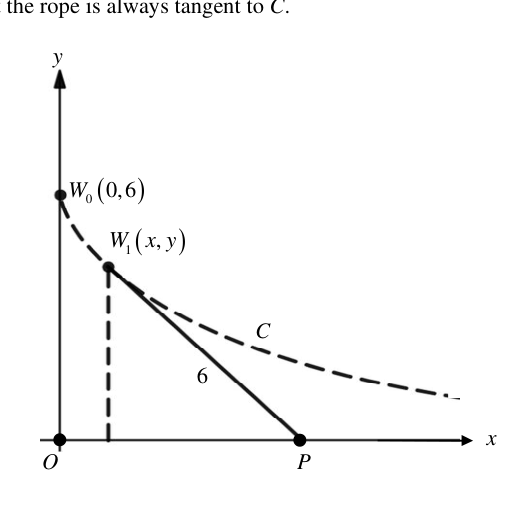
Baby Peter is pulling a toy wagon on a flat ground which is modelled by the xyxy-coordinate plane. Peter is initially at the origin OO and the toy wagon is located on the yy-axis at W0(0,6)W_0(0,6). The toy wagon is tethered to him with a rope of length 6 units. As he moves in the direction of the positive xx-axis (given by point PP), he pulls the toy wagon (given by the point W1W_1) using the rope W1PW_1P which is kept taut throughout the motion. The path of the toy wagon is given by curve CC. It is known that the rope is always tangent to CC.

  1. (a)

    Show that a differential equation for CC can be expressed as
    dydx=αy36−y2,\frac{\mathrm{d}y}{\mathrm{d}x} = \frac{\alpha y}{\sqrt{36-y^2}},
    where α\alpha is a constant to be determined.

  2. (b)

    Using the substitution w2=36−y2w^2 = 36 - y^2 where w>0w > 0, show that the differential equation in (a) can be reduced to
    dwdx=36−w2w2.\frac{\mathrm{d}w}{\mathrm{d}x} = \frac{36-w^2}{w^2}.

  3. (c)

    Find xx in terms of yy.

  4. (d)

    Determine the behaviour of xx as yy approaches 0.

Work through it with AI →

It won't just hand you the answer — it asks where you're stuck.How the checker works

Worked solution

11(a)

1. Find the horizontal distance between $W_1$ and $P$ using Pythagoras' theorem.

Let the coordinates of PP be (xP,0)(x_P, 0). In the right-angled triangle formed by W1(x,y)W_1(x, y), its projection (x,0)(x, 0) and P(xP,0)P(x_P, 0), the hypotenuse is the rope length 66.
(xP−x)2+y2=62(x_P - x)^2 + y^2 = 6^2
Since PP is moving in the direction of the positive xx-axis, PP is to the right of W1W_1, so xP>xx_P > x, giving:
xP−x=36−y2x_P - x = \sqrt{36 - y^2}

2. Formulate the gradient of the curve using the slope of the tangent segment $W_1P$.

The rope W1PW_1P is tangent to the curve CC at W1W_1. The gradient of the curve at W1W_1 is thus the gradient of the line segment W1PW_1P.
dydx=0−yxP−x\frac{\mathrm{d}y}{\mathrm{d}x} = \frac{0 - y}{x_P - x}
dydx=−y36−y2\frac{\mathrm{d}y}{\mathrm{d}x} = \frac{-y}{\sqrt{36 - y^2}}
Comparing this with dydx=αy36−y2\frac{\mathrm{d}y}{\mathrm{d}x} = \frac{\alpha y}{\sqrt{36-y^2}}, we get α=−1\alpha = -1.

Answer

dydx=−y36−y2, so α=−1\frac{\mathrm{d}y}{\mathrm{d}x} = \frac{-y}{\sqrt{36-y^2}} \text{, so } \alpha = -1

11(b)

1. Establish the specific differential equation from part (a).

The problem states the rope of length 66 is tangent to the curve CC.
Let the horizontal position of PP be XX. The coordinates of W1W_1 and PP are (x,y)(x, y) and (X,0)(X, 0) respectively.
The length of the rope is given by (X−x)2+y2=6  ⟹  X−x=36−y2\sqrt{(X-x)^2 + y^2} = 6 \implies X-x = \sqrt{36-y^2} (since PP is ahead of W1W_1, so X>xX > x).
The gradient of the tangent is dydx=0−yX−x=−y36−y2\frac{\mathrm{d}y}{\mathrm{d}x} = \frac{0 - y}{X - x} = -\frac{y}{\sqrt{36-y^2}}.
(This determines that α=−1\alpha = -1 for the differential equation in part (a)).

2. Differentiate the substitution equation implicitly with respect to $x$.

Given the substitution w2=36−y2w^2 = 36 - y^2, differentiate both sides implicitly with respect to xx:
2wdwdx=−2ydydx2w \frac{\mathrm{d}w}{\mathrm{d}x} = -2y \frac{\mathrm{d}y}{\mathrm{d}x}
dwdx=−ywdydx\frac{\mathrm{d}w}{\mathrm{d}x} = -\frac{y}{w} \frac{\mathrm{d}y}{\mathrm{d}x}

3. Substitute the expression for $\frac{\mathrm{d}y}{\mathrm{d}x}$ to reduce the differential equation entirely in terms of $w$.

Since w>0w > 0, we have w=36−y2w = \sqrt{36-y^2}.
Substitute dydx=−y36−y2=−yw\frac{\mathrm{d}y}{\mathrm{d}x} = -\frac{y}{\sqrt{36-y^2}} = -\frac{y}{w} into the derivative relation:
dwdx=−yw(−yw)=y2w2\frac{\mathrm{d}w}{\mathrm{d}x} = -\frac{y}{w} \left(-\frac{y}{w}\right) = \frac{y^2}{w^2}
From the substitution w2=36−y2w^2 = 36 - y^2, we can rewrite y2=36−w2y^2 = 36 - w^2. Replacing y2y^2 in the numerator yields:
dwdx=36−w2w2(shown)\frac{\mathrm{d}w}{\mathrm{d}x} = \frac{36-w^2}{w^2} \quad \text{(shown)}

Answer

dwdx=36−w2w2(shown)\frac{\mathrm{d}w}{\mathrm{d}x} = \frac{36-w^2}{w^2} \quad \text{(shown)}

11(c)

1. Set up the integral by separating variables from the differential equation.

Starting from the result in (b):
dwdx=36−w2w2\frac{\mathrm{d}w}{\mathrm{d}x} = \frac{36-w^2}{w^2}
Separate the variables to integrate with respect to xx and ww:
∫1 dx=∫w236−w2 dw\int 1 \, \mathrm{d}x = \int \frac{w^2}{36-w^2} \, \mathrm{d}w

2. Use algebraic manipulation to rewrite the integrand into an integrable form.

Rewrite the improper algebraic fraction by adding and subtracting 36 in the numerator:
w236−w2=−(36−w2)+3636−w2=−1+3636−w2\frac{w^2}{36-w^2} = \frac{-(36-w^2) + 36}{36-w^2} = -1 + \frac{36}{36-w^2}
So the integral becomes:
∫1 dx=∫(−1+3636−w2) dw\int 1 \, \mathrm{d}x = \int \left( -1 + \frac{36}{36-w^2} \right) \, \mathrm{d}w

3. Integrate using the standard formula for $\frac{1}{a^2-x^2}$.

Using the standard integral result ∫1a2−w2 dw=12aln⁡∣a+wa−w∣\int \frac{1}{a^2-w^2} \, \mathrm{d}w = \frac{1}{2a} \ln \left| \frac{a+w}{a-w} \right| with a=6a=6:
x=−w+36(12(6)ln⁡∣6+w6−w∣)+Cx = -w + 36 \left( \frac{1}{2(6)} \ln \left| \frac{6+w}{6-w} \right| \right) + C
x=−w+3ln⁡∣6+w6−w∣+Cx = -w + 3 \ln \left| \frac{6+w}{6-w} \right| + C
Since w=36−y2≥0w = \sqrt{36-y^2} \ge 0 and from the context y>0y > 0, we know w<6w < 6. Thus, 6+w6−w>0\frac{6+w}{6-w} > 0 and we can drop the absolute value signs:
x=−w+3ln⁡(6+w6−w)+Cx = -w + 3 \ln \left( \frac{6+w}{6-w} \right) + C

4. Apply the initial condition to find the constant of integration $C$.

Initially, the toy wagon is at W0(0,6)W_0(0,6), so x=0x = 0 when y=6y = 6.
When y=6y = 6, w=36−62=0w = \sqrt{36-6^2} = 0.
Substituting x=0x = 0 and w=0w = 0 into our general solution:
0=−0+3ln⁡(6+06−0)+C0 = -0 + 3 \ln \left( \frac{6+0}{6-0} \right) + C
0=3ln⁡(1)+C  ⟹  C=00 = 3 \ln(1) + C \implies C = 0
Thus, the particular solution is:
x=−w+3ln⁡(6+w6−w)x = -w + 3 \ln \left( \frac{6+w}{6-w} \right)

5. Substitute $w = \sqrt{36-y^2}$ back to express $x$ purely in terms of $y$.

Replace ww with 36−y2\sqrt{36-y^2}:
x=−36−y2+3ln⁡(6+36−y26−36−y2)x = -\sqrt{36-y^2} + 3 \ln \left( \frac{6+\sqrt{36-y^2}}{6-\sqrt{36-y^2}} \right)
Optionally, rationalise the argument of the logarithm to present the final answer in a neat, simplified form:
x=−36−y2+3ln⁡((6+36−y2)236−(36−y2))x = -\sqrt{36-y^2} + 3 \ln \left( \frac{(6+\sqrt{36-y^2})^2}{36 - (36-y^2)} \right)
x=−36−y2+3ln⁡((6+36−y2)2y2)x = -\sqrt{36-y^2} + 3 \ln \left( \frac{(6+\sqrt{36-y^2})^2}{y^2} \right)
x=−36−y2+6ln⁡(6+36−y2y)x = -\sqrt{36-y^2} + 6 \ln \left( \frac{6+\sqrt{36-y^2}}{y} \right)

Answer

x=−36−y2+6ln⁡(6+36−y2y)x = -\sqrt{36-y^2} + 6 \ln \left( \frac{6+\sqrt{36-y^2}}{y} \right)

11(d)

1. Determine the expression for $x$ in terms of $y$ (solving part c).

From part (b), we have dxdw=w236−w2=−1+3636−w2\frac{\mathrm{d}x}{\mathrm{d}w} = \frac{w^2}{36-w^2} = -1 + \frac{36}{36-w^2}.
Integrating with respect to ww:
x=∫(−1+3636−w2)dw=−w+3ln⁡(6+w6−w)+Cx = \int \left( -1 + \frac{36}{36-w^2} \right) \mathrm{d}w = -w + 3\ln\left(\frac{6+w}{6-w}\right) + C
Given the initial position W0(0,6)W_0(0,6), when x=0x=0, y=6y=6 and thus w=36−62=0w=\sqrt{36-6^2}=0.
0=0+3ln⁡(1)+C  ⟹  C=00 = 0 + 3\ln(1) + C \implies C=0
Substituting w=36−y2w = \sqrt{36-y^2} gives:
x=−36−y2+3ln⁡(6+36−y26−36−y2)x = -\sqrt{36-y^2} + 3\ln\left(\frac{6+\sqrt{36-y^2}}{6-\sqrt{36-y^2}}\right)

2. Evaluate the limit of $x$ as $y$ approaches 0.

As y→0y \to 0, y2→0y^2 \to 0 and thus 36−y2→6\sqrt{36-y^2} \to 6.
Consider the term inside the natural logarithm:
6+36−y26−36−y2\frac{6+\sqrt{36-y^2}}{6-\sqrt{36-y^2}}
The numerator approaches 6+6=126 + 6 = 12, and the denominator approaches 6−6=06 - 6 = 0 (from the positive side, since y>0y>0).
Hence, 6+36−y26−36−y2→∞\frac{6+\sqrt{36-y^2}}{6-\sqrt{36-y^2}} \to \infty.
Since ln⁡(v)→∞\ln(v) \to \infty as v→∞v \to \infty, the entire expression for xx approaches infinity.
Therefore, x→∞x \to \infty.

Answer

x→∞x \to \infty as y→0y \to 0

AI analysis — may contain mistakes.

Worked this one out on paper? Snap your steps and Gigle's AI math checker will circle the step where it went wrong.

More questions on this topic

  1. 1The points (x,y)(x,y) on a curve satisfy the equations x=12t2−2tx = \tfrac{1}{2}t^2 - 2t and dydx=12t−1\dfrac{dy}{dx} = \dfrac{1}{2t - 1}…
  2. 2In a large town, the number of people infected by a particular virus tt days after the virus was first discovered is xx…
  3. 3Consider the second order differential equation d2xdt2+adxdt=b,\frac{d^{2}x}{dt^{2}} + a\frac{dx}{dt} = b, where aa and bb are no…
  4. 4A freshly brewed cup of tea, initially at a temperature of 85∘C85^\circ\text{C}, is left out to cool in a room with a room…
  5. 5In a large town, the number of people infected by a particular virus tt days after the virus was first discovered is xx…