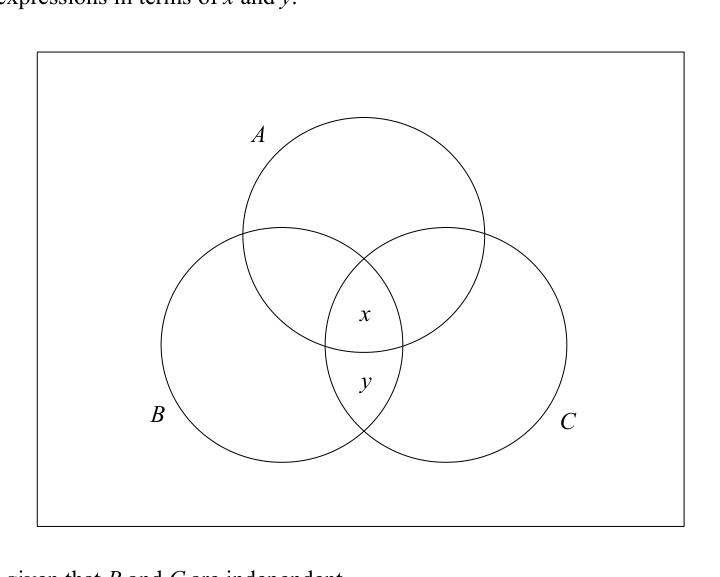
A group of 100 students are asked if they are student leaders, in a sports CCA, or studying in a science faculty. The number of students who are student leaders is 25, the number of students who are in a sports CCA is 30 and the number of students studying in a science faculty is 40. There are 15 student leaders who are in a sports CCA. The number of students who are student leaders, in a sports CCA and studying in a science faculty is . The number of students who are in a sports CCA and studying in a science faculty but not a student leader is .
One of the students is chosen at random.
is the event that the student is a student leader.
is the event that the student is in a sports CCA.
is the event that the student is studying in a science faculty.
It is given that and are independent.
- (a)
Complete the Venn diagram below to represent all the above information. You are allowed to give expressions in terms of and .
- (b)
It is further given that and are independent.
Find in terms of . Hence, find the greatest and least possible values of .
It won't just hand you the answer — it asks where you're stuck.How the checker works
Worked solution
6(a)
1. Determine the total number of students in $A \cap C$ using the independence of events $A$ and $C$.
Since choosing a student from and choosing a student from are independent events:
2. Find the expressions for the overlapping regions involving exactly two events.
We are given , , and .
The region for only (excluding ):
The region for only (excluding ):
3. Deduce the expressions for the regions representing exactly one event, and the region outside all three.
For only:
For only:
For only:
For the region outside :
- only:
- only:
- only:
- only (excluding ):
- only (excluding ):
- only (excluding ):
- :
- Outside all three circles:
6(b)
1. Find the number of students in the intersection of B and C using independence.
Since and are independent events:
The number of students in is:
2. Express $y$ in terms of $x$ using the Venn diagram.
From the Venn diagram, the region representing consists of the overlapping parts and .
3. Determine the constraints on $x$ to find the bounds for $y$.
The number of students in any region of the Venn diagram must be a non-negative integer ().
For the central intersection ():
For the region in and but not :
So, the domain for is .
4. Calculate the greatest and least possible values of $y$.
Since and :
The greatest value of occurs when is at its minimum ():
The least value of occurs when is at its maximum ():
(Checking the other regions ensures and are both safely satisfied for .)
Greatest possible value of is .
Least possible value of is .
AI analysis — may contain mistakes.
Worked this one out on paper? Snap your steps and Gigle's AI math checker will circle the step where it went wrong.
More questions on this topic
- 1Anthony plays a game using a four-sided fair die with the numbers 1, 2, 3 and 4 printed on its sides. Anthony rolls the…
- 2An amateur music composer is arranging a sequence of four musical notes followed by three beats. There are 7 possible no…
- 3The events and are such that , and …
- 4Two brothers Kai and Leo are duathlon (running and cycling) athletes who train regularly. For each day, the probability…
- 5A pair of siblings, Abbey and Betty, went to a book fair with six other friends. The eight of them stood in a queue in r…