Points A, B, C and D are at sea level. AD = 980 km, AB = 710 km and CD = 1100 km. The bearing of B and C from A are 148° and 140° respectively. The bearing of B and D from C are 300° and 016° respectively.
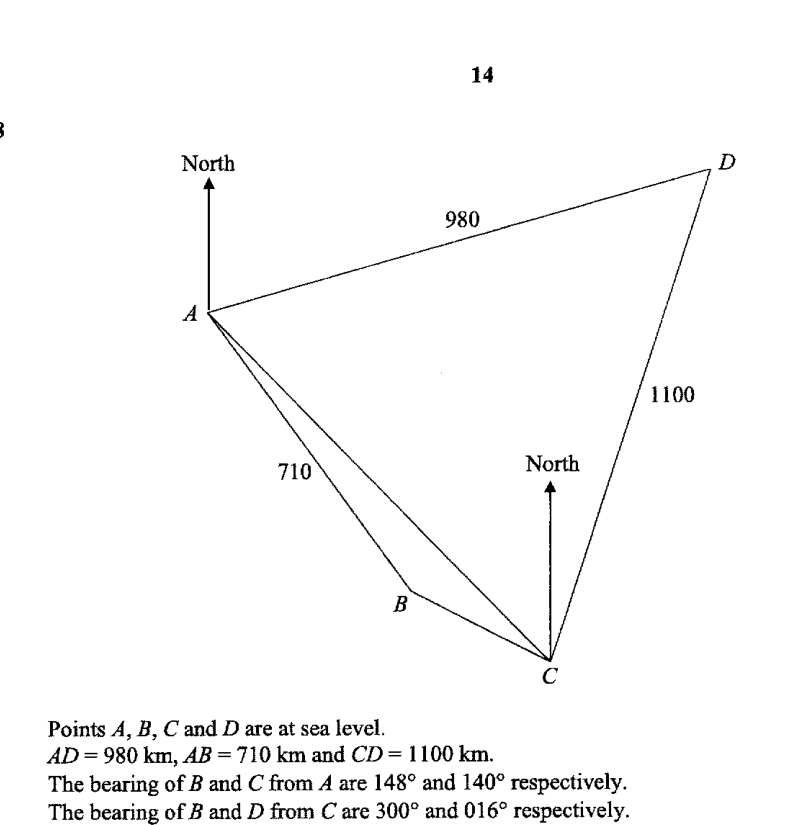
- (a)
Show that angle ACB = 20°.
- (b)
Calculate AC.
Answer ... km
- (c)
Calculate the bearing of A from D.
Answer ... °
- (d)
A ship travels in a straight line from A to C.
Calculate the shortest distance of the ship from B during the journey.Answer ... km
- (e)
A plane is at a height of 900 metres above the sea.
The angle of depression of C from the plane is 18°.
Calculate the horizontal distance, in kilometres, between the plane and C.Answer ... km
It won't just hand you the answer — it asks where you're stuck.How the checker works
Worked solution
8(a)
1. Find the bearing of A from C using the bearing of C from A.
The bearing of C from A is .
Therefore the bearing of A from C is the opposite direction:
2. Find angle ACB from the bearings at C.
At C, the bearing of B from C is and the bearing of A from C is .
Hence
8(b)
1. Find the remaining angle in triangle $ACB$.
From the bearings at ,
From part (a),
Hence
2. Apply the sine rule to find $AC$.
Using the sine rule in triangle ,
Since ,
3. Calculate and round the distance appropriately.
8(c)
1. Find angle $ACD$ using the bearings at $C$.
From part (a), the bearing of from is .
The bearing of from is .
Hence
2. Use the sine rule in triangle $ACD$ to find angle $ADC$.
Using from part (b), and ,
3. Convert the angle at $D$ into the bearing of $A$ from $D$.
The bearing of from is , so the bearing of from is
At , the angle from to is .
Therefore the bearing of from is
To the nearest degree,
8(d)
1. Find the angle between the ship's route $AC$ and the line $AB$.
At , the bearings of and are and respectively.
2. Calculate the perpendicular distance from $B$ to the route $AC$.
The shortest distance from to the straight line is the perpendicular distance.
Let this distance be .
8(e)
1. Convert the height to kilometres and identify the trigonometric ratio.
Height of plane above sea level:
Let the horizontal distance between the plane and be km.
Since the angle of depression is , the angle of elevation from to the plane is also .
2. Solve for the horizontal distance.
AI analysis — may contain mistakes.
Worked this one out on paper? Snap your steps and Gigle's AI math checker will circle the step where it went wrong.
More questions on this topic
- 1The diagram shows the positions of a harbour, H, a lighthouse, L, and two buoys P and Q. HPQ is a straight line. The bea…
- 2In the diagram, PQRS is a vertical rectangular wall of height 2.5 m and length 7.5 m. T is a point on level ground from…
- 3The diagram shows four points P, Q, R and S which lie on level ground in a garden. P is due south of Q. The bearing of S…
- 4In the diagram, ABCDEFGH is a cuboid with dimensions 8 cm by 6 cm by 15 cm. V is the centre of the rectangular base. Sho…
- 5The figure above shows a solid. The cross-section of the solid is a sector of a circle of radius 5 cm and angle 30°. The…