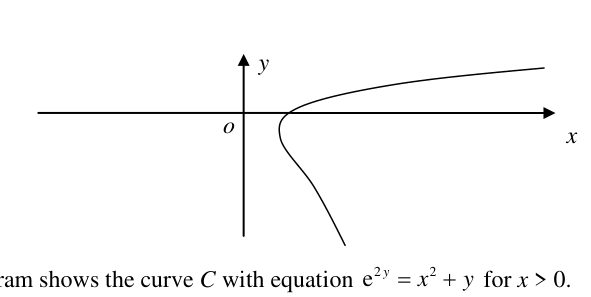
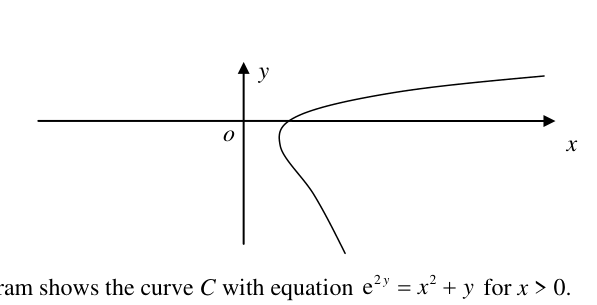
The above diagram shows the curve with equation for .
- (i)
Make a copy of the diagram to include the portion of for .
- (ii)
Show that .
- (iii)
Given that the line is a tangent to , find the possible exact values of .
- (iv)
Find the equation of the tangent to at the point and determine the -coordinate of the point where this tangent meets again.
It won't just hand you the answer — it asks where you're stuck.How the checker works
Worked solution
3(i)
1. Determine the symmetry of the curve from its equation
Substitute for in the curve's equation:
Since the equation remains unchanged when is replaced by , the curve is symmetrical about the -axis.
2. Draw the required portion of the curve
Reflect the provided portion of (where ) across the -axis. Since the original curve passes through , the reflected portion must pass through .
A single continuous curve symmetrical about the -axis. The added portion for is the exact reflection of the given curve for across the -axis, intersecting the -axis at .
3(ii)
1. Differentiate both sides of the equation with respect to $x$.
2. Make $\frac{dy}{dx}$ the subject of the formula.
3(iii)
1. Identify the condition for a vertical tangent.
The line is a vertical line. For this line to be a tangent to the curve, the gradient must be undefined. Therefore, the denominator of must be zero:
2. Solve for the $y$-coordinate of the point of tangency.
Taking the natural logarithm on both sides:
3. Substitute $y$ and $e^{2y}$ back into the original curve equation to find $x^2$.
Substitute and into the equation of , :
4. Solve for $x$ to determine the values of $k$.
Since the vertical tangent corresponds to the line , we have at this point of tangency:
3(iv)
1. Find the gradient of the tangent at $(1, 0)$
Substitute and into the derivative:
2. Find the equation of the tangent
Using the point-gradient form with point and gradient :
3. Set up the equation to find where the tangent meets the curve again
Substitute the tangent equation into the equation of curve :
4. Solve for $x$ using a Graphing Calculator
Plot and on a graphing calculator and locate their points of intersection.
The solutions are (the known point of tangency) and .
The -coordinate where the tangent meets again is (to 3 s.f.).
AI analysis — may contain mistakes.
Worked this one out on paper? Snap your steps and Gigle's AI math checker will circle the step where it went wrong.
More questions on this topic
- 1The curve has equation . Without using a calculator, find the set of values that …
- 25 (a) Solve the following integral. …
- 3A curve has the equation where . Sketch , stating the coordinates of any points o…
- 4A curve with equation is transformed by a reflection in the y-axis, followed by a translation of 1 unit in the…
- 5The curve has equation , where . Find the equation of the tangent at the poin…