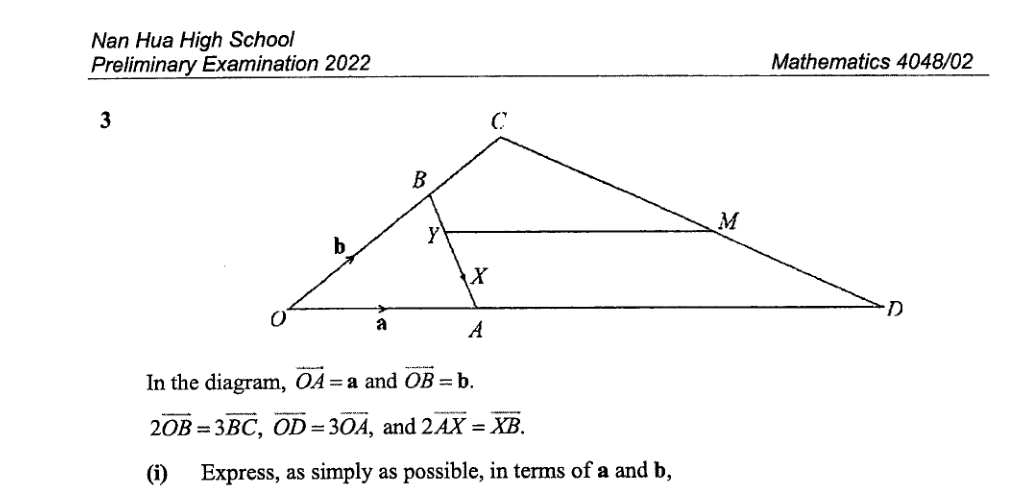
In the diagram, OA→=a\overrightarrow{OA} = a and OB→=b\overrightarrow{OB} = b. 2OB→=3BC→,  OD→=3OA→,  and 2AX→=XB→.2\overrightarrow{OB} = 3\overrightarrow{BC},\; \overrightarrow{OD} = 3\overrightarrow{OA},\; \text{and } 2\overrightarrow{AX} = \overrightarrow{XB}.

  1. (i)

    Express, as simply as possible, in terms of a and b,

    1. ((a))

      BA→\overrightarrow{BA}

    2. ((b))

      OX→\overrightarrow{OX}

    3. ((c))

      CD→\overrightarrow{CD}

  2. (ii)

    It is given that CM : MD is 10 : 9.

    1. ((a))

      Express OM→\overrightarrow{OM}, as simply as possible, in terms of a and b.

    2. ((b))

      Show that O, X and M are collinear.

    3. ((c))

      Given that MY is parallel to OD, express MY→\overrightarrow{MY} in terms of a and b.

  3. (iii)

    Find the ratio of

    1. ((a))

      area of ΔXMY\Delta XMY / area of ΔXOA′\Delta XOA'

    2. ((b))

      area of ΔOBX\Delta OBX / area of ΔOYA′\Delta OYA'

Work through it with AI →

It won't just hand you the answer — it asks where you're stuck.How the checker works

Worked solution

3(i)((a))

1. Express $\overrightarrow{BA}$ as the difference of the position vectors of $A$ and $B$.

BA→=OA→−OB→\overrightarrow{BA}=\overrightarrow{OA}-\overrightarrow{OB}
Given OA→=a\overrightarrow{OA}=a and OB→=b\overrightarrow{OB}=b,
BA→=a−b.\overrightarrow{BA}=a-b.

Answer

BA→=a−b\overrightarrow{BA}=a-b

3(i)((b))

1. Use $2\overrightarrow{AX}=\overrightarrow{XB}$ to determine the fraction of $\overrightarrow{AB}$ represented by $\overrightarrow{AX}$.

Since 2AX→=XB→2\overrightarrow{AX}=\overrightarrow{XB},
AB→=AX→+XB→=AX→+2AX→=3AX→.\overrightarrow{AB}=\overrightarrow{AX}+\overrightarrow{XB}=\overrightarrow{AX}+2\overrightarrow{AX}=3\overrightarrow{AX}.
Hence
AX→=13AB→.\overrightarrow{AX}=\frac{1}{3}\overrightarrow{AB}.

2. Express $\overrightarrow{OX}$ using position vectors of $O$, $A$ and $X$.

From earlier, BA→=a−b\overrightarrow{BA}=a-b, so
AB→=b−a.\overrightarrow{AB}=b-a.
Therefore
OX→=OA→+AX→\overrightarrow{OX}=\overrightarrow{OA}+\overrightarrow{AX}
=a+13(b−a)=a+\frac{1}{3}(b-a)
=2a+b3.=\frac{2a+b}{3}.

Answer

OX→=2a+b3\overrightarrow{OX}=\dfrac{2a+b}{3}

3(i)((c))

1. Express $\overrightarrow{OC}$ using the given relation between $\overrightarrow{OB}$ and $\overrightarrow{BC}$.

Given 2OB→=3BC→2\overrightarrow{OB}=3\overrightarrow{BC},

BC→=23OB→=23b\overrightarrow{BC}=\dfrac{2}{3}\overrightarrow{OB}=\dfrac{2}{3}b.

Hence

OC→=OB→+BC→=b+23b=53b\overrightarrow{OC}=\overrightarrow{OB}+\overrightarrow{BC}=b+\dfrac{2}{3}b=\dfrac{5}{3}b.

2. Find $\overrightarrow{CD}$ as the difference between the position vectors of $D$ and $C$.

Since OD→=3OA→=3a\overrightarrow{OD}=3\overrightarrow{OA}=3a,

CD→=OD→−OC→\overrightarrow{CD}=\overrightarrow{OD}-\overrightarrow{OC}

=3a−53b=3a-\dfrac{5}{3}b.

Answer

CD→=3a−53b\overrightarrow{CD}=3a-\dfrac{5}{3}b

3(ii)((a))

1. Use the ratio $CM:MD=10:9$ to find $\overrightarrow{CM}$ in terms of $\overrightarrow{CD}$, then form $\overrightarrow{OM}$.

Since CM:MD=10:9CM:MD=10:9,

CM→=1019CD→\overrightarrow{CM}=\dfrac{10}{19}\overrightarrow{CD}.

From earlier parts,

OC→=53bandCD→=3a−53b\overrightarrow{OC}=\dfrac{5}{3}b \quad \text{and} \quad \overrightarrow{CD}=3a-\dfrac{5}{3}b.

Hence

OM→=OC→+CM→=53b+1019(3a−53b)=53b+3019a−5057b=3019a+1519b=30a+15b19.\begin{aligned} \overrightarrow{OM} &=\overrightarrow{OC}+\overrightarrow{CM} \\ &=\dfrac{5}{3}b+\dfrac{10}{19}\left(3a-\dfrac{5}{3}b\right) \\ &=\dfrac{5}{3}b+\dfrac{30}{19}a-\dfrac{50}{57}b \\ &=\dfrac{30}{19}a+\dfrac{15}{19}b \\ &=\dfrac{30a+15b}{19}. \end{aligned}
Answer

OM→=30a+15b19\overrightarrow{OM}=\dfrac{30a+15b}{19}

3(ii)((b))

1. Write down the position vectors of $X$ and $M$ from earlier parts.

From earlier parts,
OX→=2a+b3\overrightarrow{OX}=\frac{2a+b}{3}
and
OM→=30a+15b19.\overrightarrow{OM}=\frac{30a+15b}{19}.

2. Show that $\overrightarrow{OM}$ is a scalar multiple of $\overrightarrow{OX}$.

Factorise OM→\overrightarrow{OM}:
OM→=15(2a+b)19.\overrightarrow{OM}=\frac{15(2a+b)}{19}.
Since
OX→=2a+b3,\overrightarrow{OX}=\frac{2a+b}{3},
we have
OM→=1519(2a+b)=1519×3OX→=4519OX→.\overrightarrow{OM}=\frac{15}{19}(2a+b)=\frac{15}{19}\times 3\overrightarrow{OX}=\frac{45}{19}\overrightarrow{OX}.

3. Conclude collinearity using the scalar multiple relationship from the common point $O$.

Since OM→\overrightarrow{OM} is a scalar multiple of OX→\overrightarrow{OX}, the vectors have the same direction and both start from OO.

Therefore, OO, XX and MM are collinear.

Answer

Since OM→=4519OX→\overrightarrow{OM}=\dfrac{45}{19}\overrightarrow{OX}, OO, XX and MM are collinear.

3(ii)((c))

1. Use the condition $MY \parallel OD$ to eliminate the $b$ component of $\overrightarrow{MY}$.

Since YY lies on OCOC, let OY→=kb\overrightarrow{OY}=kb.

From part (ii)(a),
OM→=30a+15b19.\overrightarrow{OM}=\frac{30a+15b}{19}.

Hence
MY→=OY→−OM→\overrightarrow{MY}=\overrightarrow{OY}-\overrightarrow{OM}
=kb−30a+15b19=kb-\frac{30a+15b}{19}
=−3019a+(k−1519)b.=-\frac{30}{19}a+\left(k-\frac{15}{19}\right)b.

Since MY∥ODMY \parallel OD and OD→=3a\overrightarrow{OD}=3a, MY→\overrightarrow{MY} must have no bb component.

So
k−1519=0,k-\frac{15}{19}=0,
k=1519.k=\frac{15}{19}.

Therefore
MY→=−3019a.\overrightarrow{MY}=-\frac{30}{19}a.

Answer

MY→=−3019a\overrightarrow{MY}=-\dfrac{30}{19}a

AI analysis — may contain mistakes.

Worked this one out on paper? Snap your steps and Gigle's AI math checker will circle the step where it went wrong.

More questions on this topic

  1. 1In the diagram, OA→=6a\overrightarrow{OA} = 6a, OB→=6b\overrightarrow{OB} = 6b and 3AN→=AB→3\overrightarrow{AN} = \overrightarrow{AB}.…
  2. 2In the diagram, OABC is a parallelogram and D is the midpoint of BC. BE and OC produced intersect at point F. It is give…
  3. 3ABCD is a parallelogram. A is the point (−6,−2)(-6,-2) and B is the point (−4,−7)(-4,-7). BC→=(8−2)\overrightarrow{BC} = \begin{pmatrix}8\\-2\end{pmatrix}…
  4. 4It is given that PQ→=(−56)\overrightarrow{PQ}=\begin{pmatrix}-5\\6\end{pmatrix} and the position vector of PP is (2−4)\begin{pmatrix}2\\-4\end{pmatrix}…