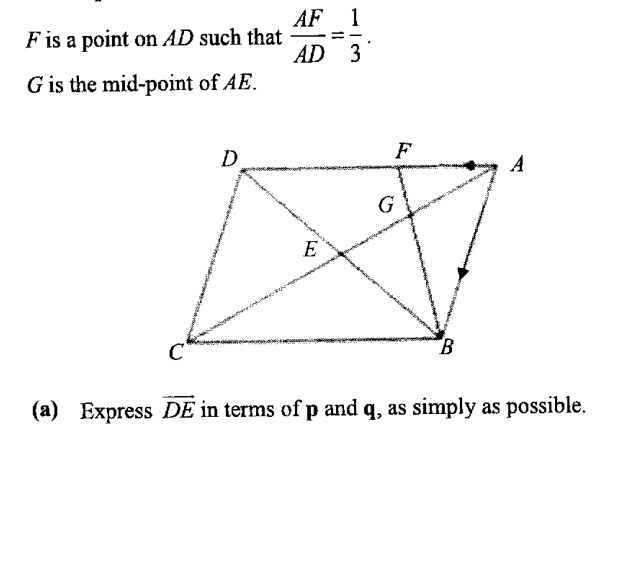
In the diagram ABCD is a parallelogram. The diagonal AC and BD intersect at E. AF→=2p\overrightarrow{AF} = 2p and AB→=6p+4q\overrightarrow{AB} = 6p + 4q. F is a point on AD such that AFAD=13\dfrac{AF}{AD} = \dfrac{1}{3}. G is the mid-point of AE.

  1. ((a))

    Express DE→\overrightarrow{DE} in terms of p and q, as simply as possible.

  2. ((b))

    Express AG→\overrightarrow{AG} in terms of p and q, as simply as possible.

  3. ((c))

    Show that BG→=−3p−3q\overrightarrow{BG} = -3p - 3q.

  4. ((d))

    Explain why B, G and F lie on a straight line.

  5. ((e))

    Calculate the area of triangle ABF


    the area of parellogram ABCD

Work through it with AI →

It won't just hand you the answer — it asks where you're stuck.How the checker works

Worked solution

6((a))

1. Find $\overrightarrow{AD}$ from the given ratio on side $AD$.

Since FF lies on ADAD and AFAD=13\dfrac{AF}{AD}=\dfrac13,
AF→=13AD→.\overrightarrow{AF}=\frac13\overrightarrow{AD}.
Given AF→=2p\overrightarrow{AF}=2p,
AD→=3(2p)=6p.\overrightarrow{AD}=3(2p)=6p.

2. Use the diagonal property of a parallelogram to find $\overrightarrow{DE}$.

In parallelogram ABCDABCD,
DB→=DA→+AB→.\overrightarrow{DB}=\overrightarrow{DA}+\overrightarrow{AB}.
Since DA→=−AD→=−6p\overrightarrow{DA}=-\overrightarrow{AD}=-6p and AB→=6p+4q\overrightarrow{AB}=6p+4q,
DB→=−6p+(6p+4q)=4q.\overrightarrow{DB}=-6p+(6p+4q)=4q.
The diagonals of a parallelogram bisect each other, so EE is the midpoint of DBDB.
Hence
DE→=12DB→=12(4q)=2q.\overrightarrow{DE}=\frac12\overrightarrow{DB}=\frac12(4q)=2q.

Answer

DE→=2q\overrightarrow{DE}=2q

6((b))

1. Find $\overrightarrow{AD}$ using the given ratio $\dfrac{AF}{AD}=\dfrac{1}{3}$.

Since AFAD=13\dfrac{AF}{AD}=\dfrac{1}{3} and AF→=2p\overrightarrow{AF}=2p,
AD→=3AF→=3(2p)=6p.\overrightarrow{AD}=3\overrightarrow{AF}=3(2p)=6p.

2. Find $\overrightarrow{AG}$ using the diagonal $AC$ and the midpoint properties of $E$ and $G$.

In parallelogram ABCDABCD,
AC→=AB→+AD→.\overrightarrow{AC}=\overrightarrow{AB}+\overrightarrow{AD}.
So
AC→=(6p+4q)+6p=12p+4q.\overrightarrow{AC}=(6p+4q)+6p=12p+4q.
Since diagonals of a parallelogram bisect each other, EE is the midpoint of ACAC:
AE→=12AC→=12(12p+4q)=6p+2q.\overrightarrow{AE}=\frac{1}{2}\overrightarrow{AC}=\frac{1}{2}(12p+4q)=6p+2q.
Since GG is the midpoint of AEAE,
AG→=12AE→=12(6p+2q)=3p+q.\overrightarrow{AG}=\frac{1}{2}\overrightarrow{AE}=\frac{1}{2}(6p+2q)=3p+q.

Answer

AG→=3p+q\overrightarrow{AG}=3p+q

6((c))

1. Express $\overrightarrow{BG}$ using a route through point $A$.

BG→=BA→+AG→\overrightarrow{BG}=\overrightarrow{BA}+\overrightarrow{AG}
Since AB→=6p+4q\overrightarrow{AB}=6p+4q,
BA→=−(6p+4q).\overrightarrow{BA}=-(6p+4q).

2. Substitute the known vector $\overrightarrow{AG}$ and simplify.

From part (b),
AG→=3p+q.\overrightarrow{AG}=3p+q.
Therefore,
BG→=−(6p+4q)+(3p+q)\overrightarrow{BG}=-(6p+4q)+(3p+q)
=−6p−4q+3p+q=-6p-4q+3p+q
=−3p−3q.=-3p-3q.

Answer

BG→=−3p−3q\overrightarrow{BG}=-3p-3q shown.

6((d))

1. Find a second vector from $B$ to a point on the suspected straight line.

BF→=BA→+AF→\overrightarrow{BF}=\overrightarrow{BA}+\overrightarrow{AF}

=−(6p+4q)+2p=-(6p+4q)+2p

=−4p−4q=-4p-4q

2. Compare $\overrightarrow{BF}$ with the known vector $\overrightarrow{BG}$ to prove collinearity.

From part (c),

BG→=−3p−3q\overrightarrow{BG}=-3p-3q.

But

BF→=−4p−4q\overrightarrow{BF}=-4p-4q.

So

BG→=34BF→\overrightarrow{BG}=\dfrac{3}{4}\overrightarrow{BF}.

Since BG→\overrightarrow{BG} is a scalar multiple of BF→\overrightarrow{BF}, BGBG is parallel to BFBF. As both vectors start from BB, the points BB, GG and FF lie on a straight line.

Answer

Since BG→=12BF→\overrightarrow{BG}=\dfrac{1}{2}\overrightarrow{BF}, the vectors BG→\overrightarrow{BG} and BF→\overrightarrow{BF} are parallel and share the same starting point BB. Therefore, BB, GG and FF lie on a straight line.

6((e))

1. Relate the height of triangle $ABF$ to the height of parallelogram $ABCD$.

Since AFAD=13\dfrac{AF}{AD}=\dfrac{1}{3} and FF lies on ADAD, the perpendicular distance of FF from ABAB is 13\dfrac{1}{3} of the perpendicular height of parallelogram ABCDABCD from base ABAB.

2. Compare the area of triangle $ABF$ with the area of parallelogram $ABCD$.

Let the base ABAB be bb and the height of parallelogram ABCDABCD be hh.

Area of parallelogram ABCD=bh\text{Area of parallelogram }ABCD=bh

Area of triangle ABF=12×b×h3=bh6\text{Area of triangle }ABF=\frac{1}{2}\times b\times \frac{h}{3}=\frac{bh}{6}

Hence,

area of triangle ABFarea of parallelogram ABCD=bh6bh=16.\frac{\text{area of triangle }ABF}{\text{area of parallelogram }ABCD}=\frac{\frac{bh}{6}}{bh}=\frac{1}{6}.

Answer

area of triangle ABFarea of parallelogram ABCD=16\dfrac{\text{area of triangle }ABF}{\text{area of parallelogram }ABCD}=\dfrac{1}{6}

AI analysis — may contain mistakes.

Worked this one out on paper? Snap your steps and Gigle's AI math checker will circle the step where it went wrong.

More questions on this topic

  1. 1In the diagram, OA→=6a\overrightarrow{OA} = 6a, OB→=6b\overrightarrow{OB} = 6b and 3AN→=AB→3\overrightarrow{AN} = \overrightarrow{AB}.…
  2. 2In the diagram, OABC is a parallelogram and D is the midpoint of BC. BE and OC produced intersect at point F. It is give…
  3. 3ABCD is a parallelogram. A is the point (−6,−2)(-6,-2) and B is the point (−4,−7)(-4,-7). BC→=(8−2)\overrightarrow{BC} = \begin{pmatrix}8\\-2\end{pmatrix}…
  4. 4It is given that PQ→=(−56)\overrightarrow{PQ}=\begin{pmatrix}-5\\6\end{pmatrix} and the position vector of PP is (2−4)\begin{pmatrix}2\\-4\end{pmatrix}…