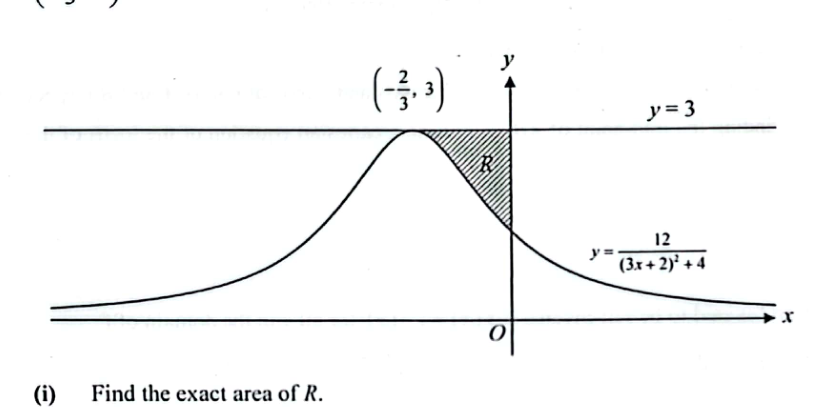
The diagram shows the curve CC with equation y=12(3x+2)2+4y = \frac{12}{(3x+2)^2 + 4} which has a turning point at (−23,3)\left(-\frac{2}{3}, 3\right). The region RR is bounded by CC, the yy-axis and the line y=3y = 3.

  1. (i)

    Find the exact area of RR.

  2. (ii)

    RR is rotated through 2π2\pi radians about the yy-axis. Find the volume of the solid of revolution formed, giving your answer to 4 decimal places.

Work through it with AI →

It won't just hand you the answer — it asks where you're stuck.How the checker works

Worked solution

3(i)

1. Set up the definite integral for the area of region $R$.

The region RR is bounded above by y=3y = 3, below by y=12(3x+2)2+4y = \frac{12}{(3x+2)^2 + 4}, and horizontally between the turning point at x=−23x = -\frac{2}{3} and the yy-axis (x=0x = 0).

Area=∫−2/30(3−12(3x+2)2+4) dx\text{Area} = \int_{-2/3}^{0} \left( 3 - \frac{12}{(3x+2)^2 + 4} \right) \, dx

2. Integrate the expression using the standard integral for $\frac{1}{x^2 + a^2}$.

∫(3−12(3x+2)2+22) dx=3x−12(13)(12)tan⁡−1(3x+22)=3x−2tan⁡−1(3x+22)\begin{aligned} \int \left( 3 - \frac{12}{(3x+2)^2 + 2^2} \right) \, dx &= 3x - 12 \left( \frac{1}{3} \right) \left( \frac{1}{2} \right) \tan^{-1}\left( \frac{3x+2}{2} \right) \\ &= 3x - 2\tan^{-1}\left( \frac{3x+2}{2} \right) \end{aligned}

3. Evaluate the definite integral using the limits to find the exact area.

Area=[3x−2tan⁡−1(3x+22)]−2/30=(3(0)−2tan⁡−1(22))−(3(−23)−2tan⁡−1(02))=(0−2tan⁡−1(1))−(−2−2tan⁡−1(0))=(0−2(π4))−(−2−0)=2−π2\begin{aligned} \text{Area} &= \left[ 3x - 2\tan^{-1}\left( \frac{3x+2}{2} \right) \right]_{-2/3}^{0} \\ &= \left( 3(0) - 2\tan^{-1}\left(\frac{2}{2}\right) \right) - \left( 3\left(-\frac{2}{3}\right) - 2\tan^{-1}\left(\frac{0}{2}\right) \right) \\ &= \left( 0 - 2\tan^{-1}(1) \right) - \left( -2 - 2\tan^{-1}(0) \right) \\ &= \left( 0 - 2\left(\frac{\pi}{4}\right) \right) - (-2 - 0) \\ &= 2 - \frac{\pi}{2} \end{aligned}

Answer

2−π22 - \frac{\pi}{2}

3(ii)

1. Find the limits of integration for $y$ by calculating the $y$-intercept of the curve $C$.

Substitute x=0x = 0 into the equation of CC to find the lower bound of yy:
y=12(3(0)+2)2+4=128=1.5y = \frac{12}{(3(0)+2)^2 + 4} = \frac{12}{8} = 1.5
From the given figure and coordinates of the turning point, the region RR is bounded vertically between y=1.5y = 1.5 and y=3y = 3.

2. Express $x$ in terms of $y$, selecting the correct square root based on the domain of region $R$.

Rearrange the equation of CC to make xx the subject:
y=12(3x+2)2+4y = \frac{12}{(3x+2)^2 + 4}
(3x+2)2+4=12y(3x+2)^2 + 4 = \frac{12}{y}
(3x+2)2=12y−4(3x+2)^2 = \frac{12}{y} - 4
Since region RR is bounded between the turning point x=−23x = -\frac{2}{3} and the yy-axis x=0x = 0, we know that −23≤x≤0-\frac{2}{3} \le x \le 0, which means 3x+2≥03x+2 \ge 0. Therefore, we must take the positive square root:
3x+2=12y−43x+2 = \sqrt{\frac{12}{y} - 4}
x=13(12y−4−2)x = \frac{1}{3}\left( \sqrt{\frac{12}{y} - 4} - 2 \right)

3. Set up the integral for the volume of revolution about the $y$-axis and evaluate it using a graphing calculator.

The volume of revolution about the yy-axis is given by V=π∫y1y2x2 dyV = \pi \int_{y_1}^{y_2} x^2 \, \mathrm{d}y:
V=π∫1.53[13(12y−4−2)]2 dyV = \pi \int_{1.5}^{3} \left[ \frac{1}{3}\left( \sqrt{\frac{12}{y} - 4} - 2 \right) \right]^2 \, \mathrm{d}y
Using a graphing calculator to evaluate this definite integral numerically:
V≈0.5125008…V \approx 0.5125008\dots
V=0.5125 (to 4 d.p.)V = 0.5125 \text{ (to 4 d.p.)}

Answer

0.5125

AI analysis — may contain mistakes.

Worked this one out on paper? Snap your steps and Gigle's AI math checker will circle the step where it went wrong.

More questions on this topic

  1. 1[Cambridge/9709/2010] The diagram shows parts of the curves y=9−x3y = 9 - x^3 and y=8x3y = \frac{8}{x^3} and their points o…
  2. 2Given that the first three terms in the expansion of 1a+bx\dfrac{1}{a+bx} are 12+14x+cx2\dfrac{1}{2}+\dfrac{1}{4}x+cx^2, find the v…
  3. 3The parametric equations of a curve C are x=at,  y=at3x = at,\; y = at^{3}, where aa is a positive constant. The point P on the c…
  4. 4A curve with equation y=f(x)y=f(x) is transformed by a reflection in the y-axis, followed by a translation of 1 unit in the…
  5. 5The curve CC has equation y=x−2kx2+x−2y = \frac{x - 2}{kx^2 + x - 2}, where k>1k > 1. Find the equation of the tangent at the poin…