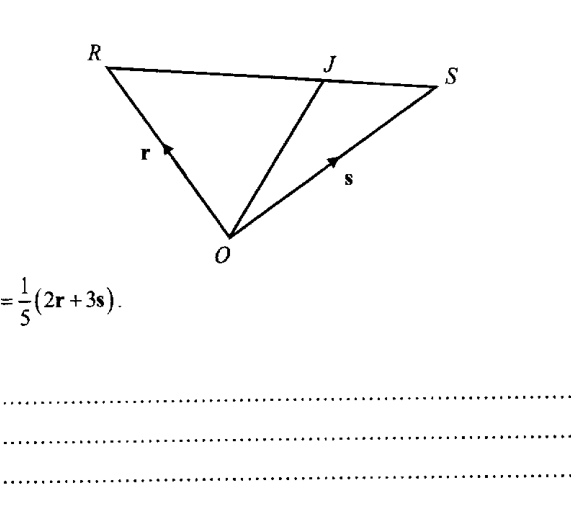
ORS is a triangle. J is a point on RS such that RJ:JS=3:2RJ:JS = 3:2. OR→=r\overrightarrow{OR} = r and OS→=s\overrightarrow{OS} = s.

  1. (a)

    Show that OJ→=15(2r+3s).\overrightarrow{OJ} = \frac{1}{5}(2r + 3s).

  2. (b)

    X is a point such that $\overrightarrow{RX} = \frac{1}{5}(r + 9s).

    Explain why O, J and X lie on a straight line.

Work through it with AI →

It won't just hand you the answer — it asks where you're stuck.How the checker works

Worked solution

25(a)

1. Express the vector from $R$ to $S$ and identify the fraction of $RS$ from $R$ to $J$.

Since RJ:JS=3:2RJ:JS=3:2, the whole line segment RSRS is split into 55 equal parts, and
overrightarrowRJ=frac35overrightarrowRS.\\overrightarrow{RJ}=\\frac{3}{5}\\overrightarrow{RS}.
Also,
overrightarrowRS=overrightarrowOS−overrightarrowOR=s−r.\\overrightarrow{RS}=\\overrightarrow{OS}-\\overrightarrow{OR}=s-r.

2. Find $\\overrightarrow{OJ}$ by following the path $O \to R \to J$ and simplify.

overrightarrowOJ=overrightarrowOR+overrightarrowRJ\\overrightarrow{OJ}=\\overrightarrow{OR}+\\overrightarrow{RJ}
=r+frac35(s−r)=r+\\frac{3}{5}(s-r)
=r+frac35s−frac35r=r+\\frac{3}{5}s-\\frac{3}{5}r
=frac25r+frac35s=\\frac{2}{5}r+\\frac{3}{5}s
=frac15(2r+3s).=\\frac{1}{5}(2r+3s).

Answer

Hence, overrightarrowOJ=dfrac15(2r+3s)\\overrightarrow{OJ}=\\dfrac{1}{5}(2r+3s).

25(b)

1. Find the position vector of $X$ from $O$.

OX→=OR→+RX→\overrightarrow{OX}=\overrightarrow{OR}+\overrightarrow{RX}
=r+15(r+9s)=r+\frac{1}{5}(r+9s)
=15(6r+9s)=\frac{1}{5}(6r+9s)

2. Compare $\overrightarrow{OX}$ with the given result for $\overrightarrow{OJ}$ and conclude collinearity.

From part (a),
OJ→=15(2r+3s).\overrightarrow{OJ}=\frac{1}{5}(2r+3s).
Now,
OX→=15(6r+9s)=35(2r+3s)=3OJ→.\overrightarrow{OX}=\frac{1}{5}(6r+9s)=\frac{3}{5}(2r+3s)=3\overrightarrow{OJ}.
Hence OX→\overrightarrow{OX} is a scalar multiple of OJ→\overrightarrow{OJ}.

Answer

Since OX→=3OJ→\overrightarrow{OX}=3\overrightarrow{OJ}, the vectors OX→\overrightarrow{OX} and OJ→\overrightarrow{OJ} are parallel and have the same initial point OO. Therefore, OO, JJ and XX lie on a straight line.

AI analysis — may contain mistakes.

Worked this one out on paper? Snap your steps and Gigle's AI math checker will circle the step where it went wrong.

More questions on this topic

  1. 1In the diagram, OA→=6a\overrightarrow{OA} = 6a, OB→=6b\overrightarrow{OB} = 6b and 3AN→=AB→3\overrightarrow{AN} = \overrightarrow{AB}.…
  2. 2In the diagram, OABC is a parallelogram and D is the midpoint of BC. BE and OC produced intersect at point F. It is give…
  3. 3ABCD is a parallelogram. A is the point (−6,−2)(-6,-2) and B is the point (−4,−7)(-4,-7). BC→=(8−2)\overrightarrow{BC} = \begin{pmatrix}8\\-2\end{pmatrix}…
  4. 4It is given that PQ→=(−56)\overrightarrow{PQ}=\begin{pmatrix}-5\\6\end{pmatrix} and the position vector of PP is (2−4)\begin{pmatrix}2\\-4\end{pmatrix}…
  5. 5In the diagram, OA‾=12 AP‾\overline{OA}=\tfrac{1}{2}\,\overline{AP} and OB‾=14 OQ‾\overline{OB}=\tfrac{1}{4}\,\overline{OQ}. M is the mi…