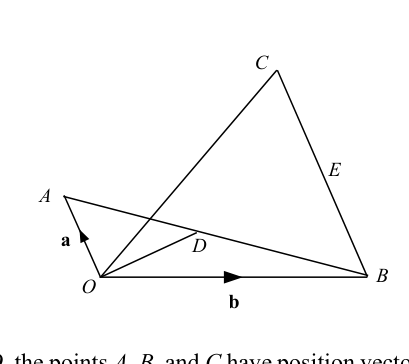
Relative to the origin OO, the points AA, BB, and CC have position vectors a\mathbf{a}, b\mathbf{b} and 3a+b3\mathbf{a}+\mathbf{b} respectively. The point DD lies on ABAB such that AD=k ABAD = k\,AB, where 0<k<10 < k < 1.

  1. (a)

    Find a vector equation of the line ODOD in terms of kk, a\mathbf{a} and b\mathbf{b}.

  2. (b)

    The point EE is the midpoint of BCBC. Find the value of kk if OO, DD and EE are collinear.

  3. (c)

    It is given that ∣a∣=1|\mathbf{a}| = 1, ∣b∣=2|\mathbf{b}| = 2 and ∣3a−2b∣=31|3\mathbf{a} - 2\mathbf{b}| = \sqrt{31}. By considering the scalar product (3a−2b)⋅(3a−2b)(3\mathbf{a}-2\mathbf{b})\cdot(3\mathbf{a}-2\mathbf{b}), find the numerical value of a⋅b\mathbf{a}\cdot\mathbf{b} and hence determine the angle between a\mathbf{a} and b\mathbf{b}.

  4. (d)

    Give a geometrical interpretation of ∣a⋅b∣|\mathbf{a}\cdot\mathbf{b}|.

Work through it with AI →

It won't just hand you the answer — it asks where you're stuck.How the checker works

Worked solution

4(a)

1. Find the position vector of $D$ using vector addition or the ratio theorem.

AD⃗=kAB⃗=k(b−a)\vec{AD} = k\vec{AB} = k(\mathbf{b} - \mathbf{a})
OD⃗=OA⃗+AD⃗=a+k(b−a)\vec{OD} = \vec{OA} + \vec{AD} = \mathbf{a} + k(\mathbf{b} - \mathbf{a})
OD⃗=(1−k)a+kb\vec{OD} = (1-k)\mathbf{a} + k\mathbf{b}

2. Formulate the vector equation of the line $OD$.

The line passes through the origin OO and has direction vector OD⃗\vec{OD}.
The vector equation is given by r=λOD⃗\mathbf{r} = \lambda \vec{OD}, where λ\lambda is a scalar parameter.
r=λ((1−k)a+kb)\mathbf{r} = \lambda ((1-k)\mathbf{a} + k\mathbf{b})

Answer

r=λ((1−k)a+kb)\mathbf{r} = \lambda ((1-k)\mathbf{a} + k\mathbf{b}), where λ∈R\lambda \in \mathbb{R}

4(b)

1. Find the position vector of $D$ (as required from the dependent part (a)).

OD⃗=OA⃗+AD⃗\vec{OD} = \vec{OA} + \vec{AD}
Since AD=k ABAD = k\,AB,
OD⃗=a+k(OB⃗−OA⃗)\vec{OD} = \mathbf{a} + k(\vec{OB} - \vec{OA})
OD⃗=a+k(b−a)=(1−k)a+kb\vec{OD} = \mathbf{a} + k(\mathbf{b} - \mathbf{a}) = (1-k)\mathbf{a} + k\mathbf{b}

2. Find the position vector of the midpoint $E$.

Since EE is the midpoint of BCBC,
OE⃗=OB⃗+OC⃗2\vec{OE} = \frac{\vec{OB} + \vec{OC}}{2}
OE⃗=b+(3a+b)2=3a+2b2\vec{OE} = \frac{\mathbf{b} + (3\mathbf{a} + \mathbf{b})}{2} = \frac{3\mathbf{a} + 2\mathbf{b}}{2}
OE⃗=32a+b\vec{OE} = \frac{3}{2}\mathbf{a} + \mathbf{b}

3. Set up an equation using the condition that $O$, $D$, and $E$ are collinear.

Since OO, DD, and EE are collinear, OD⃗=μOE⃗\vec{OD} = \mu \vec{OE} for some scalar μ\mu.
(1−k)a+kb=μ(32a+b)(1-k)\mathbf{a} + k\mathbf{b} = \mu \left( \frac{3}{2}\mathbf{a} + \mathbf{b} \right)
(1−k)a+kb=32μa+μb(1-k)\mathbf{a} + k\mathbf{b} = \frac{3}{2}\mu\mathbf{a} + \mu\mathbf{b}

4. Compare the coefficients of $\mathbf{a}$ and $\mathbf{b}$ to solve for $k$.

Comparing the coefficients of b\mathbf{b}:
k=μk = \mu

Comparing the coefficients of a\mathbf{a}:
1−k=32μ1 - k = \frac{3}{2}\mu

Substitute μ=k\mu = k into the second equation:
1−k=32k1 - k = \frac{3}{2}k
1=52k1 = \frac{5}{2}k
k=25k = \frac{2}{5}

Answer

k=25k = \frac{2}{5}

4(c)

1. Expand the scalar product expression.

(3a−2b)⋅(3a−2b)=9(a⋅a)−6(a⋅b)−6(b⋅a)+4(b⋅b)(3\mathbf{a}-2\mathbf{b})\cdot(3\mathbf{a}-2\mathbf{b}) = 9(\mathbf{a}\cdot\mathbf{a}) - 6(\mathbf{a}\cdot\mathbf{b}) - 6(\mathbf{b}\cdot\mathbf{a}) + 4(\mathbf{b}\cdot\mathbf{b})\n=9∣a∣2−12a⋅b+4∣b∣2= 9|\mathbf{a}|^2 - 12\mathbf{a}\cdot\mathbf{b} + 4|\mathbf{b}|^2

2. Substitute the known magnitudes to find the numerical value of $\mathbf{a}\cdot\mathbf{b}$.

Since (3a−2b)⋅(3a−2b)=∣3a−2b∣2(3\mathbf{a}-2\mathbf{b})\cdot(3\mathbf{a}-2\mathbf{b}) = |3\mathbf{a}-2\mathbf{b}|^2, we substitute the given magnitudes:\n(31)2=9(1)2−12a⋅b+4(2)2(\sqrt{31})^2 = 9(1)^2 - 12\mathbf{a}\cdot\mathbf{b} + 4(2)^2\n31=9−12a⋅b+1631 = 9 - 12\mathbf{a}\cdot\mathbf{b} + 16\n31=25−12a⋅b31 = 25 - 12\mathbf{a}\cdot\mathbf{b}\n12a⋅b=−612\mathbf{a}\cdot\mathbf{b} = -6\na⋅b=−0.5\mathbf{a}\cdot\mathbf{b} = -0.5

3. Calculate the angle between $\mathbf{a}$ and $\mathbf{b}$.

Let the angle between the vectors be θ\theta.\ncos⁡θ=a⋅b∣a∣∣b∣\cos\theta = \frac{\mathbf{a}\cdot\mathbf{b}}{|\mathbf{a}||\mathbf{b}|}\ncos⁡θ=−0.5(1)(2)=−0.25\cos\theta = \frac{-0.5}{(1)(2)} = -0.25\nθ=cos⁡−1(−0.25)≈104.4775∘\theta = \cos^{-1}(-0.25) \approx 104.4775^\circ\nθ≈104.5∘ (to 1 d.p.)\theta \approx 104.5^\circ \text{ (to 1 d.p.)}

Answer

a⋅b=−0.5\mathbf{a}\cdot\mathbf{b} = -0.5, angle =104.5∘= 104.5^\circ

4(d)

1. Identify the geometrical meaning using the unit magnitude of vector a

From part (c), we are given that ∣a∣=1|\mathbf{a}| = 1. This means that a\mathbf{a} is a unit vector (i.e. a=a^\mathbf{a} = \hat{\mathbf{a}}).
The expression ∣a⋅b∣|\mathbf{a} \cdot \mathbf{b}| is equivalent to ∣b⋅a^∣|\mathbf{b} \cdot \hat{\mathbf{a}}|, which by definition is the length of the projection of vector b\mathbf{b} onto the direction of vector a\mathbf{a}.

Answer

It represents the length of projection of vector b\mathbf{b} (or OBOB) onto vector a\mathbf{a} (or the line OAOA).

AI analysis — may contain mistakes.

Worked this one out on paper? Snap your steps and Gigle's AI math checker will circle the step where it went wrong.

More questions on this topic

  1. 1The lines l1l_1 and l2l_2 have equations r=(4110)+λ(1−1−6),λ∈R\mathbf{r} = \begin{pmatrix} 4 \\ 1 \\ 10 \end{pmatrix} + \lambda \begin{pmatrix} 1 \\ -1 \\ -6 \end{pmatrix}, \lambda \in \mathbb{R}…
  2. 2A drilling company plans to install a straight pipeline ABAB through a mountain. Points (x,y,z)(x, y, z) are defined relative…
  3. 3A plane Π1\Pi_1 has equation x+y+z=3x + y + z = 3. A line passes through the points PP and QQ with position vectors i+j+2k\mathbf{i} + \mathbf{j} + 2\mathbf{k}…
  4. 4The planes Π1\Pi_1 and Π2\Pi_2 have vector equations r=λ1(i+j−k)+μ1(2i−j+k)andr=λ2(i+2j+k)+μ2(3i+j−k)\mathbf{r} = \lambda_1(\mathbf{i} + \mathbf{j} - \mathbf{k}) + \mu_1(2\mathbf{i} - \mathbf{j} + \mathbf{k}) \quad \text{and} \quad \mathbf{r} = \lambda_2(\mathbf{i} + 2\mathbf{j} + \mathbf{k}) + \mu_2(3\mathbf{i} + \mathbf{j} - \mathbf{k})…
  5. 5A home interior designer is looking to design a pull-down wardrobe lift. To test his concept, the designer built a small…