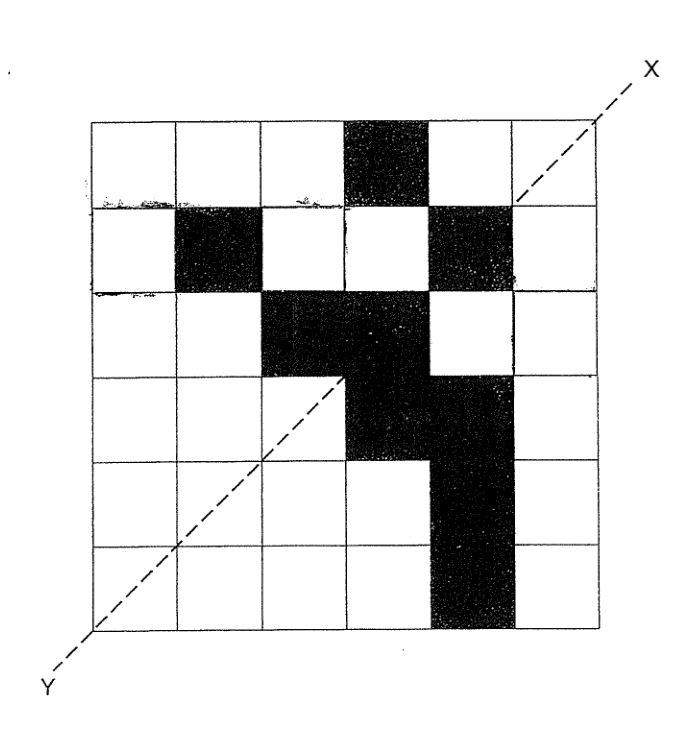
The figure below is made up of identical squares. Shade three more squares to form a symmetric figure with XY as the line of symmetry.
It won't just hand you the answer — it asks where you're stuck.How the checker works
Worked solution
20
1. Identify the line of symmetry and the rule for reflection.
The line of symmetry is the diagonal from the bottom-left to the top-right. In a coordinate system where represents column and row , the line of symmetry is . The reflection of any square across this diagonal is .
2. Find the reflections of the currently shaded squares.
We check the reflection of each shaded square:
- (Row 4, Col 6) - currently unshaded
- - already shaded
- - on the line of symmetry
- - already shaded
- - on the line of symmetry
- (Row 5, Col 3) - currently unshaded
- (Row 5, Col 1) - currently unshaded
3. Identify the three squares to be shaded.
The three unshaded squares that need to be shaded to complete the symmetry are , , and .
Shade the squares at: Row 5 Column 1, Row 5 Column 3, and Row 4 Column 6.
AI analysis — may contain mistakes.
Worked this one out on paper? Snap your steps and Gigle's AI math checker will circle the step where it went wrong.
More questions on this topic
- 1The figure below is made up of 2 squares, ABCD and DEFG. X is a point on GD and Y is a point on DE. BC = 7 cm, FE = 6 cm…
- 2The net drawn for the solid shown below is incorrect. Name the solid. Ans: (a)___ Shade a triangular face on the net tha…
- 3In the figure below, ABCD is a trapezium and AD = BC. Each of the statements is either true, false or not possible to te…
- 4In the figure, WXYZ is a trapezium and AXYB is a rhombus. XBC and XAZ are straight lines. WX // ZY, BC = BY, …
- 5The figure below shows 12 identical squares. What is the least number of such squares that must be added to the figure s…