Curve C is a circle with radius 2 and center at the origin with equation x2+y2=4x^2 + y^2 = 4. Line L has the equation 3y=x+2\sqrt{3}y = x + 2. The diagram below shows the shaded region A which is enclosed between C and L.
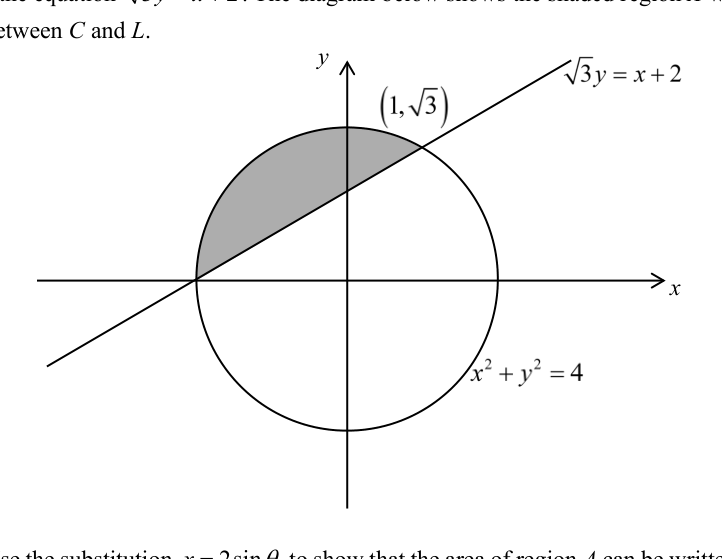
  1. (a)

    Use the substitution x=2sin⁡θx = 2\sin\theta to show that the area of region A can be written in the expression ∫ba4cos⁡2θ dθ−c\displaystyle\int_b^a 4\cos^2\theta\,d\theta - c, where aa, bb and cc are exact constants to be determined. Hence evaluate this area exactly.

  2. (b)

    The region B is bounded by the curve C, the line L and the line x=2x = 2. Find the volume generated when region B is rotated through 2π2\pi radians about the y-axis. Give your answer to two decimal places.

Work through it with AI →

It won't just hand you the answer — it asks where you're stuck.How the checker works

Worked solution

7(a)

1. Set up the area integral as the difference between the area under the curve and the area under the line.

From the given intersection points (−2,0)(-2,0) and (1,3)(1,\sqrt{3}), the limits of integration are x=−2x = -2 and x=1x = 1.
Area=∫−21(4−x2−x+23) dx\text{Area} = \int_{-2}^{1} \left( \sqrt{4-x^2} - \frac{x+2}{\sqrt{3}} \right) \, dx
=∫−214−x2 dx−∫−21x+23 dx= \int_{-2}^{1} \sqrt{4-x^2} \, dx - \int_{-2}^{1} \frac{x+2}{\sqrt{3}} \, dx

2. Evaluate the integral for the line to find the exact constant $c$.

c=∫−21x+23 dx=13[(x+2)22]−21c = \int_{-2}^{1} \frac{x+2}{\sqrt{3}} \, dx = \frac{1}{\sqrt{3}} \left[ \frac{(x+2)^2}{2} \right]_{-2}^{1}
=13(322−0)=923=332= \frac{1}{\sqrt{3}} \left( \frac{3^2}{2} - 0 \right) = \frac{9}{2\sqrt{3}} = \frac{3\sqrt{3}}{2}

3. Apply the substitution $x = 2\sin\theta$ to the integral for the curve to find $a$ and $b$.

x=2sin⁡θ  ⟹  dx=2cos⁡θ dθx = 2\sin\theta \implies dx = 2\cos\theta \, d\theta
Change of limits:
When x=−2x = -2, 2sin⁡θ=−2  ⟹  sin⁡θ=−1  ⟹  θ=−π22\sin\theta = -2 \implies \sin\theta = -1 \implies \theta = -\frac{\pi}{2}
When x=1x = 1, 2sin⁡θ=1  ⟹  sin⁡θ=12  ⟹  θ=π62\sin\theta = 1 \implies \sin\theta = \frac{1}{2} \implies \theta = \frac{\pi}{6}
Substitute into the integral:
∫−214−x2 dx=∫−π/2π/64−4sin⁡2θ (2cos⁡θ) dθ\int_{-2}^{1} \sqrt{4-x^2} \, dx = \int_{-\pi/2}^{\pi/6} \sqrt{4 - 4\sin^2\theta} \, (2\cos\theta) \, d\theta
=∫−π/2π/6(2cos⁡θ)(2cos⁡θ) dθ=∫−π/2π/64cos⁡2θ dθ= \int_{-\pi/2}^{\pi/6} (2\cos\theta)(2\cos\theta) \, d\theta = \int_{-\pi/2}^{\pi/6} 4\cos^2\theta \, d\theta
Comparing this with ∫ba4cos⁡2θ dθ−c\displaystyle\int_b^a 4\cos^2\theta \, d\theta - c, we have exact constants a=π6a = \frac{\pi}{6} and b=−π2b = -\frac{\pi}{2}.

4. Integrate $4\cos^2\theta$ using the double angle identity.

Using the identity cos⁡2θ=2cos⁡2θ−1  ⟹  4cos⁡2θ=2(1+cos⁡2θ)\cos 2\theta = 2\cos^2\theta - 1 \implies 4\cos^2\theta = 2(1 + \cos 2\theta):
∫−π/2π/64cos⁡2θ dθ=∫−π/2π/6(2+2cos⁡2θ) dθ\int_{-\pi/2}^{\pi/6} 4\cos^2\theta \, d\theta = \int_{-\pi/2}^{\pi/6} (2 + 2\cos 2\theta) \, d\theta
=[2θ+sin⁡2θ]−π/2π/6= \left[ 2\theta + \sin 2\theta \right]_{-{\pi}/{2}}^{{\pi}/{6}}

5. Evaluate the definite integral and subtract $c$ to find the exact area.

=(2(π6)+sin⁡(π3))−(2(−π2)+sin⁡(−π))= \left( 2\left(\frac{\pi}{6}\right) + \sin\left(\frac{\pi}{3}\right) \right) - \left( 2\left(-\frac{\pi}{2}\right) + \sin(-\pi) \right)
=(π3+32)−(−π+0)=4π3+32= \left( \frac{\pi}{3} + \frac{\sqrt{3}}{2} \right) - (-\pi + 0) = \frac{4\pi}{3} + \frac{\sqrt{3}}{2}
Finally, subtract cc to find the exact area:
Area=∫ba4cos⁡2θ dθ−c=(4π3+32)−332\text{Area} = \int_{b}^{a} 4\cos^2\theta \, d\theta - c = \left( \frac{4\pi}{3} + \frac{\sqrt{3}}{2} \right) - \frac{3\sqrt{3}}{2}
=4π3−3= \frac{4\pi}{3} - \sqrt{3}

Answer

a=π6a = \frac{\pi}{6}, b=−π2b = -\frac{\pi}{2}, c=332c = \frac{3\sqrt{3}}{2}
Area =4π3−3= \frac{4\pi}{3} - \sqrt{3}

7(b)

1. Express the boundary equations in terms of $y$ and determine the limits of integration along the $y$-axis.

x2+y2=4  ⟹  x=4−y2(since x≥0 in Region B)x^2 + y^2 = 4 \implies x = \sqrt{4-y^2} \quad \text{(since $x \ge 0$ in Region B)}
3y=x+2  ⟹  x=3y−2\sqrt{3}y = x + 2 \implies x = \sqrt{3}y - 2
The outer boundary is the vertical line x=2x = 2. The inner boundary is defined by the curve CC from y=0y = 0 to y=3y = \sqrt{3}, and the line LL from y=3y = \sqrt{3} to y=43y = \frac{4}{\sqrt{3}}.

2. Set up the volume integrals using the washer method for the two separate sections of Region B.

V=V1+V2V = V_1 + V_2
V1=π∫03[22−(4−y2)2] dyV_1 = \pi \int_{0}^{\sqrt{3}} \left[ 2^2 - (\sqrt{4-y^2})^2 \right] \,\mathrm{d}y
V2=π∫34/3[22−(3y−2)2] dyV_2 = \pi \int_{\sqrt{3}}^{4/\sqrt{3}} \left[ 2^2 - (\sqrt{3}y - 2)^2 \right] \,\mathrm{d}y

3. Evaluate the definite integral for the first volume segment ($V_1$).

V1=π∫03(4−(4−y2)) dyV_1 = \pi \int_{0}^{\sqrt{3}} (4 - (4 - y^2)) \,\mathrm{d}y
V1=π∫03y2 dy=π[y33]03V_1 = \pi \int_{0}^{\sqrt{3}} y^2 \,\mathrm{d}y = \pi \left[ \frac{y^3}{3} \right]_0^{\sqrt{3}}
V1=π((3)33−0)=π3V_1 = \pi \left( \frac{(\sqrt{3})^3}{3} - 0 \right) = \pi \sqrt{3}

4. Evaluate the definite integral for the second volume segment ($V_2$).

V2=π∫34/3(4−(3y2−43y+4)) dyV_2 = \pi \int_{\sqrt{3}}^{4/\sqrt{3}} \left( 4 - (3y^2 - 4\sqrt{3}y + 4) \right) \,\mathrm{d}y
V2=π∫34/3(43y−3y2) dyV_2 = \pi \int_{\sqrt{3}}^{4/\sqrt{3}} (4\sqrt{3}y - 3y^2) \,\mathrm{d}y
V2=π[23y2−y3]34/3V_2 = \pi \left[ 2\sqrt{3}y^2 - y^3 \right]_{\sqrt{3}}^{4/\sqrt{3}}
V2=π((23(163)−6433)−(23(3)−33))V_2 = \pi \left( \left( 2\sqrt{3}\left(\frac{16}{3}\right) - \frac{64}{3\sqrt{3}} \right) - \left( 2\sqrt{3}(3) - 3\sqrt{3} \right) \right)
V2=π((3233−6439)−33)V_2 = \pi \left( \left( \frac{32\sqrt{3}}{3} - \frac{64\sqrt{3}}{9} \right) - 3\sqrt{3} \right)
V2=π(963−6439−2739)=53π9V_2 = \pi \left( \frac{96\sqrt{3} - 64\sqrt{3}}{9} - \frac{27\sqrt{3}}{9} \right) = \frac{5\sqrt{3}\pi}{9}

5. Sum the volumes and convert to a decimal value rounded to two decimal places.

V=π3+53π9=143π9V = \pi\sqrt{3} + \frac{5\sqrt{3}\pi}{9} = \frac{14\sqrt{3}\pi}{9}
V≈8.46439⋯≈8.46V \approx 8.46439 \dots \approx 8.46

Answer

8.46

AI analysis — may contain mistakes.

Worked this one out on paper? Snap your steps and Gigle's AI math checker will circle the step where it went wrong.

More questions on this topic

  1. 1[Cambridge/9709/2010] The diagram shows parts of the curves y=9−x3y = 9 - x^3 and y=8x3y = \frac{8}{x^3} and their points o…
  2. 2Given that the first three terms in the expansion of 1a+bx\dfrac{1}{a+bx} are 12+14x+cx2\dfrac{1}{2}+\dfrac{1}{4}x+cx^2, find the v…
  3. 3The parametric equations of a curve C are x=at,  y=at3x = at,\; y = at^{3}, where aa is a positive constant. The point P on the c…
  4. 4A curve with equation y=f(x)y=f(x) is transformed by a reflection in the y-axis, followed by a translation of 1 unit in the…
  5. 5The curve CC has equation y=x−2kx2+x−2y = \frac{x - 2}{kx^2 + x - 2}, where k>1k > 1. Find the equation of the tangent at the poin…