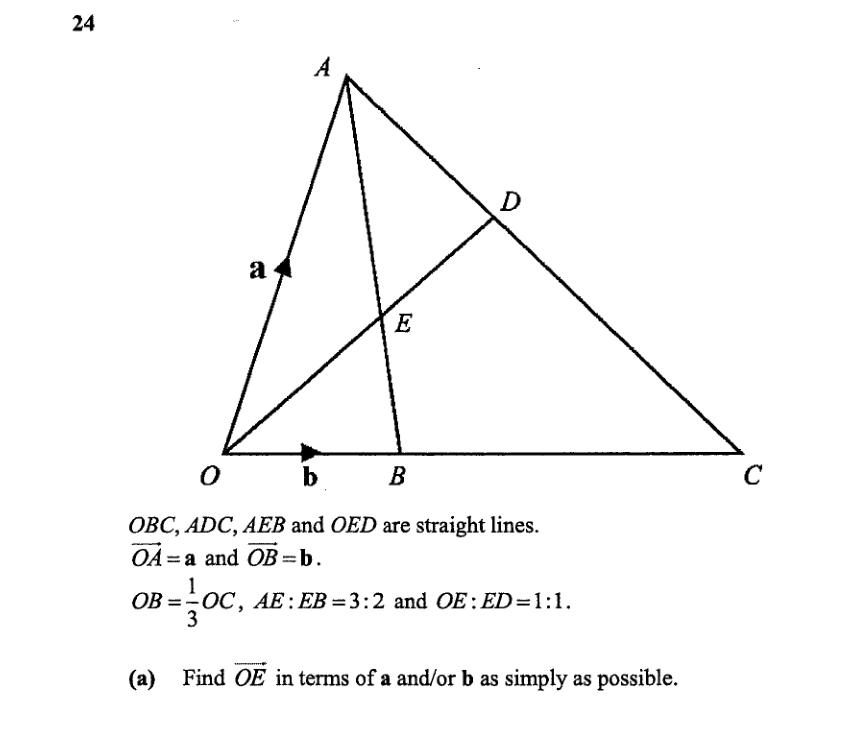
OBC, ADC, AEB and OED are straight lines.
OA→=a\overrightarrow{OA}=a and OB→=b\overrightarrow{OB}=b.
OB=13OCOB=\dfrac{1}{3}OC, AE:EB=3:2AE:EB=3:2 and OE:ED=1:1OE:ED=1:1.

  1. (a)

    Find OE→\overrightarrow{OE} in terms of aa and/or bb as simply as possible.

    Answer: OE→=\overrightarrow{OE}=\rule{6cm}{0.4pt}

  2. (b)

    Find the value of area of ΔOBE\Delta OBE / area of BEDCBEDC.

    Answer ...

Work through it with AI →

It won't just hand you the answer — it asks where you're stuck.How the checker works

Worked solution

24(a)

1. Express $\overrightarrow{AB}$ in terms of $a$ and $b$.

AB→=OB→−OA→=b−a\overrightarrow{AB}=\overrightarrow{OB}-\overrightarrow{OA}=b-a

2. Use the ratio $AE:EB=3:2$ to find $\overrightarrow{OE}$.

Since AE:EB=3:2AE:EB=3:2, AE→=35AB→=35(b−a).\overrightarrow{AE}=\frac{3}{5}\overrightarrow{AB}=\frac{3}{5}(b-a). Hence OE→=OA→+AE→=a+35(b−a)=25a+35b.\overrightarrow{OE}=\overrightarrow{OA}+\overrightarrow{AE}=a+\frac{3}{5}(b-a)=\frac{2}{5}a+\frac{3}{5}b.

Answer

OE→=2a+3b5\overrightarrow{OE}=\dfrac{2a+3b}{5}

24(b)

1. Compare the area of $\triangle ODC$ with the area of $\triangle OBE$.

Since OB=13OCOB=\dfrac13OC, we have OC=3OBOC=3OB.

Since OE:ED=1:1OE:ED=1:1, EE is the midpoint of ODOD, so OD=2OEOD=2OE.

Taking bases on the same straight line OBCOBC and corresponding heights from EE and DD,
area of △ODC=3×2×area of △OBE=6×area of △OBE.\text{area of }\triangle ODC=3\times 2\times \text{area of }\triangle OBE=6\times \text{area of }\triangle OBE.

2. Find the required ratio by subtracting $\triangle OBE$ from $\triangle ODC$.

The quadrilateral BEDCBEDC is the part of △ODC\triangle ODC outside △OBE\triangle OBE.

Let area of △OBE=x\text{area of }\triangle OBE=x.

Then
area of BEDC=6x−x=5x.\text{area of }BEDC=6x-x=5x.

Therefore
area of △OBEarea of BEDC=x5x=15.\frac{\text{area of }\triangle OBE}{\text{area of }BEDC}=\frac{x}{5x}=\frac15.

Answer

area of △OBEarea of BEDC=15\dfrac{\text{area of }\triangle OBE}{\text{area of }BEDC}=\dfrac{1}{5}

AI analysis — may contain mistakes.

Worked this one out on paper? Snap your steps and Gigle's AI math checker will circle the step where it went wrong.

More questions on this topic

  1. 1In the diagram, OA→=6a\overrightarrow{OA} = 6a, OB→=6b\overrightarrow{OB} = 6b and 3AN→=AB→3\overrightarrow{AN} = \overrightarrow{AB}.…
  2. 2In the diagram, OABC is a parallelogram and D is the midpoint of BC. BE and OC produced intersect at point F. It is give…
  3. 3ABCD is a parallelogram. A is the point (−6,−2)(-6,-2) and B is the point (−4,−7)(-4,-7). BC→=(8−2)\overrightarrow{BC} = \begin{pmatrix}8\\-2\end{pmatrix}…
  4. 4It is given that PQ→=(−56)\overrightarrow{PQ}=\begin{pmatrix}-5\\6\end{pmatrix} and the position vector of PP is (2−4)\begin{pmatrix}2\\-4\end{pmatrix}…