ABC is a triangle. D is the point on BC such that 3BD = 2DC.
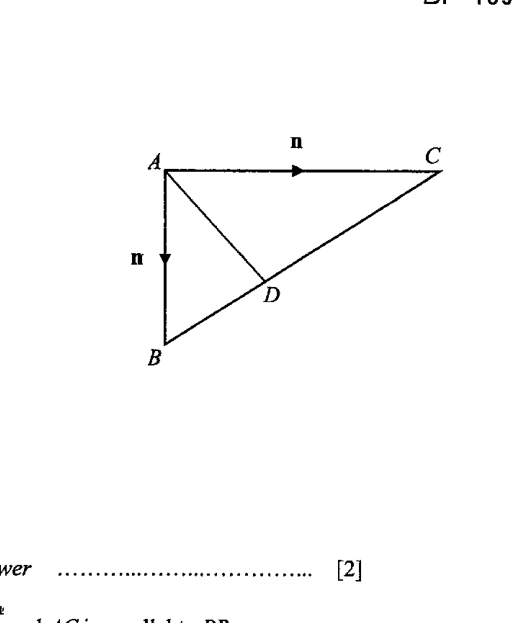
- ((a))
Find AD in terms of m and n.
Answer ...
- ((b))
R is on AD produced such that AR = k·AD and AC is parallel to BR.
- ((i))
Show that .
Answer
- ((ii))
Find the ratio area of triangle ABD : area of triangle RBD.
Answer ...
- ((i))
It won't just hand you the answer — it asks where you're stuck.How the checker works
Worked solution
27((a))
1. Convert the given condition into a ratio and express $\overrightarrow{BC}$.
Since ,
Also,
2. Find $\overrightarrow{BD}$ and hence $\overrightarrow{AD}$.
Since divides in the ratio ,
Hence
27((b))((i))
1. Express \(\overrightarrow{AR}\) in terms of \(\mathbf m\), \(\mathbf n\), and \(k\) using the result from part (a).
From part (a),
Since
2. Form \(\overrightarrow{BR}\) using a vector route from \(B\) to \(R\).
Since
Hence
3. Use the parallel condition \(BR \parallel AC\) to determine \(k\).
Since and (\overrightarrow{BR}) must be a multiple of (\mathbf n).
Therefore the coefficient of (\mathbf m) in (\overrightarrow{BR}) is zero:
27((b))((ii))
1. Use the position of R on AD produced to compare the relevant heights.
From part (b)(i),
Since is on produced,
Triangles and have the same base . Their perpendicular heights to are proportional to and because are collinear.
Hence
AI analysis — may contain mistakes.
Worked this one out on paper? Snap your steps and Gigle's AI math checker will circle the step where it went wrong.
More questions on this topic
- 1A cuboid has a volume of 250 cm^3, correct to the nearest cubic centimetre. The height of the cuboid is 8.4 cm, correct…
- 2The diagram (not drawn to scale) shows the speed-time graph of a vehicle. The vehicle starts from rest and accelerates u…
- 3The diagram below shows the speed-time graph of a bus journey. The bus accelerated from rest at 1.25 m/s^2 to a speed of…
- 4In the diagram, POR is a quadrant of a circle with radius 6 cm. OR and PQ are parallel. QR is an arc of a circle with ce…
- 5Four squares of side length , , , and units are arranged in increasing size order so that their left edges…