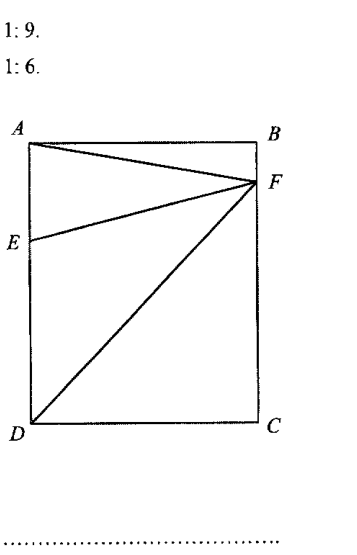
In the diagram, ABCD is a rectangle and E and F are points on AD and BC respectively. The ratio of the area of triangle ABF to the area of rectangle ABCD is 1 : 9. The ratio of the area of triangle AFE to the area of rectangle ABCD is 1 : 6. Explain with clear workings, if the following statements are true/ false.
  1. (A)

    The ratio of the area of triangle ABF to that of triangle AFE is 2 : 3.

  2. (B)

    The ratio of the area of triangle DFC to that of rectangle ABCD is 2 : 5.

  3. (C)

    The sum of the area of triangles ABF and triangle DFC is equal to the sum of the area of triangles AFE and EFD.

Work through it with AI →

It won't just hand you the answer — it asks where you're stuck.How the checker works

Worked solution

9(A)

1. Write both triangle areas as fractions of the rectangle area.

Let the area of rectangle ABCDABCD be RR.

Given
area of △ABF=19R\text{area of }\triangle ABF=\frac{1}{9}R
and
area of △AFE=16R.\text{area of }\triangle AFE=\frac{1}{6}R.

2. Find and simplify the ratio of the two triangle areas.

area of △ABF:area of △AFE\text{area of }\triangle ABF : \text{area of }\triangle AFE
=19R:16R=\frac{1}{9}R : \frac{1}{6}R
=19:16=\frac{1}{9}:\frac{1}{6}
Multiply both parts by 1818:
19×18:16×18=2:3.\frac{1}{9}\times18 : \frac{1}{6}\times18 = 2:3.

3. Compare with the statement and conclude true or false.

The ratio obtained is 2:32:3, which is the same as the statement.

Answer

Statement (A) is true.

area of △ABF:area of △AFE=19:16=2:3\text{area of }\triangle ABF : \text{area of }\triangle AFE = \frac{1}{9} : \frac{1}{6} = 2 : 3

9(B)

1. Express the given area ratio for triangle ABF using the rectangle dimensions.

Let the width of rectangle ABCDABCD be ww and the height be hh.

Then
area of rectangle ABCD=wh.\text{area of rectangle }ABCD = wh.

Since FF lies on BCBC,
area of △ABF=12×AB×BF=12w(BF).\text{area of }\triangle ABF = \frac12 \times AB \times BF = \frac12 w(BF).

Given
area of △ABFarea of rectangle ABCD=19,\frac{\text{area of }\triangle ABF}{\text{area of rectangle }ABCD}=\frac19,

12w(BF)wh=19.\frac{\frac12 w(BF)}{wh}=\frac19.

2. Find the fraction of the rectangle height represented by BF.

Simplifying,
BF2h=19.\frac{BF}{2h}=\frac19.

Hence
BFh=29.\frac{BF}{h}=\frac29.

3. Find the fraction of the rectangle height represented by FC.

Since BC=hBC=h and BF+FC=BCBF+FC=BC,
FCh=1−29=79.\frac{FC}{h}=1-\frac29=\frac79.

4. Find the area ratio of triangle DFC to the rectangle and compare with the statement.

Now
area of △DFC=12×DC×FC=12w(FC).\text{area of }\triangle DFC=\frac12 \times DC \times FC=\frac12 w(FC).

Therefore

area of △DFCarea of rectangle ABCD=12w(FC)wh=FC2h=12×79=718.\frac{\text{area of }\triangle DFC}{\text{area of rectangle }ABCD} =\frac{\frac12 w(FC)}{wh} =\frac{FC}{2h} =\frac12\times\frac79 =\frac7{18}.

So
area of △DFC:area of rectangle ABCD=7:18.\text{area of }\triangle DFC : \text{area of rectangle }ABCD = 7:18.

Since 7:18≠2:57:18 \ne 2:5, the statement is false.

Answer

Statement (B) is false.

area of △DFC:area of rectangle ABCD=7:18,\text{area of }\triangle DFC : \text{area of rectangle }ABCD = 7 : 18,

not 2:52 : 5.

9(C)

1. Express the known triangle areas as fractions of the rectangle area.

Let the area of rectangle ABCDABCD be RR.

From the question,
area(△ABF)=19R,\text{area}(\triangle ABF)=\frac{1}{9}R,
area(△AFE)=16R.\text{area}(\triangle AFE)=\frac{1}{6}R.

From part (B),
area(△DFC)=718R.\text{area}(\triangle DFC)=\frac{7}{18}R.

2. Find the area of triangle EFD as the remaining part of the rectangle.

The four triangles ABFABF, AFEAFE, EFDEFD and DFCDFC make up the rectangle.

area(△EFD)=R−(19R+16R+718R)\text{area}(\triangle EFD)=R-\left(\frac{1}{9}R+\frac{1}{6}R+\frac{7}{18}R\right)

Using denominator 1818,
area(△EFD)=R−(218R+318R+718R)\text{area}(\triangle EFD)=R-\left(\frac{2}{18}R+\frac{3}{18}R+\frac{7}{18}R\right)

=R−1218R=618R=13R.=R-\frac{12}{18}R=\frac{6}{18}R=\frac{1}{3}R.

3. Compare the two sums of areas stated in the statement.

Left-hand side:
area(△ABF)+area(△DFC)=19R+718R\text{area}(\triangle ABF)+\text{area}(\triangle DFC)=\frac{1}{9}R+\frac{7}{18}R
=218R+718R=918R=12R.=\frac{2}{18}R+\frac{7}{18}R=\frac{9}{18}R=\frac{1}{2}R.

Right-hand side:
area(△AFE)+area(△EFD)=16R+13R\text{area}(\triangle AFE)+\text{area}(\triangle EFD)=\frac{1}{6}R+\frac{1}{3}R
=16R+26R=36R=12R.=\frac{1}{6}R+\frac{2}{6}R=\frac{3}{6}R=\frac{1}{2}R.

4. Conclude whether the statement is true or false.

Since both sums are equal to 12R\frac{1}{2}R, the two sums of areas are equal.

Therefore, statement (C) is true.

Answer

Statement (C) is true.

area(△ABF)+area(△DFC)=12R\text{area}(\triangle ABF)+\text{area}(\triangle DFC)=\frac{1}{2}R

and

area(△AFE)+area(△EFD)=12R.\text{area}(\triangle AFE)+\text{area}(\triangle EFD)=\frac{1}{2}R.

AI analysis — may contain mistakes.

Worked this one out on paper? Snap your steps and Gigle's AI math checker will circle the step where it went wrong.

More questions on this topic

  1. 1In the diagram, there are two right-angled triangles ΔABD and ΔCEB such that AD = 12 cm, BD = 15 cm and BE = 20 cm. Find…
  2. 2In triangle ABC, ∠ABC=90∘\angle ABC = 90^\circ, BX=2XCBX = 2XC and sin⁡∠AXC=35\sin \angle AXC = \dfrac{3}{5}. Express as a fraction in its…
  3. 3A cuboid has a volume of 250 cm^3, correct to the nearest cubic centimetre. The height of the cuboid is 8.4 cm, correct…
  4. 4The diagram below shows a gift souvenir formed by joining the plane face of a solid hemisphere of radius 3 cm and a soli…
  5. 5In the diagram, PQRS is a vertical rectangular wall of height 2.5 m and length 7.5 m. T is a point on level ground from…