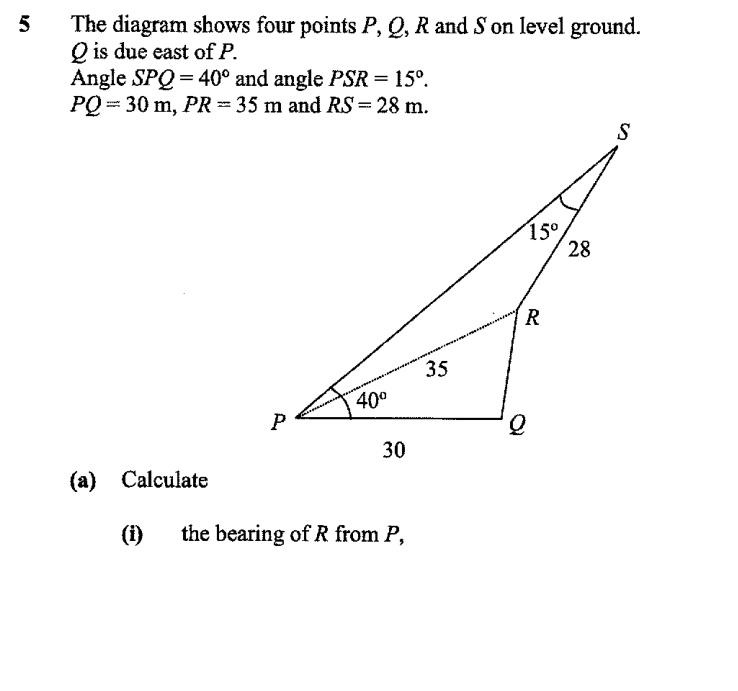
The diagram shows four points P, Q, R and S on level ground.
Q is due east of P.
Angle SPQ = 40° and angle PSR = 15°.
PQ = 30 m, PR = 35 m and RS = 28 m.
- (a)
Calculate
- (i)
the bearing of R from P,
- (ii)
QR,
- (iii)
the area of triangle PRS.
- (i)
- (b)
A vertical mast stands at R and the angle of elevation of the top of the mast from P is 18°.
- (i)
Calculate the height of the mast.
- (ii)
A bird lands on the top of the mast.
Find its largest angle of depression of a point along PQ produced.
- (i)
It won't just hand you the answer — it asks where you're stuck.How the checker works
Worked solution
5(a)(i)
1. Find angle $SPR$ in triangle $PRS$ using the sine rule.
In , is opposite , and is opposite .
2. Find the angle of $PR$ above the east direction $PQ$.
Since and ,
So is north of east.
3. Convert the direction from east into a three-figure bearing from north.
Bearings are measured clockwise from north. Since east has bearing ,
To the nearest degree, this is .
Bearing of from
5(a)(ii)
1. Find the included angle $QPR$ in triangle $PQR$.
From part (a)(i), the bearing of from is .
Since is due east of , the direction of has bearing .
So
2. Apply the cosine rule to find $QR$.
In triangle ,
Using the unrounded angle from part (a)(i) gives
5(a)(iii)
1. Find the included angle between $PR$ and $RS$.
From the earlier working in part (a)(i),
.
In triangle ,
2. Calculate the area of triangle $PRS$ using two sides and the included angle.
5(b)(i)
1. Identify the right triangle and choose the tangent ratio.
Let the height of the mast be m.
In the vertical right triangle formed by , and the top of the mast,
2. Calculate the height of the mast.
Height of mast
5(b)(ii)
1. Identify the point on $PQ$ produced giving the largest angle of depression.
The angle of depression is largest when the horizontal distance from to the point on produced is smallest.
From part (a)(ii), the shortest horizontal distance from to produced is
2. Use the tangent ratio to find the angle of depression.
Let the largest angle of depression be .
The height of the mast from part (b)(i) is .
3. Round the angle appropriately.
So the largest angle of depression is .
Largest angle of depression
AI analysis — may contain mistakes.
Worked this one out on paper? Snap your steps and Gigle's AI math checker will circle the step where it went wrong.
More questions on this topic
- 1The diagram shows the positions of a harbour, H, a lighthouse, L, and two buoys P and Q. HPQ is a straight line. The bea…
- 2A circle with centre O has a tangent XY at D. ∠ODC = 70°, ∠BCD = 120° and ∠ODA = 15°. Find ∠CDY. Find ∠DAB. Find ∠OBA. T…
- 3In the diagram, PQRS is a vertical rectangular wall of height 2.5 m and length 7.5 m. T is a point on level ground from…
- 4In triangle ABC, AB = 14.6 cm, BC = 7.6 cm and angle BAC = 31°. Find obtuse angle ACB. Answer ...° area of triangle ABC.…
- 5The diagram shows four points P, Q, R and S which lie on level ground in a garden. P is due south of Q. The bearing of S…