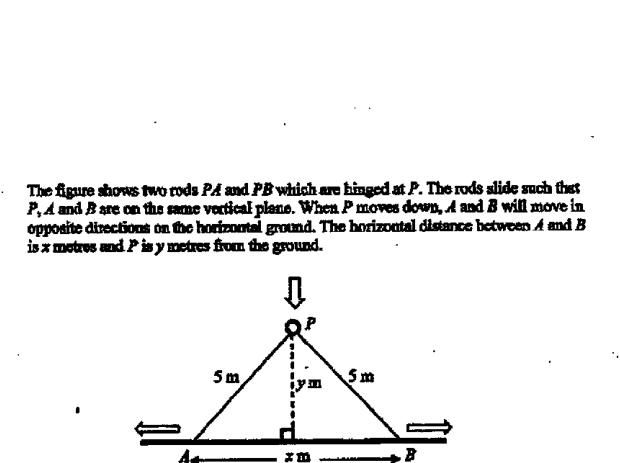
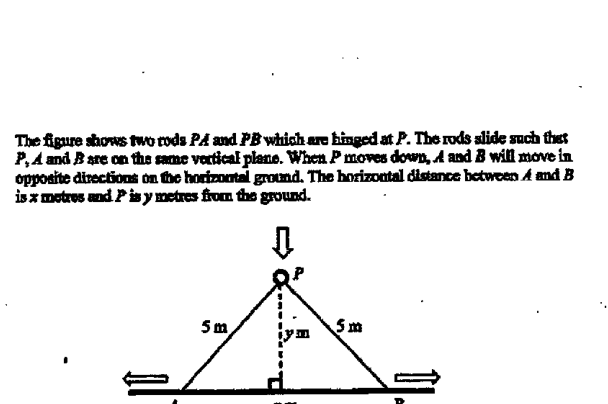
The figure shows two rods PA and PB which are hinged at P. The rods slide such that P, A and B are on the same vertical plane. When P moves down, A and B will move in opposite directions on the horizontal ground. The horizontal distance between A and B is x metres and P is y metres from the ground.
- ((a))
Express x in terms of y.
- ((b))
Given that P is falling at the rate of 2 m s^-1, find the rate of change of x when P is 3 metres from the ground.
- ((iii))
The rod PA makes an acute angle with the horizontal ground.
(iii) Using your answer to part (ii), find the rate of change of when P is 3 metres from the ground.
It won't just hand you the answer — it asks where you're stuck.How the checker works
Worked solution
8((a))
1. Form an equation using Pythagoras' theorem.
Since P is vertically above the midpoint of , the horizontal distance from the midpoint of to is .
Using Pythagoras' theorem on the right-angled triangle,
2. Rearrange the equation to express $x$ in terms of $y$.
Since is a distance, take the positive square root.
8((b))
1. Write the geometric relation between $x$ and $y$.
From the right triangle,
so
2. Differentiate implicitly with respect to time.
Differentiate both sides with respect to :
3. Substitute $y=3$ and the falling rate of $P$ to find $\dfrac{dx}{dt}$.
Since is falling at ,
When ,
Substitute into
So is increasing at .
8((iii))
1. Write a trigonometric relation connecting $x$ and $\theta$.
From the right triangle with hypotenuse and adjacent side ,
2. Differentiate the relation with respect to time.
Differentiate
with respect to :
3. Find $\sin\theta$ when $P$ is $3$ metres from the ground.
When , from the earlier geometry,
so and .
Thus
Since is acute,
4. Substitute $\dfrac{dx}{dt}=\dfrac32$ and solve for $\dfrac{d\theta}{dt}$.
Using the answer to part (ii),
Substitute into
So is decreasing at .
AI analysis — may contain mistakes.
Worked this one out on paper? Snap your steps and Gigle's AI math checker will circle the step where it went wrong.
More questions on this topic
- 1In the diagram, there are two right-angled triangles ΔABD and ΔCEB such that AD = 12 cm, BD = 15 cm and BE = 20 cm. Find…
- 2In triangle ABC, , and . Express as a fraction in its…
- 3In the diagram, POR is a quadrant of a circle with radius 6 cm. OR and PQ are parallel. QR is an arc of a circle with ce…
- 4Triangle ABC is a right-angled triangle. Given that two of its lengths are 11 cm and 5 cm, find two possible lengths for…
- 5The diagram below shows a gift souvenir formed by joining the plane face of a solid hemisphere of radius 3 cm and a soli…