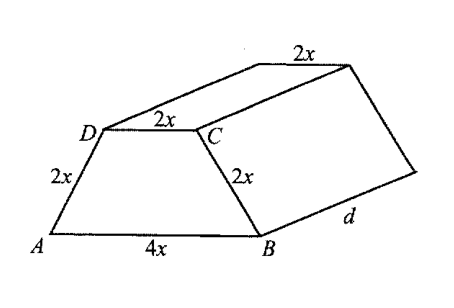
The diagram shows a prism in which the cross-section is a trapezium ABCDABCD.
AB=4x cmAB = 4x\text{ cm}, BC=DC=AD=2x cmBC = DC = AD = 2x\text{ cm}. The length of the prism is d cmd\text{ cm}.

  1. (i)

    Show that the area of trapezium ABCDABCD is 33x2 cm23\sqrt{3}x^2\text{ cm}^2.

  2. (ii)

    The volume of the prism is 38883 cm33888\sqrt{3}\text{ cm}^3.
    Express dd in terms of xx.

  3. (iii)

    Show that the total surface area, A cm2A\text{ cm}^2, of the prism is given by
    A=63x2+12960x.A = 6\sqrt{3}x^2 + \frac{12960}{x}.

  4. (iv)

    Given that xx can vary, find the value of xx which gives a stationary value of AA.

  5. (v)

    Explain why this value of xx gives the smallest possible surface area of the prism.

Work through it with AI →

It won't just hand you the answer — it asks where you're stuck.How the checker works

Worked solution

9(i)

1. Find the horizontal projection of the slanted sides.

Let the perpendiculars from CC and DD to ABAB meet ABAB at FF and EE respectively.
EF=DC=2xEF = DC = 2x
Since the trapezium is isosceles (AD=BC=2xAD = BC = 2x), AE=FB=AB−EF2=4x−2x2=xAE = FB = \frac{AB - EF}{2} = \frac{4x - 2x}{2} = x.

2. Calculate the height of the trapezium using Pythagoras' theorem.

In △ADE\triangle ADE, using Pythagoras' theorem:
DE2+AE2=AD2DE^2 + AE^2 = AD^2
h2+x2=(2x)2h^2 + x^2 = (2x)^2
h2=4x2−x2=3x2h^2 = 4x^2 - x^2 = 3x^2
h=3xh = \sqrt{3}x

3. Calculate the area of the trapezium.

Area of trapezium ABCD=12×(AB+DC)×hABCD = \frac{1}{2} \times (AB + DC) \times h
=12×(4x+2x)×3x= \frac{1}{2} \times (4x + 2x) \times \sqrt{3}x
=12×6x×3x= \frac{1}{2} \times 6x \times \sqrt{3}x
=33x2 cm2= 3\sqrt{3}x^2\text{ cm}^2 (shown)

Answer

Area =33x2 cm2= 3\sqrt{3}x^2\text{ cm}^2 (shown)

9(ii)

1. Set up the equation for the volume of the prism

Volume=Base Area×Length\text{Volume} = \text{Base Area} \times \text{Length}
38883=(33x2)×d3888\sqrt{3} = (3\sqrt{3}x^2) \times d

2. Solve for $d$ in terms of $x$

d=3888333x2d = \frac{3888\sqrt{3}}{3\sqrt{3}x^2}
d=1296x2d = \frac{1296}{x^2}

Answer

d=1296x2d = \frac{1296}{x^2}

9(iii)

1. Find the length of the prism, $d$, in terms of $x$ using the volume from part (ii).

Volume=Base Area×d\text{Volume} = \text{Base Area} \times d
33x2×d=388833\sqrt{3}x^2 \times d = 3888\sqrt{3}
d=3888333x2=1296x2d = \frac{3888\sqrt{3}}{3\sqrt{3}x^2} = \frac{1296}{x^2}

2. Express the total surface area $A$ in terms of $x$ and $d$.

The total surface area consists of 2 trapezoidal faces and 4 rectangular faces.
A=2×(Area of ABCD)+(AB+BC+CD+DA)×dA = 2 \times (\text{Area of } ABCD) + (AB + BC + CD + DA) \times d
A=2(33x2)+(4x+2x+2x+2x)dA = 2(3\sqrt{3}x^2) + (4x + 2x + 2x + 2x)d
A=63x2+10xdA = 6\sqrt{3}x^2 + 10xd

3. Substitute $d$ into the surface area equation to show the final expression.

A=63x2+10x(1296x2)A = 6\sqrt{3}x^2 + 10x\left(\frac{1296}{x^2}\right)
A=63x2+12960xA = 6\sqrt{3}x^2 + \frac{12960}{x} (shown)

Answer

A=63x2+12960xA = 6\sqrt{3}x^2 + \frac{12960}{x}

9(iv)

1. Differentiate $A$ with respect to $x$.

A=63x2+12960x−1A = 6\sqrt{3}x^2 + 12960x^{-1}

dAdx=123x−12960x−2\frac{dA}{dx} = 12\sqrt{3}x - 12960x^{-2}

2. Set the derivative to zero to find the stationary value.

For a stationary value, dAdx=0\frac{dA}{dx} = 0:

123x−12960x2=012\sqrt{3}x - \frac{12960}{x^2} = 0

123x3=1296012\sqrt{3}x^3 = 12960

3. Solve for $x$.

x3=12960123x^3 = \frac{12960}{12\sqrt{3}}

x3=10803=3603x^3 = \frac{1080}{\sqrt{3}} = 360\sqrt{3}

x=36033≈8.5433x = \sqrt[3]{360\sqrt{3}} \approx 8.5433

x≈8.54x \approx 8.54 (to 3 s.f.)

Answer

x=8.54x = 8.54

9(v)

1. Find the second derivative of $A$ with respect to $x$.

From (iv), dAdx=123x−12960x−2\frac{dA}{dx} = 12\sqrt{3}x - 12960x^{-2}.

d2Adx2=123−(−2)(12960)x−3\frac{d^2A}{dx^2} = 12\sqrt{3} - (-2)(12960)x^{-3}
d2Adx2=123+25920x3\frac{d^2A}{dx^2} = 12\sqrt{3} + \frac{25920}{x^3}

2. Use the second derivative test to justify the minimum.

Since xx is a length, x>0x > 0.
Therefore, 25920x3>0\frac{25920}{x^3} > 0, which means d2Adx2>0\frac{d^2A}{dx^2} > 0.
Since the second derivative is positive, this value of xx gives a minimum (smallest possible) surface area.

Answer

Since d2Adx2>0\frac{d^2A}{dx^2} > 0 for x>0x > 0, the stationary value is a minimum.

AI analysis — may contain mistakes.

Worked this one out on paper? Snap your steps and Gigle's AI math checker will circle the step where it went wrong.

More questions on this topic

  1. 1The normal to the curve y=2tan⁡3x−1y = 2\tan 3x - 1 at point P(π3,−1)P\left(\frac{\pi}{3}, -1\right) crosses the yy-axis at point AA…
  2. 2The point PP lies on the curve y=ln⁡(x+1x−1)y = \ln\left(\frac{x+1}{x-1}\right) for x>1x > 1. The normal to the curve at PP is par…
  3. 3The figure shows part of the curve y=g(x)y = g(x). (2,8)(2, 8) and (6,1)(6, 1) are two points on the curve. Given that ∫26y dx=32\int_{2}^{6} y \text{ } dx = 32…
  4. 4The diagram shows part of the curve y=3e−12x−6y = 3e^{-\frac{1}{2}x} - 6 which crosses the xx-axis at PP and the yy-axis at QQ…
  5. 5The triangle ABC is such that its area is 16+7102 cm2\dfrac{16 + 7\sqrt{10}}{2}\ \text{cm}^2, the length of AB is (32+5) cm(3\sqrt{2} + \sqrt{5})\ \text{cm}…