NJC JC1 Promo 9758/2019/Q6 A vessel is formed by removing a smaller cone of radius 5 m from a bigger cone whose semi-vertical angle is , where . Water flows out of the vessel at a rate of per minute, where is a positive constant. At time minutes, the height of the water surface from the hole is (see diagram).
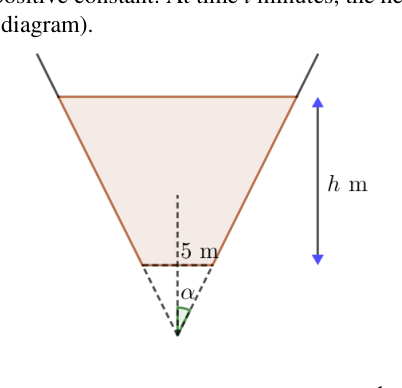
- (i)
Show that the volume of the water , in , is given by .
- (ii)
Find the rate of change of , in terms of , when .
It won't just hand you the answer — it asks where you're stuck.How the checker works
Worked solution
4(i)
1. Determine the height of the smaller, removed cone.
Let be the height of the removed cone at the bottom of the vessel.
Using the right-angled triangle formed by the semi-vertical angle , the height , and the radius of the hole:
Given ,
2. Express the radius of the water surface in terms of the water height $h$.
Let be the radius of the water surface. The total distance from the cone's vertex to the water surface is .
Using the semi-vertical angle again:
3. Formulate the equation for the volume of the water.
The volume of water is the volume of the cone containing the water (from the vertex to the water surface) minus the volume of the removed small cone.
Substitute into the equation:
Shown
4(ii)
1. Find the height $h$ when the volume $V = 120\pi$.
2. Differentiate the given volume equation with respect to $h$.
3. Relate the rates of change using the chain rule.
By the chain rule:
Since water flows out of the vessel, the volume is decreasing, so the rate of change of volume is negative:
4. Substitute the calculated values to find the rate of change of $h$.
Substitute and into the equation for :
AI analysis — may contain mistakes.
Worked this one out on paper? Snap your steps and Gigle's AI math checker will circle the step where it went wrong.
More questions on this topic
- 1A drilling company plans to install a straight pipeline through a mountain. Points are defined relative…
- 2NJC JC1 Promo 9758/2019/Q6 A vessel is formed by removing a smaller cone of radius 5 m from a bigger cone whose semi-ver…
- 3[The surface area and volume of a sphere are given by and respectively.] An aquarist wh…
- 4Fig. 1 shows a piece of card, , in the form of a rhombus of sides cm. The card is made up of 2 identical equil…
- 5The diagram shows a V-shaped tank with dimensions , and . The tank…