In the diagram, O is centre of the rectangular base ABCD of a right pyramid with vertex V. Perpendicular unit vectors i, j, k are parallel to AB, BC, OV respectively. The length of AB, BC and OV are 12 units, 6 units and 6 units respectively. The point M is the mid-point of CV and the point O is taken as the origin for position vectors.
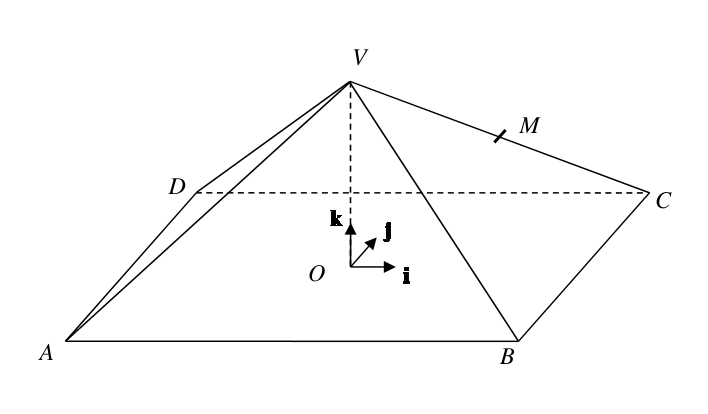
  1. (i)

    Show that the equation of the line AM may be expressed as

    r=(−6−30)+t(632),\mathbf{r} = \begin{pmatrix} -6 \\ -3 \\ 0 \end{pmatrix} + t \begin{pmatrix} 6 \\ 3 \\ 2 \end{pmatrix},

    where tt is a parameter.

  2. (ii)

    Find the perpendicular distance from B to the line AM.

  3. (iii)

    Find the acute angle between the line DV and the plane AMB.

  4. (iv)

    The plane Π\Pi has equation

    r⋅(−14a)=4.\mathbf{r}\cdot\begin{pmatrix} -1 \\ 4 \\ a \end{pmatrix} = 4.

    Given that the three planes AMB, AMD and Π\Pi have no point in common, find the value of aa.

Work through it with AI →

It won't just hand you the answer — it asks where you're stuck.How the checker works

Worked solution

4(i)

1. Determine the position vectors of vertices A, C, and V.

The centre of the rectangle is at the origin OO.
With dimensions AB=12AB = 12 and BC=6BC = 6, and taking note of the unit vectors directions, the position vectors of the corners are:
OA=(−6−30),OC=(630)\mathbf{OA} = \begin{pmatrix} -6 \\ -3 \\ 0 \end{pmatrix}, \quad \mathbf{OC} = \begin{pmatrix} 6 \\ 3 \\ 0 \end{pmatrix}
Since OV=6OV = 6 and is parallel to k\mathbf{k}:
OV=(006)\mathbf{OV} = \begin{pmatrix} 0 \\ 0 \\ 6 \end{pmatrix}

2. Find the position vector of point M.

Since MM is the mid-point of CVCV:
OM=OC+OV2=12[(630)+(006)]=(31.53)\mathbf{OM} = \frac{\mathbf{OC} + \mathbf{OV}}{2} = \frac{1}{2} \left[ \begin{pmatrix} 6 \\ 3 \\ 0 \end{pmatrix} + \begin{pmatrix} 0 \\ 0 \\ 6 \end{pmatrix} \right] = \begin{pmatrix} 3 \\ 1.5 \\ 3 \end{pmatrix}

3. Find the direction vector of the line AM.

The direction of the line AMAM is given by the displacement vector AM\mathbf{AM}:
AM=OM−OA=(31.53)−(−6−30)=(94.53)\mathbf{AM} = \mathbf{OM} - \mathbf{OA} = \begin{pmatrix} 3 \\ 1.5 \\ 3 \end{pmatrix} - \begin{pmatrix} -6 \\ -3 \\ 0 \end{pmatrix} = \begin{pmatrix} 9 \\ 4.5 \\ 3 \end{pmatrix}

4. Formulate the equation of the line in the required form.

To match the required form with integer components, observe that AM\mathbf{AM} is a scalar multiple of the given direction vector:
AM=1.5(632)\mathbf{AM} = 1.5 \begin{pmatrix} 6 \\ 3 \\ 2 \end{pmatrix}
Thus, a valid direction vector for the line is (632)\begin{pmatrix} 6 \\ 3 \\ 2 \end{pmatrix}.
Using the position vector of point A(−6,−3,0)A(-6, -3, 0), the vector equation of the line AMAM is:
r=(−6−30)+t(632)(shown)\mathbf{r} = \begin{pmatrix} -6 \\ -3 \\ 0 \end{pmatrix} + t \begin{pmatrix} 6 \\ 3 \\ 2 \end{pmatrix} \quad \text{(shown)}

Answer

r=(−6−30)+t(632)\mathbf{r} = \begin{pmatrix} -6 \\ -3 \\ 0 \end{pmatrix} + t \begin{pmatrix} 6 \\ 3 \\ 2 \end{pmatrix}

4(ii)

1. Find the displacement vector $\vec{AB}$ and identify the direction vector of the line AM.

From the coordinates derived in the context, a=(−6−30)\mathbf{a} = \begin{pmatrix} -6 \\ -3 \\ 0 \end{pmatrix} and b=(6−30)\mathbf{b} = \begin{pmatrix} 6 \\ -3 \\ 0 \end{pmatrix}.

AB⃗=b−a=(6−30)−(−6−30)=(1200)\vec{AB} = \mathbf{b} - \mathbf{a} = \begin{pmatrix} 6 \\ -3 \\ 0 \end{pmatrix} - \begin{pmatrix} -6 \\ -3 \\ 0 \end{pmatrix} = \begin{pmatrix} 12 \\ 0 \\ 0 \end{pmatrix}.

From part (i), the direction vector of line AM is d=(632)\mathbf{d} = \begin{pmatrix} 6 \\ 3 \\ 2 \end{pmatrix}.

2. Calculate the cross product of $\vec{AB}$ and the direction vector $\mathbf{d}$.

AB⃗×d=(1200)×(632)=((0)(2)−(0)(3)(0)(6)−(12)(2)(12)(3)−(0)(6))=(0−2436)\vec{AB} \times \mathbf{d} = \begin{pmatrix} 12 \\ 0 \\ 0 \end{pmatrix} \times \begin{pmatrix} 6 \\ 3 \\ 2 \end{pmatrix} = \begin{pmatrix} (0)(2) - (0)(3) \\ (0)(6) - (12)(2) \\ (12)(3) - (0)(6) \end{pmatrix} = \begin{pmatrix} 0 \\ -24 \\ 36 \end{pmatrix}

3. Compute the perpendicular distance using the magnitude of the cross product.

The perpendicular distance from BB to line AM is given by D=∣AB⃗×d∣∣d∣D = \frac{|\vec{AB} \times \mathbf{d}|}{|\mathbf{d}|}.

∣AB⃗×d∣=02+(−24)2+362=1872=1213|\vec{AB} \times \mathbf{d}| = \sqrt{0^2 + (-24)^2 + 36^2} = \sqrt{1872} = 12\sqrt{13}
∣d∣=62+32+22=49=7|\mathbf{d}| = \sqrt{6^2 + 3^2 + 2^2} = \sqrt{49} = 7

D=12137≈6.18 unitsD = \frac{12\sqrt{13}}{7} \approx 6.18 \text{ units}

Answer

12137\frac{12\sqrt{13}}{7} or 6.186.18 units

4(iii)

1. Find a normal vector to the plane AMB.

The direction vector of line AMAM is d1=(632)\mathbf{d}_1 = \begin{pmatrix} 6 \\ 3 \\ 2 \end{pmatrix} (from part (i)).
Since A=(−6,−3,0)A = (-6, -3, 0) and B=(6,−3,0)B = (6, -3, 0), the vector AB⃗=(1200)\vec{AB} = \begin{pmatrix} 12 \\ 0 \\ 0 \end{pmatrix}. A parallel, simplified direction vector is d2=(100)\mathbf{d}_2 = \begin{pmatrix} 1 \\ 0 \\ 0 \end{pmatrix}.
The normal vector to plane AMBAMB, n\mathbf{n}, is the cross product of these two vectors:
n=d2×d1=(100)×(632)=(0−23)\mathbf{n} = \mathbf{d}_2 \times \mathbf{d}_1 = \begin{pmatrix} 1 \\ 0 \\ 0 \end{pmatrix} \times \begin{pmatrix} 6 \\ 3 \\ 2 \end{pmatrix} = \begin{pmatrix} 0 \\ -2 \\ 3 \end{pmatrix}

2. Find the direction vector of the line DV.

Given D=(−6,3,0)D = (-6, 3, 0) and V=(0,0,6)V = (0, 0, 6), the direction vector of line DVDV is:
DV⃗=(006)−(−630)=(6−36)\vec{DV} = \begin{pmatrix} 0 \\ 0 \\ 6 \end{pmatrix} - \begin{pmatrix} -6 \\ 3 \\ 0 \end{pmatrix} = \begin{pmatrix} 6 \\ -3 \\ 6 \end{pmatrix}
We can factor out 3 to use a simpler parallel direction vector m=(2−12)\mathbf{m} = \begin{pmatrix} 2 \\ -1 \\ 2 \end{pmatrix}.

3. Calculate the acute angle between the line DV and the plane AMB.

Let the acute angle between the line DVDV and the plane AMBAMB be θ\theta. Using the relationship between a line and a plane's normal:
sin⁡θ=∣m⋅n∣∣m∣∣n∣\sin \theta = \frac{|\mathbf{m} \cdot \mathbf{n}|}{|\mathbf{m}| |\mathbf{n}|}
m⋅n=(2−12)⋅(0−23)=0+2+6=8\mathbf{m} \cdot \mathbf{n} = \begin{pmatrix} 2 \\ -1 \\ 2 \end{pmatrix} \cdot \begin{pmatrix} 0 \\ -2 \\ 3 \end{pmatrix} = 0 + 2 + 6 = 8
∣m∣=22+(−1)2+22=9=3|\mathbf{m}| = \sqrt{2^2 + (-1)^2 + 2^2} = \sqrt{9} = 3
∣n∣=02+(−2)2+32=13|\mathbf{n}| = \sqrt{0^2 + (-2)^2 + 3^2} = \sqrt{13}
sin⁡θ=8313\sin \theta = \frac{8}{3\sqrt{13}}
θ=sin⁡−1(8313)≈47.697∘\theta = \sin^{-1}\left( \frac{8}{3\sqrt{13}} \right) \approx 47.697^\circ
The acute angle is 47.7∘47.7^\circ (to 1 d.p.).

Answer

47.7∘47.7^\circ

4(iv)

1. Relate the intersection of the three planes to the line $AM$ and the plane $\Pi$.

The planes AMBAMB and AMDAMD intersect at the line AMAM. For the three planes AMBAMB, AMDAMD and Π\Pi to have no point in common, the line of intersection AMAM must be parallel to the plane Π\Pi (and not lie on it).

2. Use the orthogonality of the line's direction vector and the plane's normal vector to solve for $a$.

From part (i), the direction vector of line AMAM is d=(632)\mathbf{d} = \begin{pmatrix} 6 \\ 3 \\ 2 \end{pmatrix}, and the normal vector of plane Π\Pi is n=(−14a)\mathbf{n} = \begin{pmatrix} -1 \\ 4 \\ a \end{pmatrix}.

For the line to be parallel to the plane, their dot product must be zero (d⋅n=0\mathbf{d} \cdot \mathbf{n} = 0):
(632)⋅(−14a)=0\begin{pmatrix} 6 \\ 3 \\ 2 \end{pmatrix} \cdot \begin{pmatrix} -1 \\ 4 \\ a \end{pmatrix} = 0
−6+12+2a=0-6 + 12 + 2a = 0
6+2a=06 + 2a = 0
2a=−62a = -6
a=−3a = -3

(Note: Checking point A(−6,−3,0)A(-6, -3, 0) in the plane equation gives 6−12+0=−6≠46 - 12 + 0 = -6 \neq 4, confirming the line AMAM does not lie on Π\Pi.)

Answer

a=−3a = -3

AI analysis — may contain mistakes.

Worked this one out on paper? Snap your steps and Gigle's AI math checker will circle the step where it went wrong.

More questions on this topic

  1. 1The lines l1l_1 and l2l_2 have equations r=(4110)+λ(1−1−6),λ∈R\mathbf{r} = \begin{pmatrix} 4 \\ 1 \\ 10 \end{pmatrix} + \lambda \begin{pmatrix} 1 \\ -1 \\ -6 \end{pmatrix}, \lambda \in \mathbb{R}…
  2. 2A drilling company plans to install a straight pipeline ABAB through a mountain. Points (x,y,z)(x, y, z) are defined relative…
  3. 3A plane Π1\Pi_1 has equation x+y+z=3x + y + z = 3. A line passes through the points PP and QQ with position vectors i+j+2k\mathbf{i} + \mathbf{j} + 2\mathbf{k}…
  4. 4The planes Π1\Pi_1 and Π2\Pi_2 have vector equations r=λ1(i+j−k)+μ1(2i−j+k)andr=λ2(i+2j+k)+μ2(3i+j−k)\mathbf{r} = \lambda_1(\mathbf{i} + \mathbf{j} - \mathbf{k}) + \mu_1(2\mathbf{i} - \mathbf{j} + \mathbf{k}) \quad \text{and} \quad \mathbf{r} = \lambda_2(\mathbf{i} + 2\mathbf{j} + \mathbf{k}) + \mu_2(3\mathbf{i} + \mathbf{j} - \mathbf{k})…
  5. 5A home interior designer is looking to design a pull-down wardrobe lift. To test his concept, the designer built a small…