A function g is defined by In the rest of the question, the domain of is , where takes the value determined in part (b).
- (a)
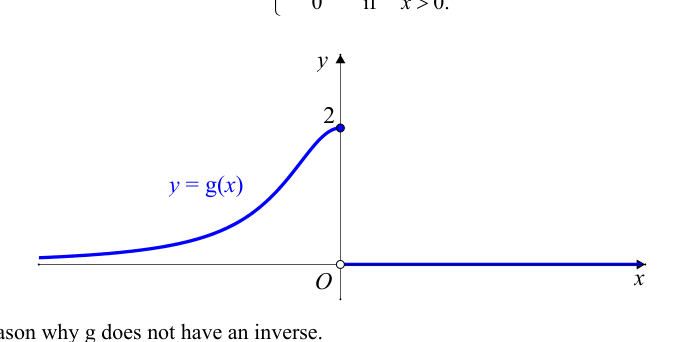
Give a reason why does not have an inverse.
- (b)
The function exists if the domain of is restricted to . State the greatest possible value of .
- (c)
Find and state the domain of .
- (d)
Sketch, on the axes given below, the graphs of and . Label the two graphs clearly. Write down the equation of the line in which the graph of must be reflected in order to obtain the graph of .
It won't just hand you the answer — it asks where you're stuck.How the checker works
Worked solution
7(a)
1. State the reason based on the definition of a one-to-one function
For , . This means multiple values of map to the same value . Hence, is a many-to-one function. For a function to have an inverse, it must be a one-to-one function.
is not a one-to-one function.
7(b)
1. Identify the maximum domain for which the function is one-to-one
For to exist, the function must be one-to-one.
From the given definition and graph, for all . Thus, any interval that includes values of will contain multiple -values mapping to the same -value (many-to-one).
However, for , is strictly increasing and therefore one-to-one.
Thus, the restricted domain can at most extend up to , meaning the greatest possible value is:
7(c)
1. Set up the equation $y = g(x)$ and rearrange to make $x$ the subject.
Let .
2. Choose the correct sign for $x$ based on the restricted domain of $g$.
From part (b), the restricted domain of for an inverse to exist is (so ).
Since , we must reject the positive root and take the negative root:
Therefore, .
3. Determine the domain of $g^{-1}$ by finding the range of $g$ over its restricted domain.
The domain of is the range of for .
For , , which implies .
Taking the reciprocal and multiplying by 2 yields:
The range of is .
Thus, the domain of is .
, Domain:
7(d)
1. Identify and describe the graph of $y = g(x)$ for its restricted domain.
From part (b), the restricted domain for to have an inverse is .
Draw the graph of strictly for . This is a curve entirely in the second quadrant (and positive -axis) that starts at the -intercept with a solid dot, and continuously decreases towards the left, approaching the negative -axis as a horizontal asymptote ( as ). Label this curve as .
2. Sketch the graph of the inverse function $y = g^{-1}(x)$.
The graph of an inverse function is the reflection of the original function's graph across the line .
Reflect the curve from Step 1. The new curve will lie entirely in the fourth quadrant (and positive -axis). It starts at the -intercept with a solid dot, and continuously decreases downwards, approaching the negative -axis as a vertical asymptote ( as ). Label this curve as .
3. State the equation of the line of reflection.
By the geometric property of inverse functions, the reflection axis that maps onto is the line .
Equation of the line of reflection:
AI analysis — may contain mistakes.
Worked this one out on paper? Snap your steps and Gigle's AI math checker will circle the step where it went wrong.