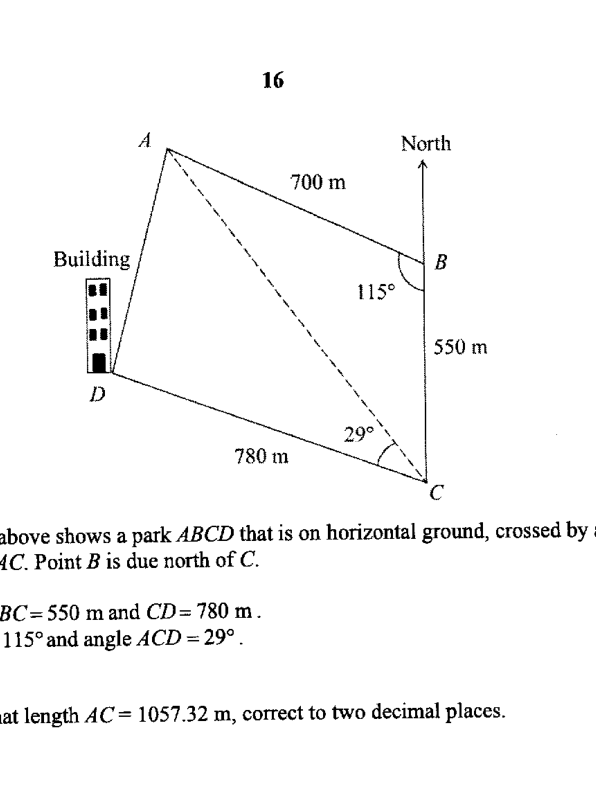
The diagram above shows a park that is on horizontal ground, crossed by a straight path . Point is due north of .
and .
Angle and angle .
- (a)
Show that length , correct to two decimal places.
Answer
- (b)
Calculate the bearing of from .
Answer ...
- (c)
Find the total area of the park ABCD.
Correct your answer to the nearest whole number.Answer ... m^2
- (d)
A vertical building is located at point D.
The angle of elevation of the top of the building from point C is 10.9°.
Find the height of the building.Answer ... m
It won't just hand you the answer — it asks where you're stuck.How the checker works
Worked solution
7(a)
1. Apply the cosine rule to triangle $ABC$ to find $AC^2$.
In ,
2. Evaluate and round the length to two decimal places.
, correct to 2 decimal places.
7(b)
1. Find angle $ACB$ in triangle $ABC$.
Using the sine rule in ,
2. Use the direction of north and the given angle $ACD$ to calculate the bearing of $D$ from $C$.
Since is due north of , is the north line.
The angle from north to , measured anticlockwise, is
Bearings are measured clockwise from north, so
To the nearest degree,
7(c)
1. Find the area of triangle $ABC$ using the two given sides and the included angle.
2. Find the area of triangle $ACD$ and add the two triangle areas.
Using from part (a),
Total area
7(d)
1. Identify the right-angled triangle and choose the correct trigonometric ratio.
Since the building is vertical and the ground is horizontal, the building height is perpendicular to .
Let the height of the building be m.
For the angle of elevation from ,
2. Calculate the height of the building.
So, to 3 significant figures,
AI analysis — may contain mistakes.
Worked this one out on paper? Snap your steps and Gigle's AI math checker will circle the step where it went wrong.
More questions on this topic
- 1The diagram shows the positions of a harbour, H, a lighthouse, L, and two buoys P and Q. HPQ is a straight line. The bea…
- 2A circle with centre O has a tangent XY at D. ∠ODC = 70°, ∠BCD = 120° and ∠ODA = 15°. Find ∠CDY. Find ∠DAB. Find ∠OBA. T…
- 3In the diagram, PQRS is a vertical rectangular wall of height 2.5 m and length 7.5 m. T is a point on level ground from…
- 4In triangle ABC, AB = 14.6 cm, BC = 7.6 cm and angle BAC = 31°. Find obtuse angle ACB. Answer ...° area of triangle ABC.…
- 5The diagram shows four points P, Q, R and S which lie on level ground in a garden. P is due south of Q. The bearing of S…