The figure below shows a sketch of part of the graph of for . The vertical asymptote is also a line of symmetry of the graph.
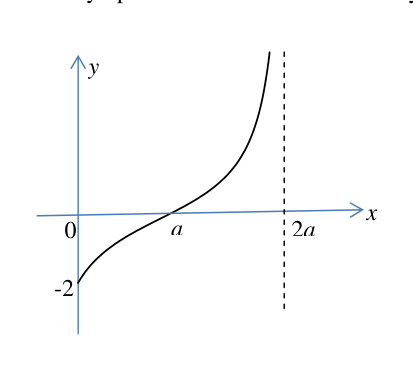
Sketch, on separate diagrams, the graph of
(i) for ;
(ii) for ;
(iii) for .
indicating clearly the asymptote(s) and the axial intercept(s).
It won't just hand you the answer — it asks where you're stuck.How the checker works
Worked solution
7[0]
1. Sketch $y = f(x)$ for $0 \le x \le 4a$ using the given line of symmetry.
Since the graph has a line of symmetry at , the portion for is the reflection of the graph for .
- The original -intercept at reflects to a new -intercept at .
- The original starting point reflects to the endpoint .
- The vertical asymptote remains at .
2. Sketch the reciprocal graph $y = \frac{1}{f(x)}$ for $0 \le x \le 4a$.
For the graph of :
- The -intercepts of at and become vertical asymptotes.
- As , , so . Since is positive on both sides of , touches the -axis at , forming a local minimum.
- The -intercept is .
- The endpoint at is .
- For and , is negative, so is negative and approaches at the asymptotes.
- For , is positive, so is positive and approaches at the asymptotes.
3. Sketch $y = f\left(\frac{x}{2} + a\right)$ for $-2a \le x \le 6a$ by determining its transformations.
Let . This corresponds to a horizontal translation left by , followed by a horizontal stretch by a factor of .
- Vertical Asymptote: .
- -intercepts: and .
- -intercept: Occurs at , where .
- Endpoints:
When , and .
When , and .
The overall shape is identical to but stretched horizontally. It passes through , , rises to the asymptote at , falls from the asymptote to pass through , and ends at .
(i) Graph of :
- Curve starts at , passes through the -intercept , and approaches the vertical asymptote upwards.
- Symmetrical curve from the asymptote downwards, passing through the -intercept and ending at .
(ii) Graph of :
- Curve starts from the -intercept downwards, approaching the vertical asymptote towards .
- U-shaped curve descending from at , touching the -axis at , and going up to at the vertical asymptote .
- Curve from at upwards, ending at .
(iii) Graph of :
- Curve starts at , passes through the origin , and approaches the vertical asymptote upwards.
- Symmetrical curve from the asymptote downwards, passing through the -intercept and ending at .
AI analysis — may contain mistakes.
Worked this one out on paper? Snap your steps and Gigle's AI math checker will circle the step where it went wrong.
More questions on this topic
- 15 (a) Solve the following integral. …
- 2Sketch, on the same diagram, the graphs of and . (You are not required to label any a…
- 3The diagram shows the graphs of and . The graph of has t…
- 4The graph of has a maximum turning point at and passes through the origin. The lines …
- 5On a single diagram, sketch the graphs of and where the following conditions are satisfied, indi…