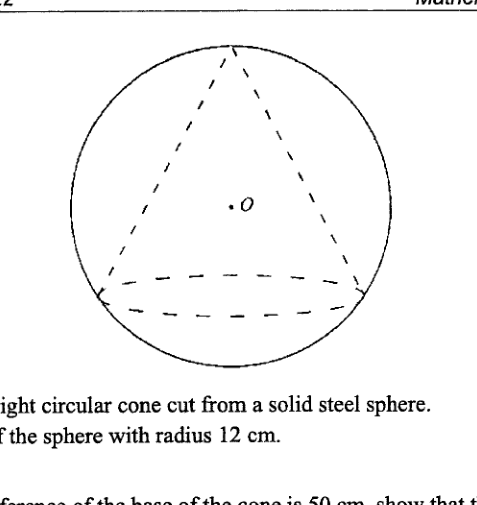
The diagram shows a right circular cone cut from a solid steel sphere. Point O is the centre of the sphere with radius 12 cm.
- ((a))
Given the circumference of the base of the cone is 50 cm, show that the height of the cone is 21.0 cm, corrected to 3 significant figures.
Answer
- ((b))
Find the curved surface area of the cone.
Answer ... cm^2
- ((c))
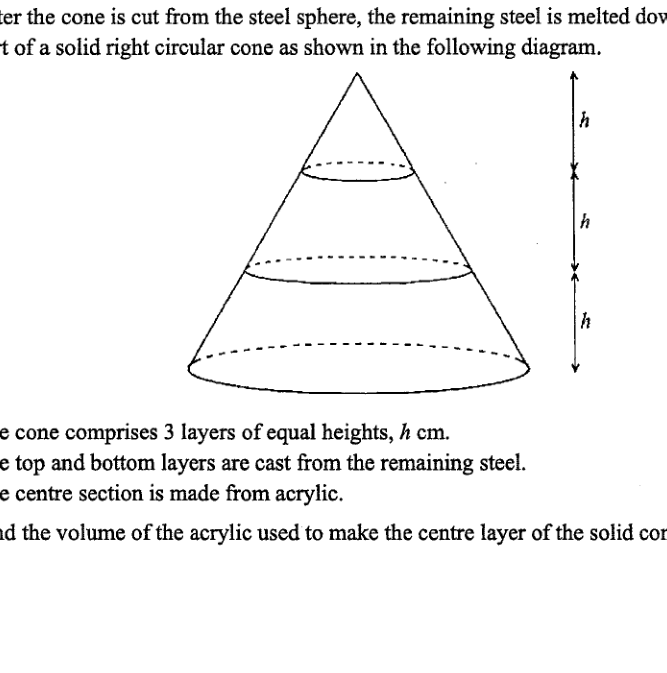
After the cone is cut from the steel sphere, the remaining steel is melted down to form part of a solid right circular cone as shown in the following diagram.
The cone comprises 3 layers of equal heights, cm.
The top and bottom layers are cast from the remaining steel.
The centre section is made from acrylic.Find the volume of the acrylic used to make the centre layer of the solid cone.
Answer ... cm^3
It won't just hand you the answer — it asks where you're stuck.How the checker works
Worked solution
5((a))
1. Find the radius of the base of the cone from its circumference.
Let the radius of the base of the cone be cm.
2. Use Pythagoras' theorem to find the distance from the sphere centre to the base plane.
In the right triangle formed by the centre , a point on the rim of the base, and the axis of the cone, the hypotenuse is the radius of the sphere, cm.
Let the distance from to the base plane be cm.
3. Find the height of the cone and round to 3 significant figures.
The apex is cm above , and the base plane is cm below .
Height of cone , correct to 3 significant figures.
5((b))
1. Find the radius of the base of the cone from its circumference.
Given circumference ,
2. Find the curved surface area of the cone.
From part (a), the height of the cone is .
Slant height:
Curved surface area of cone:
5((c))
1. Find the volume of steel remaining after the original cone is cut from the sphere.
From earlier parts, the cone cut from the sphere has base circumference and height .
Radius of its base:
Volume of sphere:
Volume of cone cut out:
Remaining steel volume:
2. Use similarity to find the volume ratio of the top, centre and bottom layers of the new cone.
The cone has three equal heights: , , .
Since similar cones have volumes in the ratio of the cubes of their corresponding lengths,
So the three layer volumes are:
The top and bottom layers are made from steel, so
3. Calculate the volume of acrylic used for the centre layer.
Since the remaining steel forms the top and bottom layers, the acrylic volume is
Therefore, the volume of acrylic used is
to 3 significant figures.
AI analysis — may contain mistakes.
Worked this one out on paper? Snap your steps and Gigle's AI math checker will circle the step where it went wrong.
More questions on this topic
- 1In the diagram, there are two right-angled triangles ΔABD and ΔCEB such that AD = 12 cm, BD = 15 cm and BE = 20 cm. Find…
- 2In triangle ABC, , and . Express as a fraction in its…
- 3In the diagram, POR is a quadrant of a circle with radius 6 cm. OR and PQ are parallel. QR is an arc of a circle with ce…
- 4Triangle ABC is a right-angled triangle. Given that two of its lengths are 11 cm and 5 cm, find two possible lengths for…
- 5The diagram below shows a gift souvenir formed by joining the plane face of a solid hemisphere of radius 3 cm and a soli…