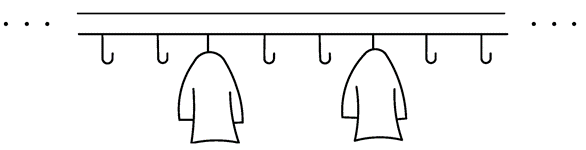
A classroom has a row of 35 coat hooks. Paulina likes coats to be equally spaced, so that there is the same number of empty hooks before the first coat, after the last coat, and between every coat and the next one. Suppose there is at least 1 coat and at least 1 empty hook. How many different numbers of coats can satisfy Paulina's pattern?A. 2B. 4C. 5D. 7E. 9
It won't just hand you the answer — it asks where you're stuck.How the checker works
Worked solution
1. 2025 AMC 8 官方解析
Answer (D): Suppose the coat hooks are numbered from #1 to #35. Imagine an extra hook #36 with a coat on it. If the coats are evenly spaced, then the 36 hooks must be divided into some number of equal-sized blocks, each consisting of a sequence of empty hooks, followed by 1 coat on a hook. For example, if there are 3 blocks with 12 hooks in each block, then coats would hang on hooks #12 and #24 (and the imaginary #36) with 11 empty hooks on either side of each coat. In this way, every factor of 36 corresponds to a possible number of blocks:
| Factor of 36 | Block Size | Number of coats | Hook #s with coats |
|---|---|---|---|
| 1 | 36 | 0 | none |
| 2 | 18 | 1 | 18 |
| 3 | 12 | 2 | 12, 24 |
| 4 | 9 | 3 | 9, 18, 27 |
| 6 | 6 | 5 | 6, 12, 18, 24, 30 |
| 9 | 4 | 8 | 4, 8, 12, 16, 20, 24, 28, 32 |
| 12 | 3 | 11 | 3, 6, 9, 12, 15, 18, 21, 24, 27, 30, 33 |
| 18 | 2 | 17 | all even-numbered hooks |
| 36 | 1 | 35 | all hooks |
Excluding the case with 1 block, which has no coats on the original 35 hooks, and the case with 36 blocks, which leaves no empty hooks, there are 7 different numbers of coats that can satisfy Paulina's pattern, namely 1, 2, 3, 5, 8, 11, and 17.
OR
Let represent the number of coats. Then there are empty hooks that must be evenly distributed across the gaps between the coats, including the ends of the row. Let integer represent the number of empty hooks in each gap. Then
which can be simplified by cross-multiplying and gathering terms to produce
Adding 1 to both sides and factoring gives
It follows that the possible values of can be determined by examining , which must be a factor of 36. There are 9 factors of 36. Excluding the factor , which corresponds to coats, and the factor , which corresponds to coats with no empty hooks, the remaining 7 factors all yield a valid value for . Therefore there are 7 different numbers of coats that can satisfy Paulina's pattern.
| Factor | Factor | Number of empty hooks | Number of coats |
|---|---|---|---|
| 36 | 1 | 35 | 0 |
| 18 | 2 | 17 | 1 |
| 12 | 3 | 11 | 2 |
| 9 | 4 | 8 | 3 |
| 6 | 6 | 5 | 5 |
| 4 | 9 | 3 | 8 |
| 3 | 12 | 2 | 11 |
| 2 | 18 | 1 | 17 |
| 1 | 36 | 0 | 35 |
D. 7
AI analysis — may contain mistakes.
Worked this one out on paper? Snap your steps and Gigle's AI math checker will circle the step where it went wrong.
More questions on this topic
- 1一个除法算式,把被除数、除数、商相加得124,被除数是( ) A. 62 B. 124 C. 不能确定
- 2Greta Grasshopper sits on a long line of lily pads in a pond. From any lily pad, Greta can jump pads to the right or…
- 3In a sequence of positive integers, each term after the second is the product of the previous two terms. The sixth term…
- 4Ralph went to the store and bought 12 pairs of socks for a total of 1 a pair, som…
- 5In trapezoid , angles and measure and . The side lengths are all positive integers and…