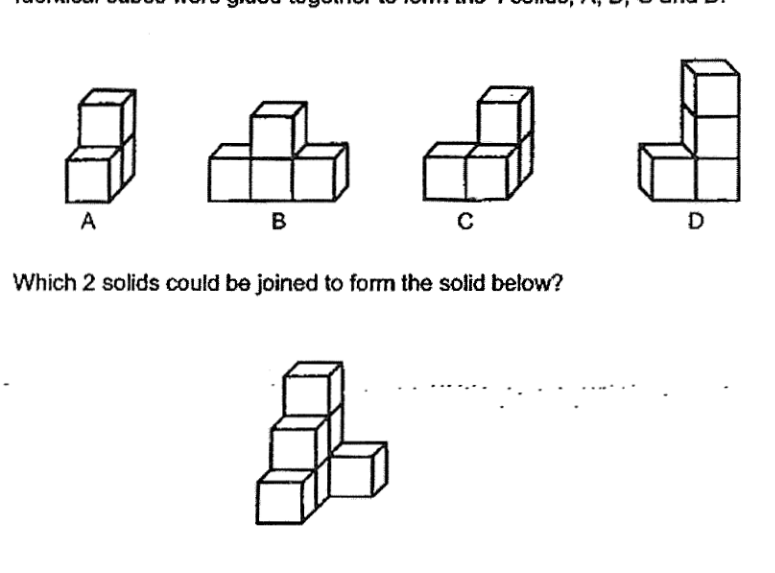
Identical cubes were glued together to form the 4 solids, A, B, C and D. Which 2 solids could be joined to form the solid below?
It won't just hand you the answer — it asks where you're stuck.How the checker works
Worked solution
6
1. Count the number of cubes in the target solid to determine the required combination.
The target solid consists of a base (4 cubes), a vertical stack extending 2 more cubes upwards from one corner, and 1 cube attached to the side of the middle cube of the stack.
Total number of cubes = cubes.
Since Solid A has 3 cubes and Solids B, C, and D each have 4 cubes, the target solid must be formed by Solid A and one of the 4-cube solids.
2. Analyse the dimensions of the solids to eliminate impossible options.
Solid B has a horizontal row of 3 cubes. However, the target solid has a base, meaning its maximum horizontal length in any direction is 2 cubes. Therefore, Solid B cannot fit inside the target solid. This eliminates options involving Solid B.
3. Verify if Solid A and Solid D can form the target solid.
Solid D consists of a vertical stack of 3 cubes with 1 cube attached to the side of the bottom cube. If we place Solid D such that its vertical stack forms the 3-cube high column of the target solid, its attached bottom cube forms one of the adjacent base cubes.
The remaining empty spaces in the target solid are: 2 adjacent cubes on the base and 1 cube directly above one of them (attached to the middle of the vertical stack). This remaining shape is exactly 2 cubes stacked vertically with 1 cube attached to the side of the bottom cube, which perfectly matches Solid A.
Thus, Solids A and D join to form the target solid.
Option (2)
AI analysis — may contain mistakes.
Worked this one out on paper? Snap your steps and Gigle's AI math checker will circle the step where it went wrong.