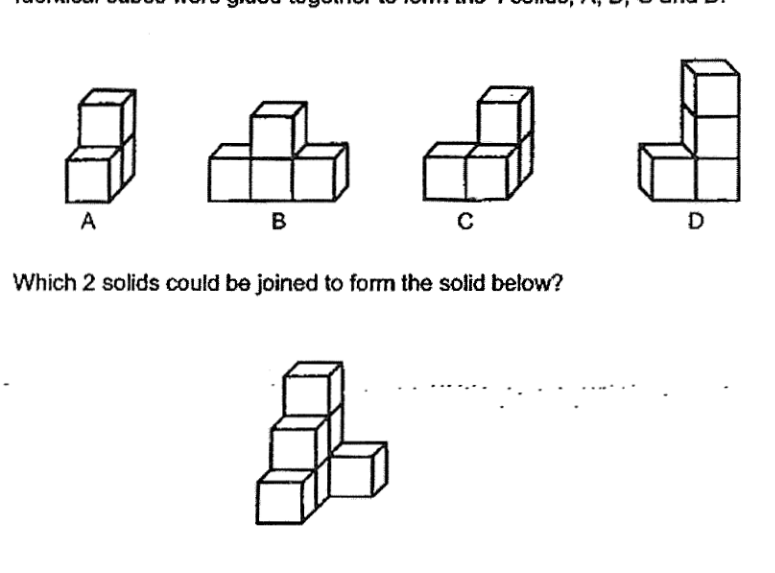
用相同的立方体粘在一起,组成了 4 个立体图形 A、B、C 和 D。 哪 2 个立体图形可以拼成下面的立体图形?
它不会直接告诉你答案,而是问你卡在哪一步看看 AI 是怎么陪你一步步弄懂这道题的
完整解法
6
1. Count the number of cubes in the target solid to determine the required combination.
The target solid consists of a base (4 cubes), a vertical stack extending 2 more cubes upwards from one corner, and 1 cube attached to the side of the middle cube of the stack.
Total number of cubes = cubes.
Since Solid A has 3 cubes and Solids B, C, and D each have 4 cubes, the target solid must be formed by Solid A and one of the 4-cube solids.
2. Analyse the dimensions of the solids to eliminate impossible options.
Solid B has a horizontal row of 3 cubes. However, the target solid has a base, meaning its maximum horizontal length in any direction is 2 cubes. Therefore, Solid B cannot fit inside the target solid. This eliminates options involving Solid B.
3. Verify if Solid A and Solid D can form the target solid.
Solid D consists of a vertical stack of 3 cubes with 1 cube attached to the side of the bottom cube. If we place Solid D such that its vertical stack forms the 3-cube high column of the target solid, its attached bottom cube forms one of the adjacent base cubes.
The remaining empty spaces in the target solid are: 2 adjacent cubes on the base and 1 cube directly above one of them (attached to the middle of the vertical stack). This remaining shape is exactly 2 cubes stacked vertically with 1 cube attached to the side of the bottom cube, which perfectly matches Solid A.
Thus, Solids A and D join to form the target solid.
Option (2)
AI 分析,可能出错
用 AI 批改,圈出写错的那一步,并自动将你的薄弱点存入错题本,形成你的错因库。