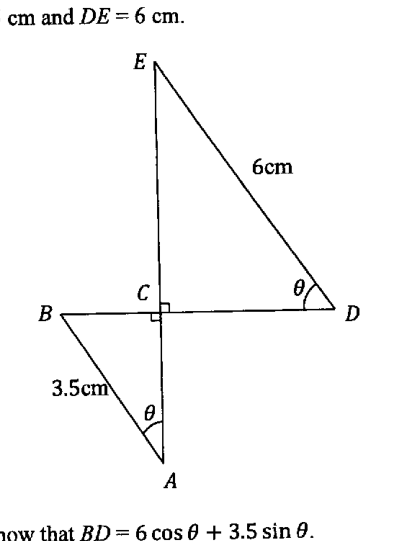
The diagram shows two right-angled triangles, ABCABC and DECDEC. ∠BAC=∠CDE=θ\angle BAC = \angle CDE = \theta, AB=3.5 cmAB = 3.5\text{ cm} and DE=6 cmDE = 6\text{ cm}.

  1. (a)

    Show that BD=6cos⁡θ+3.5sin⁡θBD = 6 \cos \theta + 3.5 \sin \theta.

  2. (b)

    Express BDBD in the form Rcos⁡(θ−α)R \cos(\theta - \alpha), where R>0R > 0 and α\alpha is an acute angle.

  3. (c)

    State the maximum length of BDBD and the corresponding value of θ\theta.

  4. (d)

    Find the value of θ\theta when BD=6 cmBD = 6\text{ cm}.

Work through it with AI →

It won't just hand you the answer — it asks where you're stuck.How the checker works

Worked solution

5(a)

1. Express the length of $BC$ in terms of $\theta$ using triangle $ABC$.

In △ABC\triangle ABC, ∠BCA=90∘\angle BCA = 90^\circ.
sin⁡θ=BCAB\sin \theta = \frac{BC}{AB}
BC=3.5sin⁡θBC = 3.5 \sin \theta

2. Express the length of $CD$ in terms of $\theta$ using triangle $DEC$.

In △DEC\triangle DEC, ∠ECD=90∘\angle ECD = 90^\circ.
cos⁡θ=CDDE\cos \theta = \frac{CD}{DE}
CD=6cos⁡θCD = 6 \cos \theta

3. Combine $BC$ and $CD$ to find the total length of $BD$.

BD=BC+CDBD = BC + CD
BD=3.5sin⁡θ+6cos⁡θBD = 3.5 \sin \theta + 6 \cos \theta
BD=6cos⁡θ+3.5sin⁡θ (Shown)BD = 6 \cos \theta + 3.5 \sin \theta \text{ (Shown)}

Answer

BD=6cos⁡θ+3.5sin⁡θBD = 6 \cos \theta + 3.5 \sin \theta (Shown)

5(b)

1. Find the value of $R$

Let 6cos⁡θ+3.5sin⁡θ=Rcos⁡(θ−α)=Rcos⁡θcos⁡α+Rsin⁡θsin⁡α6 \cos \theta + 3.5 \sin \theta = R \cos(\theta - \alpha) = R \cos \theta \cos \alpha + R \sin \theta \sin \alpha.
Comparing coefficients:
Rcos⁡α=6R \cos \alpha = 6
Rsin⁡α=3.5R \sin \alpha = 3.5
R=62+3.52R = \sqrt{6^2 + 3.5^2}
R=36+12.25=48.25≈6.9462R = \sqrt{36 + 12.25} = \sqrt{48.25} \approx 6.9462

2. Find the value of $\alpha$

tan⁡α=Rsin⁡αRcos⁡α=3.56\tan \alpha = \frac{R \sin \alpha}{R \cos \alpha} = \frac{3.5}{6}
α=tan⁡−1(3.56)≈30.256∘\alpha = \tan^{-1}\left(\frac{3.5}{6}\right) \approx 30.256^\circ

3. Write the final expression

BD=6.95cos⁡(θ−30.3∘)BD = 6.95 \cos(\theta - 30.3^\circ) (to 3 s.f. and 1 d.p. respectively)

Answer

6.95cos⁡(θ−30.3∘)6.95 \cos(\theta - 30.3^\circ)

5(c)

1. Identify the maximum value of BD from the R-formula form

From part (b), BD=Rcos⁡(θ−α)BD = R \cos(\theta - \alpha).
R=62+3.52=36+12.25=48.25≈6.9462R = \sqrt{6^2 + 3.5^2} = \sqrt{36 + 12.25} = \sqrt{48.25} \approx 6.9462
tan⁡α=3.56  ⟹  α≈30.256∘\tan \alpha = \frac{3.5}{6} \implies \alpha \approx 30.256^\circ
So BD=48.25cos⁡(θ−30.256∘)BD = \sqrt{48.25} \cos(\theta - 30.256^\circ).
The maximum value of cos⁡(θ−α)\cos(\theta - \alpha) is 11.
Maximum length of BD=48.25≈6.95 cmBD = \sqrt{48.25} \approx 6.95\text{ cm} (to 3 s.f.).

2. Find the corresponding value of theta

For maximum BDBD, cos⁡(θ−30.256∘)=1\cos(\theta - 30.256^\circ) = 1.
θ−30.256∘=0∘\theta - 30.256^\circ = 0^\circ
θ=30.256∘≈30.3∘\theta = 30.256^\circ \approx 30.3^\circ (to 1 d.p.).

Answer

Maximum length = 6.95 cm6.95\text{ cm}, θ=30.3∘\theta = 30.3^\circ

5(d)

1. Recall the $R$-formula expression for $BD$ from part (b)

From part (b), BD=Rcos⁡(θ−α)BD = R \cos(\theta - \alpha) where R=62+3.52=48.25R = \sqrt{6^2 + 3.5^2} = \sqrt{48.25} and α=tan⁡−1(3.56)≈30.256∘\alpha = \tan^{-1}\left(\frac{3.5}{6}\right) \approx 30.256^\circ.
So, BD=48.25cos⁡(θ−30.256∘)BD = \sqrt{48.25} \cos(\theta - 30.256^\circ).

2. Set up the equation for $BD = 6$ and solve for $\theta$

48.25cos⁡(θ−30.256∘)=6\sqrt{48.25} \cos(\theta - 30.256^\circ) = 6
cos⁡(θ−30.256∘)=648.25\cos(\theta - 30.256^\circ) = \frac{6}{\sqrt{48.25}}
θ−30.256∘=cos⁡−1(648.25)\theta - 30.256^\circ = \cos^{-1}\left(\frac{6}{\sqrt{48.25}}\right)
θ−30.256∘=30.256∘\theta - 30.256^\circ = 30.256^\circ
θ=60.512∘≈60.5∘\theta = 60.512^\circ \approx 60.5^\circ (to 1 d.p.)

Answer

60.5∘60.5^\circ

AI analysis — may contain mistakes.

Worked this one out on paper? Snap your steps and Gigle's AI math checker will circle the step where it went wrong.

More questions on this topic

  1. 1Given that cos⁡x=−45\cos x = -\frac{4}{5} and tan⁡x>0\tan x > 0, find sin⁡2x\sin 2x, cos⁡x2\cos \frac{x}{2}.
  2. 2A bird is sitting on the top, TT, of a vertical pole 20 m above the ground and the angle of elevation of the bird at TT…
  3. 3Given that sin⁡A=−35\sin A = -\frac{3}{5} and cos⁡B=−817\cos B = -\frac{8}{17}, where angle AA and angle BB are in the same quadrant,…
  4. 4The diagram shows a chocolate bar in the form of a triangular prism and the cross-section of the chocolate bar is an iso…
  5. 5The diagram shows two chords AB and CD intersect at X such that angle CXB = 90∘90^\circ. Given that AC=5 cmAC = 5\ \text{cm},…