[Cambridge/2006]
- (a)
Find the coordinates of the points on the curve
at which the tangent is parallel to the -axis. - (b)
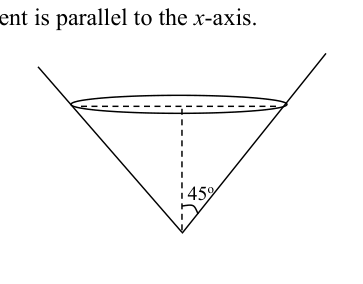
A hollow cone of semi-vertical angle is held with its axis vertical and vertex downwards (see diagram). At the beginning of an experiment, it is filled with 390 cm of liquid. The liquid runs out through a small hole at the vertex at a constant rate of 2 cm s. Find the rate at which the depth of the liquid is decreasing 3 minutes after the start of the experiment.
It won't just hand you the answer — it asks where you're stuck.How the checker works
Worked solution
Q10(a)
1. Differentiate the equation of the curve implicitly with respect to $x$.
2. Apply the condition for the tangent to be parallel to the $x$-axis and find the relationship between $x$ and $y$.
For the tangent to be parallel to the -axis, .
Substituting into the differentiated equation:
3. Substitute $y = -6x$ into the original curve equation to solve for $x$.
4. Find the corresponding $y$-coordinates and state the final points.
When , .
When , .
The coordinates of the points are and .
and
Q10(b)
1. Calculate the remaining volume of the liquid 3 minutes after the start.
2. Express the volume $V$ entirely in terms of the depth $h$.
3. Relate the rate of change of volume to the rate of change of depth using the chain rule.
4. Find the depth $h$ when the volume is 30 cm³.
5. Substitute the known values to calculate the rate at which the depth is decreasing.
AI analysis — may contain mistakes.
Worked this one out on paper? Snap your steps and Gigle's AI math checker will circle the step where it went wrong.
More questions on this topic
- 1The curve C has equation . It is given that C has only one turning point. Show that …
- 2The curve C has equation It is given that C has only one turning point. Show that …
- 3A curve has the equation where . Sketch , stating the coordinates of any points o…
- 4A curve has parametric equations where …
- 5It is given that where . Show that …