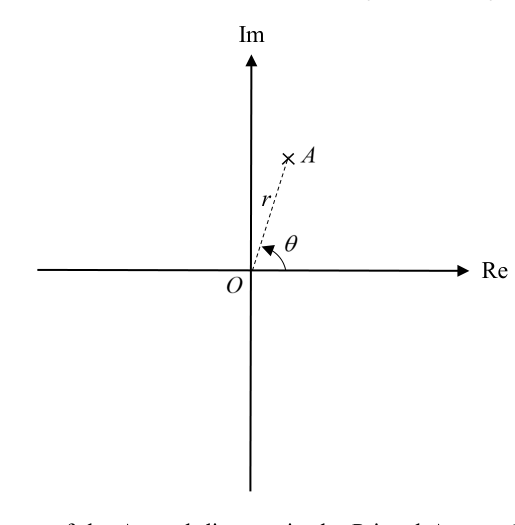
The point on the Argand diagram below represents the complex number with modulus and argument . It is given that the complex numbers and satisfy the equations
Let , and represent the complex numbers , and respectively.
- (a)
On the copy of the Argand diagram in the Printed Answer Book, plot the points , and , indicating clearly the modulus and argument of and .
- (b)
State, in radians, the angle .
- (c)
By considering the quadrilateral , find in terms of and in terms of .
It won't just hand you the answer — it asks where you're stuck.How the checker works
Worked solution
3(a)
1. Determine the modulus and argument of $w_2$ and plot point $B$.
Given , the point is a rotation of by radians about the origin (equivalent to a reflection through the origin).
Plot in the third quadrant such that is a straight line. On the diagram, label the length as and draw an angle arc from the positive real axis to labelled .
2. Determine the modulus and argument of $w_3$ and plot point $C$.
Given , multiplying by scales the modulus by and adds to the argument (an anti-clockwise rotation by ).
Plot in the fourth quadrant such that anti-clockwise. Label the length as and draw an angle arc from the positive real axis to labelled .
3. Plot point $D$ representing $w_2 + w_3$.
Point represents the sum . By the parallelogram law of vector addition on the Argand diagram, is the fourth vertex of the parallelogram . Since adjacent sides and are equal in length () and perpendicular (), complete the construction such that forms a square.
[A completed Argand diagram with the following features:]
- Point plotted in the 3rd quadrant directly opposite (collinear with ). The line segment is labelled with length and its angle from the positive real axis is marked and labelled as .
- Point plotted in the 4th quadrant such that anti-clockwise. The line segment is labelled with length and its angle from the positive real axis is marked and labelled as .
- Point plotted in the 3rd or 4th quadrant such that forms a square, completing the parallelogram for vector addition .
3(b)
1. Determine the angle $BOC$ using the geometric effect of multiplying by $\text{i}$
Since , the complex number is obtained by rotating by radians anti-clockwise about the origin.
Therefore, the angle between the line segments and is .
Angle
3(c)
1. Identify the shape of the quadrilateral $OBDC$ to find the modulus $|w_2 + w_3|$.
The length .
The length .
Since , is obtained by rotating counter-clockwise by radians about the origin, so .
The point represents , making a parallelogram. Since adjacent sides and are equal and perpendicular, is a square of side length .
The distance is the diagonal of the square:
2. Use the geometric properties of the square to find $\arg(w_2 + w_3)$.
Since and is in the first quadrant with argument , is in the third quadrant. Its principal argument is:
Since is a square, the diagonal bisects .
Thus, is rotated counter-clockwise from by exactly radians.
and
AI analysis — may contain mistakes.
Worked this one out on paper? Snap your steps and Gigle's AI math checker will circle the step where it went wrong.
More questions on this topic
- 1Solve the equation , giving your roots in the form , where and . Ske…
- 2Solve the equation , giving your roots in the form , where and . Sketch…
- 3The complex number satisfies the equation where is a real numbe…
- 4The complex number has modulus and argument , where and …
- 5The point A represents a fixed complex number a such that . The complex numbers and …