A rectangular tank contained some water at first. A tap was then turned on to fill the tank completely with water. The tap was turned off at the end of 48 minutes. The graph below shows the amount of water in the tank at the end of 48 minutes.
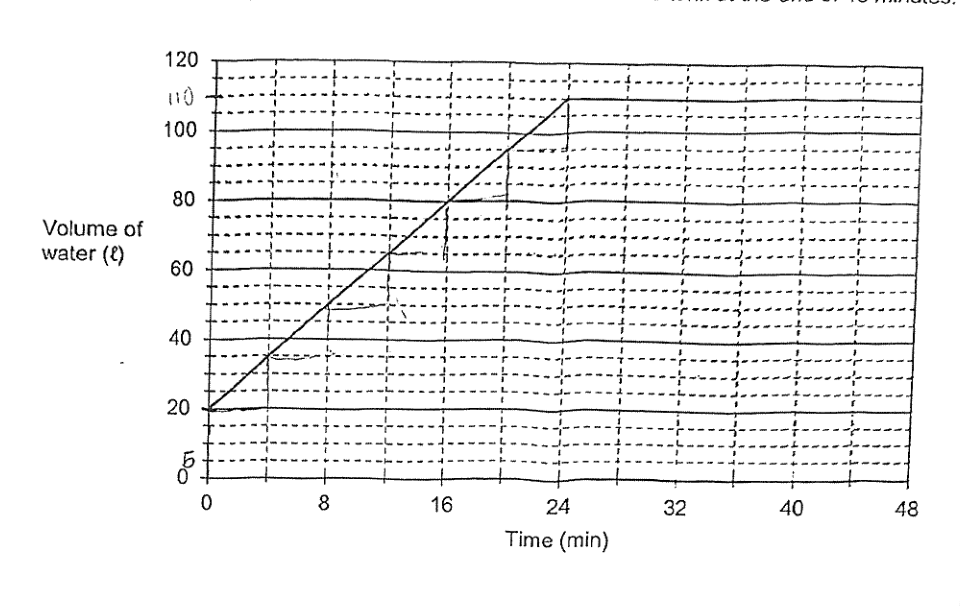
- (a)
In a minute, how many litres of water flowed from the tap?
- (b)
How many litres of water overflowed from the tank at the end of 48 minutes?
It won't just hand you the answer — it asks where you're stuck.How the checker works
Worked solution
7(a)
1. Identify the initial and final volume of water during the filling phase from the graph
From the graph, at min, the volume is L.
The tank is completely filled at min, where the volume is L.
2. Calculate the total volume of water that flowed from the tap
Total volume flowed = L
3. Calculate the rate of water flow per minute
Rate = L/min
litres
7(b)
1. Determine the duration for which the water overflowed
The tank is completely filled at minutes. The tap was turned off at minutes.
Time during which water overflowed = minutes.
2. Calculate the volume of water that overflowed
From the graph, the amount of water that flowed from the tap in the first minutes is L.
Since the tap flows at a constant rate, the amount of water that flowed (and overflowed) in the next minutes is also L.
Alternatively, using the rate from part (a) ( L/min):
Volume overflowed = L.
L
AI analysis — may contain mistakes.
Worked this one out on paper? Snap your steps and Gigle's AI math checker will circle the step where it went wrong.