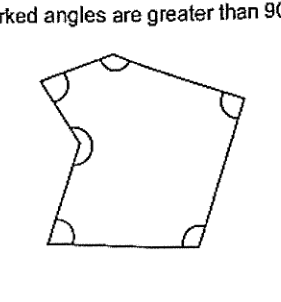
In the figure, how many of the six marked angles are greater than ?
It won't just hand you the answer — it asks where you're stuck.How the checker works
Worked solution
8
1. Identify the angles greater than 90 degrees from the figure description
Based on the description of the figure:
- Bottom-left angle: looks like (not greater than )
- Middle-left angle: reflex/obtuse, marked on the inside (greater than )
- Top-left angle: obtuse (greater than )
- Top-middle angle: obtuse (greater than )
- Top-right angle: obtuse (greater than )
- Bottom-right angle: looks like (not greater than )
2. Count the number of angles greater than 90 degrees
There are 4 angles that are obtuse or reflex, which means they are greater than .
Answer
4 (option 4)
AI analysis — may contain mistakes.
Worked this one out on paper? Snap your steps and Gigle's AI math checker will circle the step where it went wrong.
More questions on this topic
- 1In the figure, WXYZ is a trapezium and AXYB is a rhombus. XBC and XAZ are straight lines. WX // ZY, BC = BY, …
- 2In the figure below, ABCD is a trapezium. AF and EC are straight lines. Peishan wrote four statements to describe the fi…
- 3In the figure below, ABGF and BCDG are rhombuses. , and EF is parallel to…
- 4In the figure, PQ = PS and SRP is a straight line. Find . Ans: ___
- 53.76°= 度 分 秒.