The variables and are related by . When values of are plotted against , a straight line is obtained. The straight line intersects the vertical and horizontal axes at and respectively.
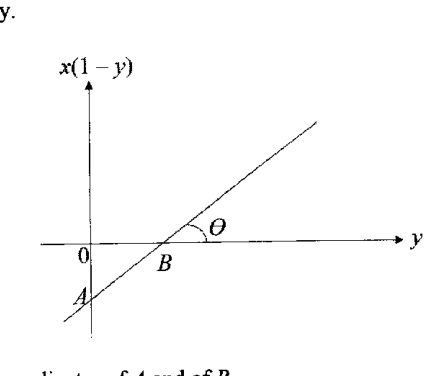
- (i)
Find the coordinates of and of .
- (ii)
State the value of .
It won't just hand you the answer — it asks where you're stuck.How the checker works
Worked solution
3(i)
1. Rearrange the given equation to group terms involving $x$ together
2. Factorise to isolate the expression $x(1-y)$
3. Express the equation in the linear form $Y = mX + c$
This is in the form where and .
4. Find the coordinates of the intercepts $A$ and $B$
For the vertical intercept , (i.e., ):
So, is .
For the horizontal intercept , (i.e., ):
So, is .
,
3(ii)
1. Relate $\tan \theta$ to the gradient of the straight line
The angle is the angle the straight line makes with the positive horizontal axis. Therefore, is equal to the gradient of the line.
2. Calculate the gradient of the line using the linear form derived in part (i)
From the linear form , the gradient is .
Alternatively, using the coordinates of and from part (i):
Thus, .
AI analysis — may contain mistakes.
Worked this one out on paper? Snap your steps and Gigle's AI math checker will circle the step where it went wrong.
More questions on this topic
- 1The mass, m mg, of a radioactive substance decreases with time, t hours. Measured values of m and t are given in the tab…
- 2A drug is administered to a patient through an injection. The concentration of drug, mg/ in a patient's bloodstre…
- 3The table shows experimental values of two variables, and . | | 2 | 4 | 6 | 8 | |---|---|---|---|---| | |…
- 4Measured values of and are given in the following table. | | 1.2 | 1.6 | 2.0 | 2.6 | 3.5 | 4.5 | |---|---|--…
- 5The table shows experimental values of and . | | 2 | 3 | 4 | 5 | 6 | |---|---|---|---|---|---| | | 11.8 |…