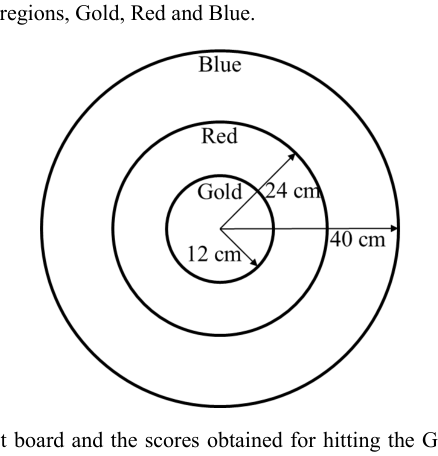
The diagram below shows a circular target board of radius 40 cm, divided by two concentric circles of radii 12 cm and 24 cm, into three regions, Gold, Red and Blue. Arrows are shot at the target board and the scores obtained for hitting the Gold, Red and Blue regions are 10 points, 6 points and 3 points respectively. Arrows that land outside the target board score 0 points. Alex shoots one arrow at the target board. The probability that his shot lands on the target board is , where . If his shot lands on the target board, the arrow is equally likely to hit any position on the board. Let represent the score obtained from a single shot. You may assume that the arrow does not land on the boundary of any region.
- (a)
Show that .
- (b)
Given that , find the value of .
It won't just hand you the answer — it asks where you're stuck.How the checker works
Worked solution
8(a)
1. Calculate the area of the Red region.
The Red region is the annulus between the circles of radii 12 cm and 24 cm.
2. Calculate the total area of the target board.
The target board has a radius of 40 cm.
3. Calculate the probability of scoring 6 points.
Since the arrow is equally likely to hit any position on the board if it lands on it, the conditional probability of hitting the Red region is the ratio of its area to the total area. We multiply this by the probability that the arrow lands on the board.
8(b)
1. Find the probability distribution of $X$ by determining the probabilities of scoring 10, 3, and 0 points in terms of $p$.
For a single shot, the arrow lands on the board with probability . Given that it lands on the board, the probability of hitting a specific region is proportional to its area.
Total area of the board =
Area of Gold region =
Area of Blue region =
From part (a), .
The probability of missing the board entirely (scoring 0) is:
2. Express the expected values $E(X)$ and $E(X^2)$ in terms of $p$.
3. Set up a quadratic equation in $p$ using the given variance.
Using the variance formula :
4. Solve the quadratic equation and select the valid root.
Using a graphing calculator to solve the quadratic equation:
Since it is given in the question that , we reject .
0.95
AI analysis — may contain mistakes.
Worked this one out on paper? Snap your steps and Gigle's AI math checker will circle the step where it went wrong.
More questions on this topic
- 1An amateur music composer is arranging a sequence of four musical notes followed by three beats. There are 7 possible no…
- 2Two brothers Kai and Leo are duathlon (running and cycling) athletes who train regularly. For each day, the probability…
- 3Colour Vision Deficiency is the decreased ability to see differences in colours. Someone with normal colour vision will…
- 4A pair of siblings, Abbey and Betty, went to a book fair with six other friends. The eight of them stood in a queue in r…
- 5A particular disease is known to infect approximately 1 in every 10 000 people. A test for this disease is 99.9% accurat…