In the diagram below, the line makes an angle of with the positive -axis such that and lies on the -axis.
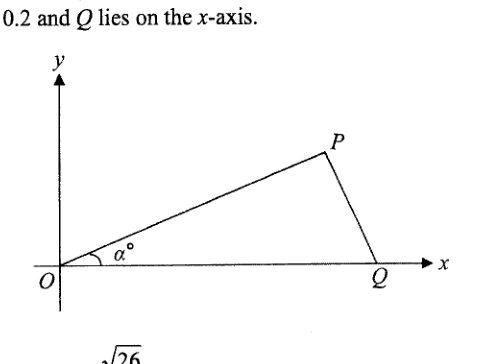
- (a)
Given that units, show that .
- (b)
Given that the area of is , find the coordinates of .
- (c)
Explain, with calculations, why is a right-angled triangle.
- (d)
Find the coordinates of such that is a rectangle.
It won't just hand you the answer — it asks where you're stuck.How the checker works
Worked solution
7(a)
1. Express the coordinates of $P$ in terms of a single variable using the given tangent ratio.
Let the coordinates of be .
Since is in the first quadrant, and .
2. Set up an equation using the length of $OP$.
3. Solve for $x$ and $y$ to show the coordinates of $P$.
Substitute into the equation:
Since , .
Therefore, .
Shown that .
7(b)
1. Express the area of triangle OPQ in terms of the coordinates of Q
Let the coordinates of be .
The base of is .
The perpendicular height of from to the -axis is .
Area of
Area
2. Equate to the given area and solve for q
Therefore, the coordinates of are .
7(c)
1. Find the coordinates of $Q$ using the area of the triangle given in part (b)
The base of is (which lies on the -axis) and its perpendicular height is the -coordinate of , which is .
Since lies on the positive -axis, .
2. Calculate the gradients of $OP$ and $PQ$
Gradient of , (or given as ).
Gradient of , .
3. Show that the lines are perpendicular by multiplying their gradients
Since the product of their gradients is , is perpendicular to . Therefore, , making a right-angled triangle.
Since the product of the gradients of and is , . Thus, and is a right-angled triangle.
7(d)
1. Find the coordinates of $Q$ from the area of $\Delta OPQ$
Area of
Since lies on the positive -axis, .
2. Use the midpoint property of the diagonals of a rectangle to find $R$
In rectangle , the diagonals and bisect each other.
Midpoint of
Let .
Midpoint of
Equating the midpoints:
AI analysis — may contain mistakes.
Worked this one out on paper? Snap your steps and Gigle's AI math checker will circle the step where it went wrong.
More questions on this topic
- 1Given that and , find , .
- 2A bird is sitting on the top, , of a vertical pole 20 m above the ground and the angle of elevation of the bird at …
- 3Given that and , where angle and angle are in the same quadrant,…
- 4The diagram shows a chocolate bar in the form of a triangular prism and the cross-section of the chocolate bar is an iso…
- 5The diagram shows two chords AB and CD intersect at X such that angle CXB = . Given that ,…