In stall A, one Chicken pie costs 1.30 and one Tuna pie costs $1.80. In stall B, one Chicken pie costs 0.30 less and one Tuna pie costs $0.10 less. The information can be represented by the matrix P (see figure description).
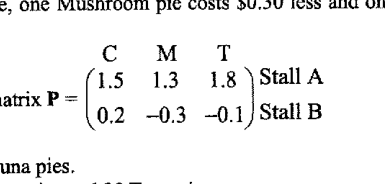
- ((a))
Simon buys 50 Chicken pies and 20 Tuna pies.
Ivy buys 40 Chicken pies, 20 Mushroom pies and 30 Tuna pies.
Represent their purchases in a 3 × 2 Matrix Q.
Answer Q =
- ((b))
Evaluate the matrix R = PQ.
Answer R =
- ((c))
Use your answer in (b) to explain whether it is better for Simon to buy from stall A or stall B.
Answer
Stall ... because ...
...
- ((d))
Stall B has a promotion of 30% off on all pies while prices of pies in stall A has increased by 10%.
Using your answer in (b) or otherwise, calculate the lowest total amount both Simon and Ivy will pay for the pies.
Answer $
It won't just hand you the answer — it asks where you're stuck.How the checker works
Worked solution
2((a))
1. Arrange the purchases in a $3\times2$ matrix using the order Chicken, Mushroom, Tuna for the rows and Simon, Ivy for the columns.
Since has columns in the order , the rows of should be in the order so that is defined.
Simon buys Chicken, Mushroom and Tuna pies.
Ivy buys Chicken, Mushroom and Tuna pies.
2((b))
1. Set up the matrix multiplication using the given matrix $P$ and the purchase matrix $Q$ from part (a).
Since is and is , will be a matrix.
2. Calculate each entry of $R$ by row-by-column multiplication.
3. Simplify the entries to obtain the final matrix.
2((c))
1. Interpret Simon's entries in the first column of $R$.
From part (b),
For Simon, the first column is
This means Simon pays $111 at Stall A, and Stall B costs $8 more than Stall A for his purchase.
2. Decide which stall is better for Simon.
Since Stall B costs $8 more than Stall A, Simon should buy from Stall A.
Stall A because the corresponding value for Simon in the second row of is , so Stall B costs $8 more.
2((d))
1. Find the original total cost at Stall B for Simon and Ivy using matrix R.
From part (b),
The first row gives the total cost at Stall A, and the second row gives the change from Stall A to Stall B.
Simon at Stall B:
Ivy at Stall B:
2. Calculate the new costs after Stall A increases prices by 10% and Stall B gives 30% discount.
Stall A increases by , so multiply by .
Simon at Stall A:
Ivy at Stall A:
Stall B gives off, so multiply by .
Simon at Stall B:
Ivy at Stall B:
3. Choose the lower cost for each person and add them to get the lowest total amount.
For Simon, the lower cost is from Stall B:
For Ivy, the lower cost is also from Stall B:
Lowest total amount:
$174.30
AI analysis — may contain mistakes.
Worked this one out on paper? Snap your steps and Gigle's AI math checker will circle the step where it went wrong.
More questions on this topic
- 1On every weekday, a bakery delivers chicken pies and apple pies to four cafes. On every weekend, it delivers double the…
- 2A tour agency sells cruise packages to Vietnam, Maldives and Taiwan at $1299, $1398 and $2538 respectively. The table…
- 3Given that …
- 4A theatre sells tickets for a musical performance based on different categories. The table below shows the number of tic…
- 5A cake shop sells 3 types of cakes. On Day 1, the shop sold 84 chocolate cakes, 90 vanilla cakes and 56 strawberry cakes…